
How to Identify Acadian Flycatcher Feathers
A guide to the small olive-and-yellow feathers of the Acadian Flycatcher, with an honest look at why single feathers of this species are hard to separate from other Empidonax flycatchers.
Read the full Acadian Flycatcher encyclopedia entry →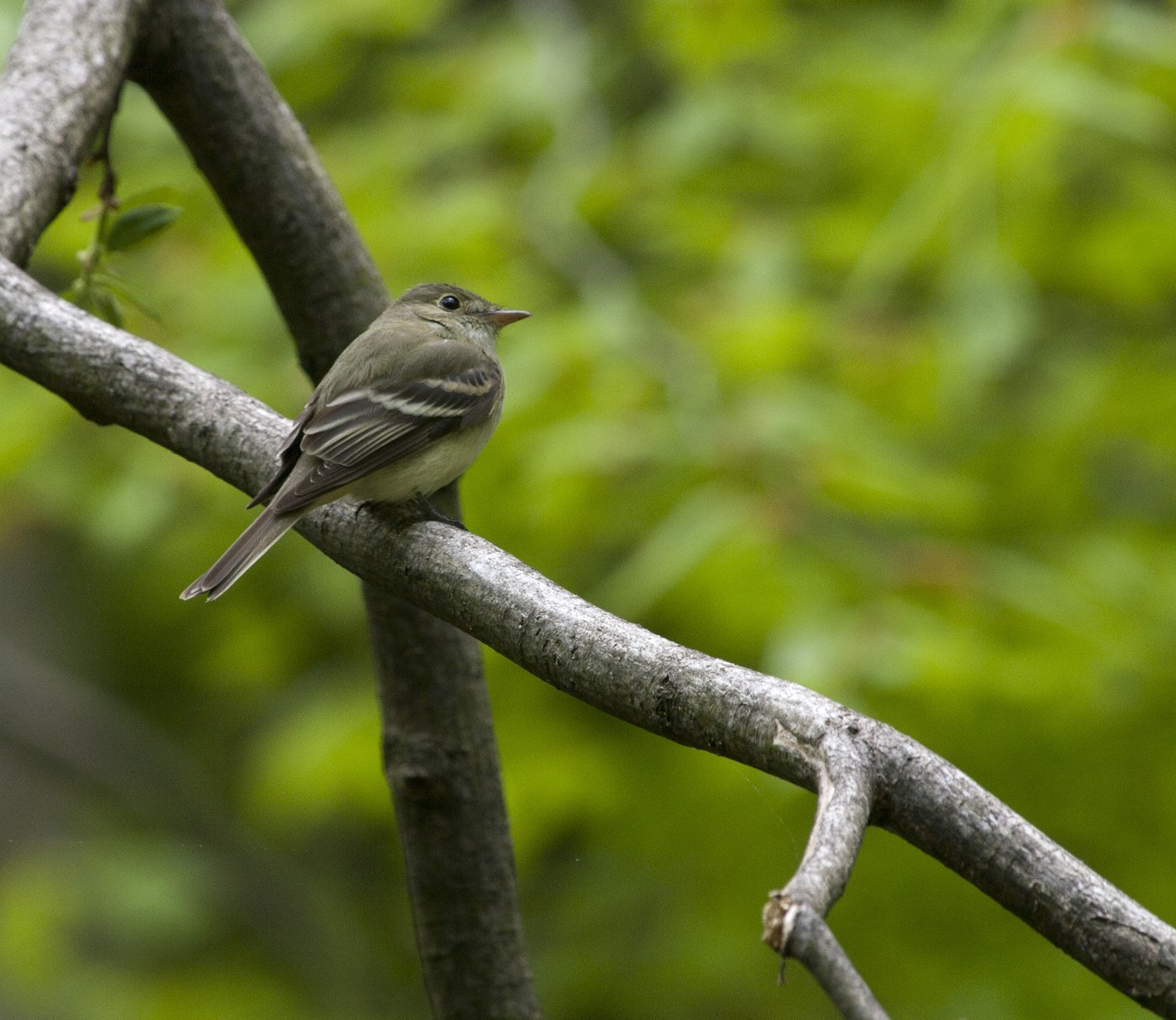
What Acadian Flycatcher's Feathers Look Like
Acadian Flycatcher is a small, compact bird of shaded forest interiors, and its feathers are correspondingly small and understated. Upperparts are olive-green, while underparts are pale with a soft yellowish wash on the belly and a whitish throat and breast. The most useful single feature is a pair of buffy-white wing bars crossing the otherwise dark grayish-brown flight feathers — these bars are formed by pale tips on the greater and median covert feathers. Flight feathers themselves are short, typically only 5-6 cm, with rounded tips. The tail is slightly notched, olive-brown, and unmarked. Overall feather texture is soft and fine, consistent with a small woodland songbird rather than a sparrow or larger perching bird.
Step-by-Step: Is This Feather From a Acadian Flycatcher?
- Check the size. A feather under 7 cm with a soft, fine texture points to a small songbird in the flycatcher-to-warbler size range.
- Look for double wing bars. Two distinct pale buffy-white bars on a dark covert feather is the most useful field mark available from a single feather.
- Check overall tone. Olive-green above and pale with a yellow wash below is consistent with this species, though it overlaps broadly with related flycatchers.
- Consider the habitat. A feather found in the shaded interior of mature deciduous forest, especially near streams or ravines, fits Acadian Flycatcher's strong habitat preference better than more open-country flycatchers.
- Be realistic about limits. Be cautious about clinching an ID to species from a single body feather — this is one of the hardest groups in North America to identify even for experienced birders with the whole bird in hand.
Similar Species & How to Tell Them Apart
- Willow, Least, and Yellow-bellied Flycatchers (other Empidonax): All are nearly identical at the single-feather level — pale wing bars, olive upperparts, and pale underparts recur across the genus. Habitat is the best practical separator: Acadian strongly favors mature forest interior rather than shrubby wetlands (Willow), open second growth (Least), or boreal bogs (Yellow-bellied).
- Eastern Wood-Pewee: Larger overall, with longer wings and less crisply contrasting wing bars; its flight feathers run noticeably longer than an Acadian's.
- Eastern Phoebe: Lacks obvious wing bars as an adult and has a plainer, grayer olive tone overall, without the yellow belly wash.
Where & When You'll Find Them
Acadian Flycatcher breeds in mature deciduous forest, especially in ravines, along streams, and in beech-maple or oak-hickory woods across the eastern United States. It winters in Central and northern South America. Feathers are most likely found on the forest floor beneath favored perches during the breeding season (May through August); the post-breeding molt begins before southbound migration in August-September, with a more complete molt occurring later on the wintering grounds.
Frequently asked questions
Can a single feather really confirm an Acadian Flycatcher?
Not with full confidence — the *Empidonax* flycatchers are notoriously similar even in the hand, so treat a feather ID as a strong probability based on habitat and wing-bar pattern rather than a certainty.
What's the most useful clue on a single feather?
Crisp, double buffy-white wing bars on a small, olive-toned covert feather, combined with a forest-interior habitat, is the best combination available without the whole bird.
How is this different from identifying a warbler feather?
Warblers often show bolder, more varied colors (yellow, black masks, chestnut) while Acadian Flycatcher and its relatives are more uniformly olive-and-pale, lacking bold facial patterns.
Does molt timing help narrow things down?
Somewhat — fresh feathers found in eastern deciduous forest in mid-to-late summer are consistent with post-breeding molt timing, whereas a feather found in winter would be unlikely since the species has left for the tropics.