
How to Identify African Pygmy Falcon Feathers
A guide to the tiny, boldly spotted black-and-white feathers of the African Pygmy Falcon, the smallest raptor in Africa.
Read the full African Pygmy Falcon encyclopedia entry →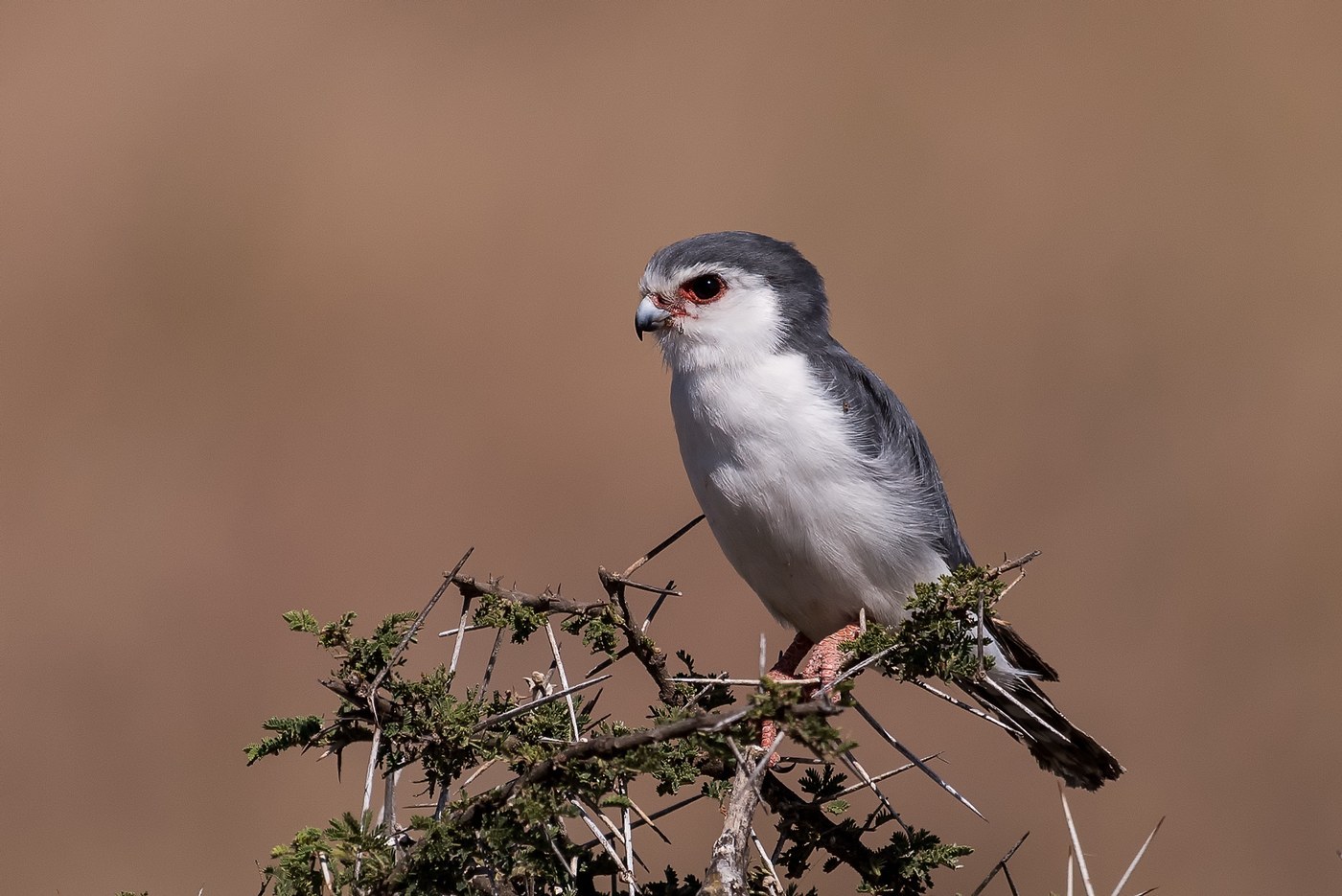
What African Pygmy Falcon's Feathers Look Like
African Pygmy Falcon is Africa's smallest raptor, and its feathers are correspondingly tiny but boldly patterned. Underparts are pure white and unmarked, while the back and crown are soft gray. The wings carry the most distinctive feature: black flight feathers marked with neat rows of bold white spots, creating a spotted pattern unlike the barring or streaking seen in most other small raptors. A patch of white also covers the rump and lower back. Perhaps the most curious detail is a set of small white "false-eye" spots on the nape, formed by feathers with a bright white spot near the tip against an otherwise gray-black background. Flight feathers themselves are tiny for a raptor, typically only 4-6 cm.
Step-by-Step: Is This Feather From a African Pygmy Falcon?
- Check the size first. A flight feather only 4-6 cm long, far smaller than expected for a raptor, is itself a strong clue given how few birds of prey are this small.
- Look for bold white spots on black. Neat, evenly spaced white spots along a black flight feather is the species' signature pattern.
- Check underparts for plain white. Completely unmarked white body feathers, with no streaking or barring.
- Look for a nape false-eye feather. A small feather with a distinct white spot near the tip against a gray-black background suggests the nape "eye-spot" pattern.
- Rule out songbirds. Despite the tiny size, the stiffer, more raptor-like feather structure (rather than soft, downy songbird texture) should confirm a raptor rather than a small passerine.
Similar Species & How to Tell Them Apart
- African Grey Woodpecker or barbets: Some small African birds show spotted black-and-white patterns, but these tend to include greenish or yellowish tones absent in African Pygmy Falcon's strictly black-white-gray palette.
- Fiscal Shrike and other shrikes: Show bold black-and-white patterning too, but in solid blocks rather than the neat rows of small white spots on black seen in this falcon's wings.
- Pearl-spotted Owlet: Also tiny with spotted upperparts and false eye-spots on the nape, but its spotting is more diffuse and buffy-toned rather than crisp white-on-black, and its overall structure is softer, reflecting its owl silent-flight adaptations.
Where & When You'll Find Them
African Pygmy Falcon is a resident of dry savanna and thornveld in Southern and East Africa, closely tied to the presence of sociable weaver or buffalo weaver colonies, whose abandoned nest chambers it uses for roosting and breeding. Because of this close association, feathers are most often found near large communal weaver nests built in acacia and other thorny trees. Molt is gradual, and the species does not migrate.
Frequently asked questions
What makes this species' feathers easy to spot despite their tiny size?
The combination of very small size with bold, evenly spaced white spots on black flight feathers is distinctive enough that even a single tiny feather can be recognized once you know to look for the spotting pattern.
Why would I find feathers near a weaver bird nest?
African Pygmy Falcon relies on the nest chambers built by sociable and buffalo weavers for its own roosting and breeding, so feathers frequently accumulate near these large communal nest structures in acacia trees.
How is this different from a Pearl-spotted Owlet feather?
The owlet's spotting is softer, buffier, and less crisply defined, and its overall feather texture is softer due to silent-flight adaptations that this falcon's feathers lack.
Do males and females have different feather patterns?
Females typically show a chestnut patch on the back that males lack, so a small feather with a warm rufous tone mixed in with the gray-and-white pattern may indicate a female.