
How to Identify Amazon Kingfisher Feathers
A field guide to recognizing the glossy bottle-green body feathers and white-spotted wings of the Amazon Kingfisher, the largest of the American green kingfishers.
Read the full Amazon Kingfisher encyclopedia entry →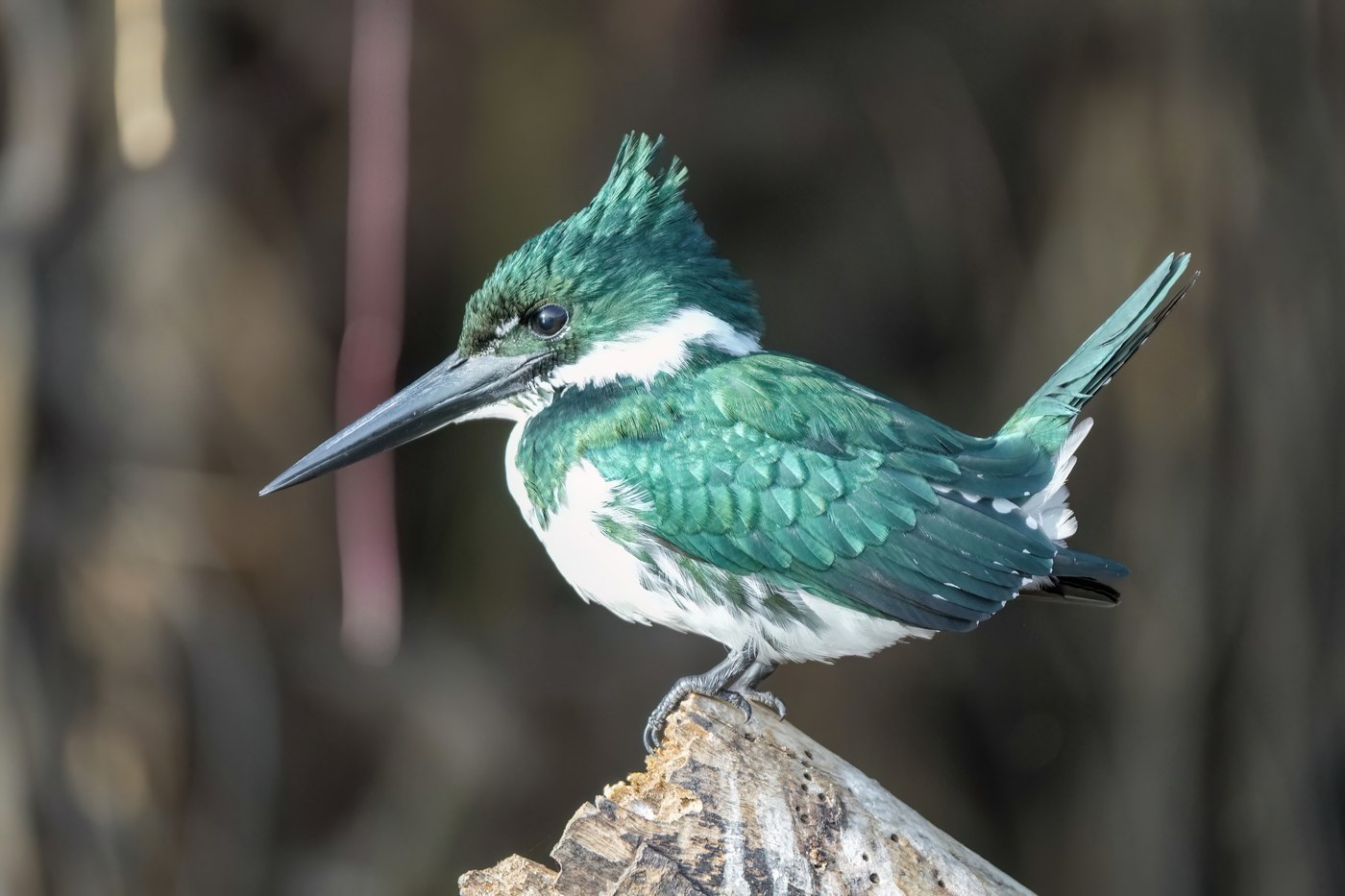
What Amazon Kingfisher's Feathers Look Like
The Amazon Kingfisher is the largest of the "green" kingfishers found from Mexico through much of South America, and its feathers reflect that bulk. Body and back feathers are a deep, glossy bottle-green with a bronzy sheen, dense and slightly stiff to the touch rather than soft and downy. Wing covert feathers are green but marked with small, crisp white spots near the tips, arranged in tidy rows across the closed wing — a pattern that becomes obvious once you lay several coverts side by side. Flight feathers (primaries and secondaries) are darker, almost blackish-green, with narrow pale edging. Tail feathers are green above with bold white barring on the underside and outer edges, and the outermost tail feather usually shows the most white. Underparts feathers are white on the belly, with a chestnut-rufous breast band in males (a single wide band) or a partial, patchier rufous patch in females. Overall feather size is large for a kingfisher — flight feathers can run 8–12 cm, reflecting a bird nearly a foot long.
Step-by-Step: Is This Feather From an Amazon Kingfisher?
- Measure it. Primaries longer than about 8 cm with a dark, blackish-green cast suggest a large kingfisher, not a small songbird.
- Check the color under good light. True bottle-green with bronze iridescence (not blue, not turquoise) points to Amazon Kingfisher rather than the blue-and-white Ringed or Belted Kingfishers.
- Look for white spotting. Small white dots near the tips of covert feathers in neat rows are a strong diagnostic; plain unspotted green coverts suggest a different green kingfisher species.
- Inspect any breast feathers. A solid, wide chestnut band points to a male; patchy or partial rufous suggests a female.
- Examine tail feathers for barring. Heavy white barring on the underside of a green tail feather is typical of this species.
- Consider where it was found — riverbanks, lake edges, or mangroves in Central or South America fit this species' habits.
Similar Species & How to Tell Them Apart
The closest look-alike is the much smaller Green Kingfisher, which shares the bottle-green color but has noticeably smaller feathers (its whole body is barely half the Amazon Kingfisher's size) and finer white spotting. The Green-and-Rufous Kingfisher has rufous, not white, underparts, so any feather showing rufous below the green (rather than white) belongs to that species instead. The Ringed Kingfisher, found in the same rivers, is much larger still but colored blue-gray above rather than green — an easy separator by color alone. American Pygmy Kingfisher feathers are tiny and show a rufous collar rather than white spotting.
Where & When You'll Find Them
Amazon Kingfishers stick close to slow rivers, oxbow lakes, and mangrove-lined coasts from Mexico south to Argentina, perching low over the water to hunt. Because they are non-migratory residents throughout their range, feathers can be found year-round near water, with a noticeable uptick during the post-breeding molt, typically after the wet-season nesting period when adults replace worn flight feathers. Look along muddy banks, under overhanging perches, and near nest burrows dug into riverbanks.
Frequently asked questions
How can I tell a male from a female Amazon Kingfisher feather?
Breast feathers are the key: males show one solid, wide chestnut band, while females show only a partial or patchy rufous patch, sometimes broken into two smaller marks.
Why does the green look different in different light?
The bottle-green color comes partly from structural iridescence, so the same feather can look darker or more bronze depending on the angle of light.
Could this be a parrot feather instead?
Parrot feathers usually show a more uniform, matte green without the crisp white spotting on coverts or the white-barred tail typical of Amazon Kingfisher.
Is the white spotting always present?
Yes, on wing covert feathers of adults it is a consistent and useful field mark, though it can be worn down on old, faded feathers found later in the season.