
How to Identify Andean Flamingo Feathers
A field guide to distinguishing the pale pink body plumes and black flight feathers of the Andean Flamingo from other high-Andes flamingos.
Read the full Andean Flamingo encyclopedia entry →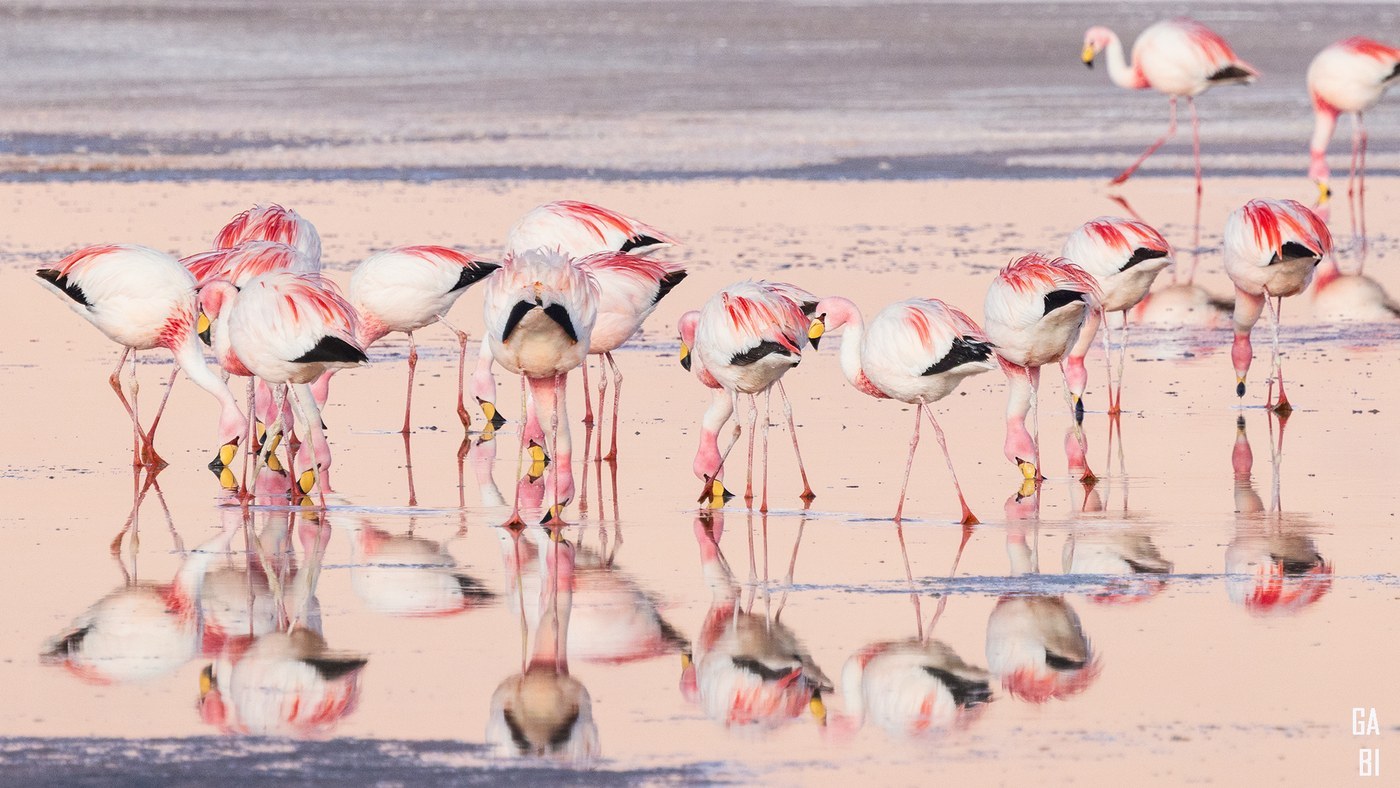
What Andean Flamingo Feathers Look Like
Andean Flamingos are large, long-necked wading birds whose plumage runs from pale pink to a richer salmon-pink across the body and neck, with bright crimson-pink wing covert feathers that show as a bold shoulder patch in flight. In sharp contrast, the flight feathers (primaries and secondaries) are solid black, visible only when the wings are open - a folded bird looks almost entirely pink. Body contour feathers are soft, fluffy, and rounded, adapted to the cold, dry high-altitude environment they live in. Breeding adults grow elongated, pointed plume feathers on the scapulars and lower back that trail gracefully over the folded wings. Tail feathers are short and pale pink to whitish.
Step-by-Step: Is This Feather From an Andean Flamingo?
- Check the base color. Soft pink to salmon body plumage is the starting point - pure white or gray feathers are not from a flamingo.
- Look for black flight feathers. If the feather is solid glossy black with a fairly broad, blunt shape, it is likely a primary or secondary rather than a body feather.
- Judge the saturation of pink. Andean Flamingo tends to run a bit paler pink than the deep carmine-red wing coverts of the smaller James's (Puna) Flamingo, but richer than the very pale pink of Chilean Flamingo body feathers.
- Note the size. Andean Flamingo is the largest of the three high-Andes flamingos, so its feathers, especially flight feathers, run larger overall than James's Flamingo.
- Look for long, pointed plume feathers. Elongated scapular plumes with a soft, drooping structure suggest a breeding-condition bird.
Similar Species & How to Tell Them Apart
- Chilean Flamingo: Body feathers tend to be paler pink overall, and the species is noticeably smaller; the two are the hardest to separate on plumage alone since ranges overlap at some Andean lakes.
- James's Flamingo (Puna Flamingo): Smaller-bodied with deeper, more saturated carmine-red wing covert feathers and a comparatively small black flight-feather patch relative to body size.
- Greater Flamingo (where ranges brush in South America via vagrancy): Even paler pink overall with a larger body size than any Andean species, though this is a rare consideration.
Where & When You'll Find Them
Andean Flamingos breed and forage on high-altitude saline lakes across the Andean altiplano of Chile, Bolivia, Argentina, and Peru, typically above 3,000 m elevation, often in mixed flocks with the other two Andean flamingo species. Flamingos undergo a flightless wing molt after breeding, during which large numbers of flight and covert feathers accumulate along lakeshores and mudflats near colonies, generally in the austral summer months (December-March) when breeding activity winds down - shorelines near known colonies are the most productive places to look.
Frequently asked questions
What color is Andean Flamingo plumage?
Body feathers range from pale to salmon-pink with bright crimson-pink wing coverts, while the flight feathers are solid black.
How do I tell Andean Flamingo feathers from Chilean Flamingo feathers?
It's difficult on color alone since both are pale pink, but Andean Flamingo runs larger overall and its wing covert pink tends to be a touch richer.
Why are some flamingo feathers black?
The primaries and secondaries (flight feathers) are black in all three high-Andes flamingo species, only visible when the wings are spread.
When is the best time to find flamingo feathers?
During the austral summer post-breeding flightless molt (roughly December-March), when many feathers accumulate near lakeshore colonies.
Do Andean Flamingos have special breeding feathers?
Yes, breeding adults grow elongated, pointed scapular plumes that drape over the folded wings.