
How to Identify Audubon's Oriole Feathers
A guide to the black-hooded, greenish-yellow feathers of Audubon's Oriole, the only yellow (not orange) oriole in its South Texas range.
Read the full Audubon's Oriole encyclopedia entry →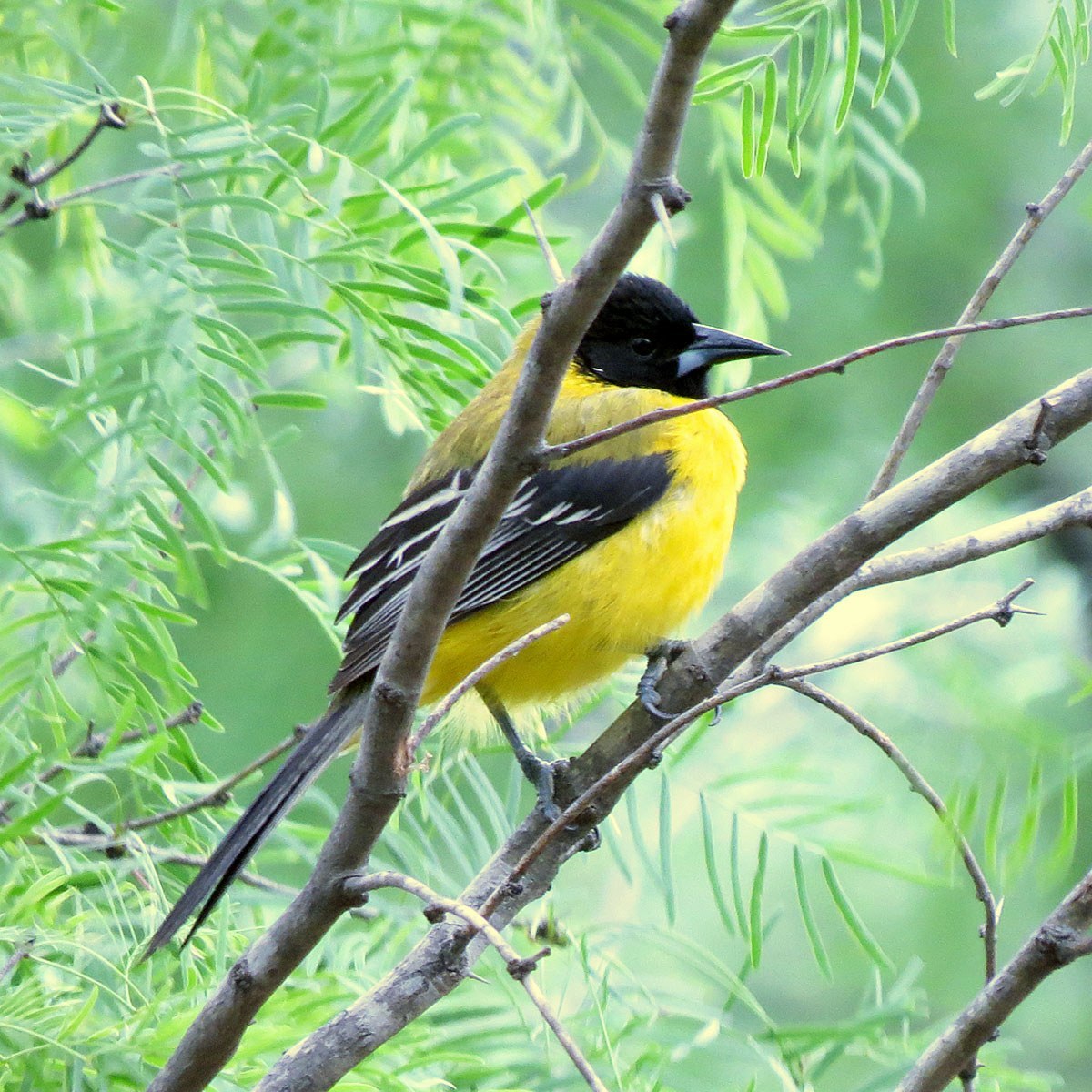
What Audubon's Oriole Feathers Look Like
Audubon's Oriole is a striking black-and-yellow bird of dense South Texas thorn scrub, and color is the key to identifying its feathers. The head is entirely black, forming a solid hood that extends down onto the upper back, giving way to a greenish-yellow mantle rather than solid black across the whole back. Wings are black with a yellowish-white wing-bar formed by pale tips on the greater coverts. The rest of the underparts and rump are bright yellow, and the tail is solid black. This combination - black head and wings, greenish-yellow back, yellow (not orange) body - is unique among the orioles found in its range.
Step-by-Step: Is This Feather From an Audubon's Oriole?
- Check body color first. Yellow, not orange, underparts rule out several similarly patterned orioles in the same region.
- Look at the back color. A greenish-yellow mantle feather (not solid black) distinguishes Audubon's from orioles with fully black backs.
- Check hood extent. Solid black covering the head and extending partway down onto the back is diagnostic when combined with the yellow body.
- Look for a pale wing-bar. A whitish-yellow bar formed by covert feather tips against black wing feathers.
- Consider habitat. Dense thorn scrub and woodland of South Texas and northeastern Mexico - a fairly restricted, distinctive range.
Similar Species & How to Tell Them Apart
- Scott's Oriole: Also black-and-yellow, but the black covers the entire back as well as the head (no greenish-yellow mantle), and it favors more arid, open habitat with yuccas rather than dense thorn scrub.
- Altamira Oriole: Body color is orange rather than yellow, with a different wing pattern that includes a white patch, easily separating it by color alone.
- Hooded Oriole: Body color is more orange-toned, and the black is confined to a smaller bib/throat area rather than a full head hood extending onto the back.
Where & When You'll Find Them
Audubon's Oriole is a year-round resident of dense thorn scrub and riparian woodland in South Texas and northeastern Mexico, a notably secretive oriole that spends much of its time skulking in thick brush rather than in the open. As a non-migratory resident, molt follows the late-summer post-breeding period, and because the species is so closely tied to dense understory cover, shed feathers are most often found low in thorn scrub thickets and along brushy woodland edges rather than in open canopy. Unlike most North American orioles, it does not build the classic hanging woven nest in an open tree crown; instead nests are tucked low and well hidden within dense brush, meaning any feathers dropped during the nesting cycle also tend to stay concealed close to the ground rather than scattering into open, easily searched areas.
Frequently asked questions
What is the main color clue for Audubon's Oriole feathers?
Yellow, not orange, body plumage combined with a black head that extends onto a greenish-yellow (not solid black) back.
How does Audubon's Oriole differ from Scott's Oriole?
Scott's Oriole has an entirely black back as well as head, while Audubon's shows a greenish-yellow mantle behind the black hood.
Is Audubon's Oriole an orange bird like some other orioles?
No - it's one of the few yellow-bodied orioles in its range, distinguishing it from the more orange-toned Altamira and Hooded Orioles.
Where does this species live?
Dense thorn scrub and riparian woodland in South Texas and northeastern Mexico, staying low in thick brush most of the time.
Where should I search for shed feathers?
Low in thorn scrub thickets and brushy woodland edges, since the species rarely ventures into open canopy.