
How to Identify Australasian Gannet Feathers
A guide to the black-tipped white wings and unique black central tail feathers that separate Australasian Gannet from other gannet species.
Read the full Australasian Gannet encyclopedia entry →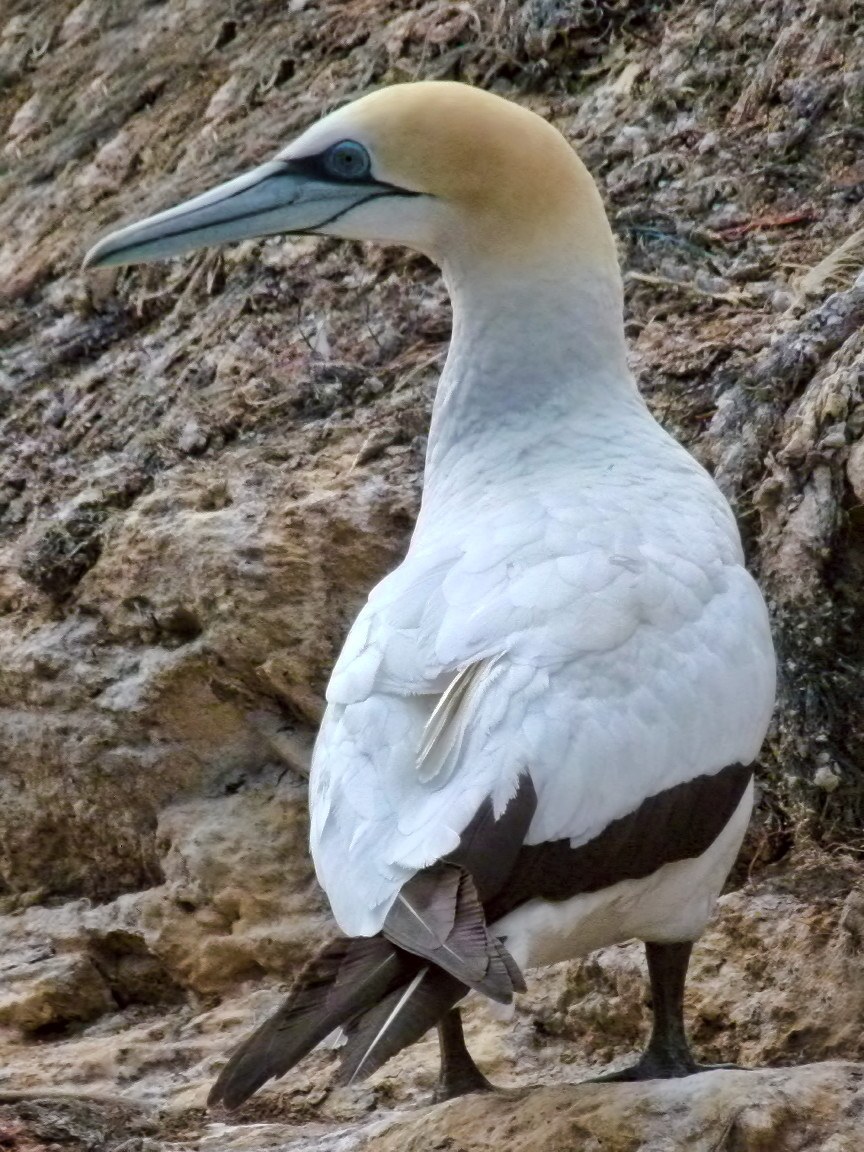
What Australasian Gannet Feathers Look Like
The Australasian Gannet is a large white seabird with a bold flight-feather pattern: the primaries are solid black, while the secondaries are mostly white with black tips, together forming a solid black triangular patch across the trailing wing when seen in flight - on individual feathers, this shows as primaries being uniformly dark and secondaries being white-based with only the outer portion black. The head and nape carry a warm buffy-yellow wash, most visible on fresh feathers before it fades with wear. The single most distinctive feature, and one that separates this species from most other gannets, is the tail: Australasian Gannet has black central tail feathers, while the outer tail feathers remain white - giving the closed tail a dark central stripe unlike the all-white tail of most relatives.
Step-by-Step: Is This Feather From an Australasian Gannet?
- Check the tail feathers first. Black central rectrices with white outer tail feathers is a strong, distinctive clue for this species specifically.
- Look at the flight feathers. Solid black primaries versus white-based, black-tipped secondaries, forming a clear two-part pattern.
- Note head coloring if present. A buffy-yellow wash on head/nape feathers, strongest when fresh and fading with age and wear.
- Consider size. A large, robust seabird, so expect substantial feather size compared to gulls or terns in the same habitat.
- Think about location. Coastal cliffs and islands of Australia and New Zealand strongly favor this species over its relatives.
Similar Species & How to Tell Them Apart
- Cape Gannet: Also shows a mostly black tail, but the black throat/gular stripe extends further down the neck than in Australasian Gannet - a subtle difference best confirmed with a full specimen rather than isolated feathers.
- Northern Gannet: Shows an all-white tail without any black central feathers, making the tail the clearest way to separate it from Australasian Gannet.
- Juvenile gannets of any species: Mottled brown overall rather than clean white-and-black, and best identified by size and location rather than fine plumage detail.
Where & When You'll Find Them
Australasian Gannets breed colonially on coastal cliffs and islands around Australia and New Zealand, nesting in dense colonies that can number in the thousands. Molt generally follows the breeding season, occurring in autumn as birds disperse from colonies, so shed feathers are most reliably found at or near breeding colonies and on adjacent beaches during and just after the nesting season, when feather wear and replacement is at its peak. Outside the breeding season, birds disperse widely along the coastline and across the Tasman Sea to forage, so worn body feathers can also wash up on ordinary beaches far from any colony, though these are usually more weathered and less crisply patterned than feathers collected directly at a nesting site.
Frequently asked questions
What is the most distinctive Australasian Gannet feather feature?
Black central tail feathers with white outer tail feathers - a pattern most other gannet species don't share.
How do the flight feathers differ from the tail?
Primaries are solid black, while secondaries are white-based with black tips, forming a black trailing-edge triangle in flight.
How is this different from Northern Gannet?
Northern Gannet has an all-white tail with no black central feathers, unlike Australasian Gannet's dark-centered tail.
What does the head coloring look like?
A buffy-yellow wash on the head and nape, strongest in fresh feathers and fading with wear over time.
When and where should I look for shed feathers?
At or near breeding colonies on Australian and New Zealand coastal cliffs, especially during and after the autumn breeding/molt season.