
How to Identify Bat Falcon Feathers
A guide to identifying the rufous-throated, barred-bellied feathers of the Bat Falcon, a small dusk-hunting falcon of Neotropical forests.
Read the full Bat Falcon encyclopedia entry →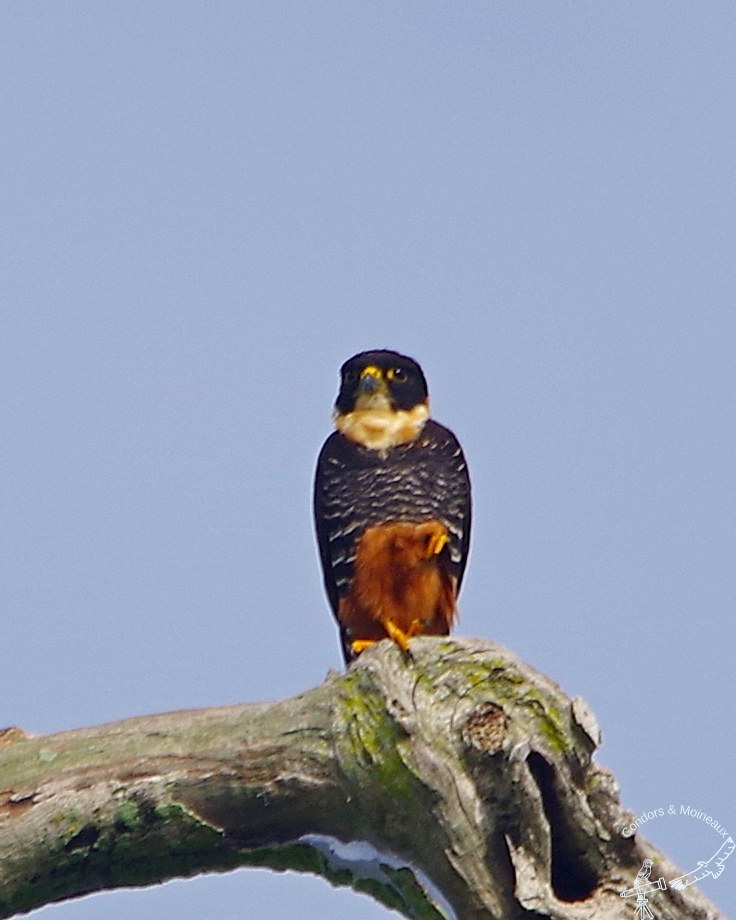
What Bat Falcon's Feathers Look Like
The Bat Falcon is a small, compact, powerfully built falcon of Neotropical forests and edges. Upperpart contour feathers (crown, back, wing coverts) are blackish-slate, dense and fairly plain, sometimes with a faint bluish sheen. The throat and upper breast stand out with a patch of rich rufous-orange feathers, sharply set off from the dark head. Below that, breast and belly feathers show crisp black-and-white barring, fine and regular, while the thighs and lower belly switch to solid rufous-chestnut, unbarred - this two-tone underside (barred chest, solid rufous thighs) is a strong combination clue. Flight feathers are blackish with narrow pale barring on the inner webs, relatively long and pointed, reflecting this species' fast, aerial-hunting lifestyle (it catches bats and swifts on the wing). Tail feathers are blackish with several narrow white or pale bars and a white tip.
Step-by-Step: Is This Feather From a Bat Falcon?
- Look for the rufous throat/breast patch - a small feather in warm orange-rufous, sharply bordered by dark slate, is highly suggestive.
- Check the belly-to-thigh transition - barred black-and-white belly feathers giving way to solid rufous thigh feathers is a strong combination.
- Assess overall size - this is a small falcon (about 23-30 cm), so feathers should be modest, not large.
- Confirm wing shape cues - flight feathers should be long and pointed, consistent with fast aerial pursuit.
- Examine tail banding - narrow pale bars on a blackish tail feather with a white tip.
- Rule out owls - flight feather edges should be stiff and smooth, lacking any soft owl-like fringe.
Similar Species & How to Tell Them Apart
The Orange-breasted Falcon, a close and much rarer relative, is considerably larger with a broader, more extensive orange breast band and bigger feathers overall. American Kestrel shows a much more colorful back (rufous with black barring) and lacks the solid rufous thigh patch, instead showing spotted underparts throughout. Aplomado Falcon has a more contrastingly banded head pattern (black mask, pale supercilium) and a longer tail with bolder banding, plus a black band across the belly rather than fine even barring.
Where & When You'll Find Them
Bat Falcons range from Mexico through much of South America, favoring forest edges, clearings, and areas near cliffs or tall trees used as hunting perches, often near water where bats and swifts concentrate at dusk. They are non-migratory residents. Molt proceeds gradually through the year in most of the tropical range without one sharp peak, though feather turnover often increases somewhat after the breeding season. Feathers are most findable near favored perch trees, cliff ledges, or nest sites used for plucking prey.
Frequently asked questions
What's the most distinctive single feather to look for?
A rufous-orange throat/breast feather sharply bordered by dark slate is very characteristic of Bat Falcon and few other regional species share it.
How is this different from an American Kestrel feather?
Kestrels show a rufous, black-barred back and spotted underparts throughout, without the solid unbarred rufous thigh patch that Bat Falcon has.
Could this be an Orange-breasted Falcon feather?
Possible if the feathers are notably larger and the orange breast patch more extensive; Orange-breasted Falcon is a bigger bird with a broader orange band.
Why are the flight feathers so pointed?
Bat Falcons hunt fast-flying prey like bats and swifts on the wing at dusk, and pointed, long primaries support that high-speed pursuit style.
Is there a seasonal pattern to feather loss?
Not a sharp one - molt is fairly continuous through the year in this tropical resident, with a modest increase after breeding.