
How to Identify Bean Goose Feathers
A guide to identifying Bean Goose feathers using their warm brown, scaled body plumage and how to rule out similar grey geese.
Read the full Bean Goose encyclopedia entry →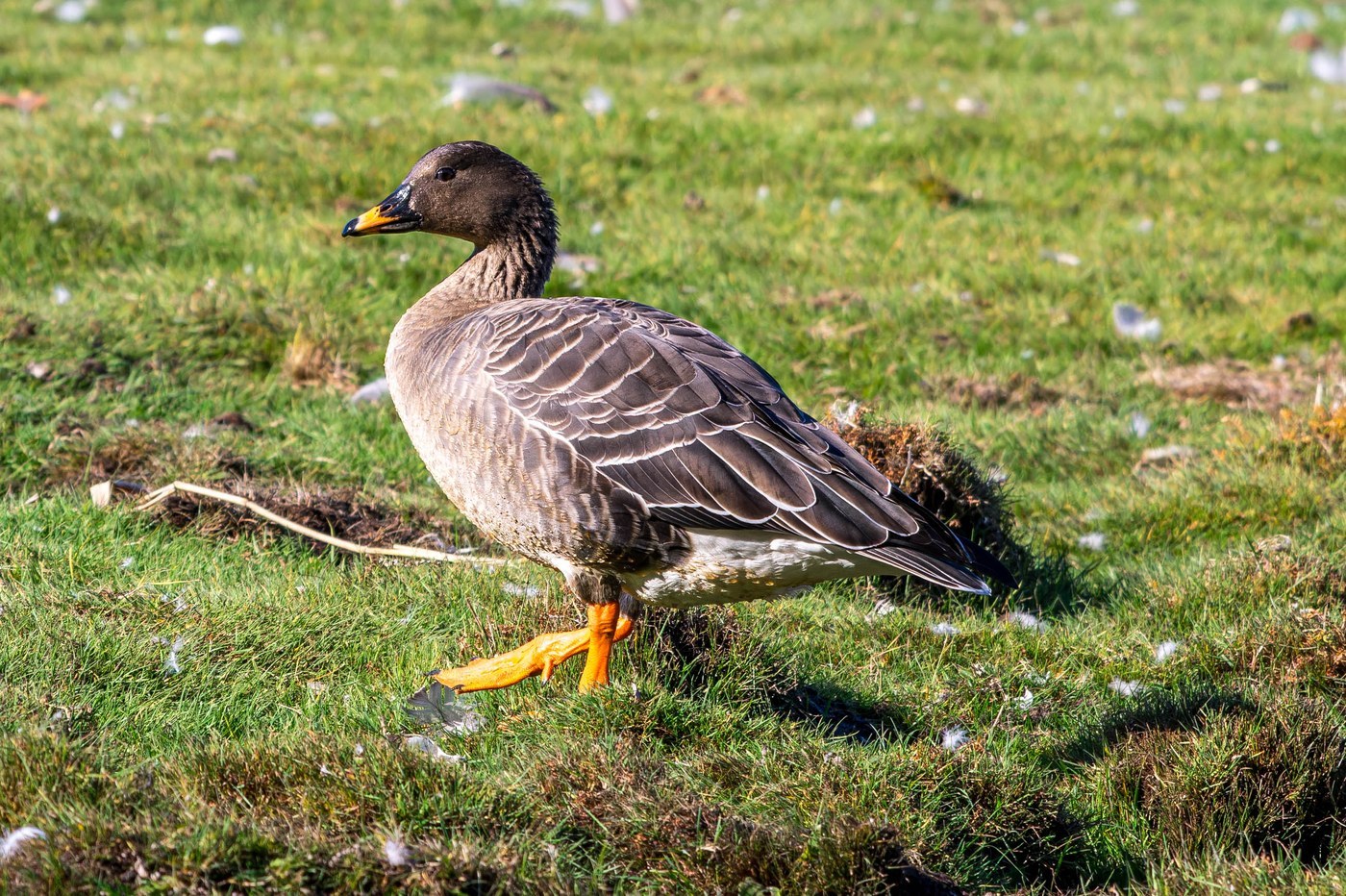
What Bean Goose's Feathers Look Like
Bean Goose feathers show the classic understated brown palette typical of "grey goose" species, without any bold black-and-white patterning. Body contour feathers (breast, back, flanks) are warm brown, and importantly each feather carries a pale buff-to-whitish fringe along its edge, so overlapping feathers create a subtle scaled or scalloped appearance across the back and flanks rather than a smooth solid color. The head and neck feathers are somewhat darker brown than the body, without any white face markings (unlike white-fronted geese) or black-and-white barring (unlike Barnacle Goose). The belly is paler brown to whitish, without bold black belly-barring. Flight feathers are dark grey-brown, fairly plain, and the tail is dark brown with a narrow white terminal band on each feather, giving a thin white edge to the closed tail.
Step-by-Step: Is This Feather From a Bean Goose?
- Check the base tone - warm to medium brown throughout, no black-and-white contrast anywhere.
- Look for pale feather fringes - a scalloped, scaled look from pale edges on back and flank feathers is a good supporting clue.
- Rule out face markings - no white patch at the feather base near where the bill would sit, unlike Greater/Lesser White-fronted Goose.
- Rule out belly barring - no bold black blotches on belly feathers, unlike White-fronted Goose.
- Examine tail feather tip - a narrow white band at the tip is typical.
- Consider size - a fairly large goose, so feathers should be substantial, similar in scale to Canada Goose or Greylag feathers.
Similar Species & How to Tell Them Apart
Greylag Goose feathers are paler, colder grey-brown overall with less warm tone and a more silvery cast to the wing coverts, plus a more uniformly pale (almost bluish-grey) forewing patch not present in Bean Goose. Greater White-fronted Goose shows the same brown scaled body pattern but adds a white feather patch at the base of the bill and irregular black barring across the belly feathers, both absent in Bean Goose. Pink-footed Goose, a close relative, is very similar but slightly smaller and colder brown overall with a more contrasting darker head/neck against a paler body - a subtle difference best judged with several feathers together rather than one alone.
Where & When You'll Find Them
Bean Geese breed across the subarctic tundra and taiga of northern Europe and Siberia and winter further south across temperate Europe and East Asia in farmland, wetlands, and river valleys. Flight feather molt occurs during a flightless period on the breeding grounds in summer, so primaries are mainly found there, while body/contour feathers turn up more broadly on wintering fields and marshes through the non-breeding season as birds preen and roost in large flocks.
Frequently asked questions
What rules out this being a White-fronted Goose feather?
The absence of a white patch at the bill base and absence of black barring on belly feathers - Bean Goose stays uniformly brown without those markings.
How is this different from a Greylag Goose feather?
Greylag tends to be paler, colder grey-brown with a distinct pale bluish-grey forewing patch, while Bean Goose runs warmer brown with less contrast.
Why do the feathers look scaled or scalloped?
Each back and flank feather has a pale buff fringe, and when many feathers overlap this creates a scalloped pattern typical of several grey goose species including this one.
When would I find a flight feather versus a body feather?
Flight feathers are shed during the flightless summer molt on Arctic/subarctic breeding grounds, while body feathers are lost more steadily and are more findable near wintering flocks.
Could this be confused with a Pink-footed Goose feather?
Yes, they're quite similar; Pink-footed tends to be slightly smaller and colder-toned with more head/body contrast, but distinguishing single feathers can be genuinely difficult.