
How to Identify Bell's Vireo Feathers
A guide to identifying Bell's Vireo feathers, one of the plainest vireos, using faint wingbars, a broken eye-ring, and dull olive-grey coloring.
Read the full Bell's Vireo encyclopedia entry →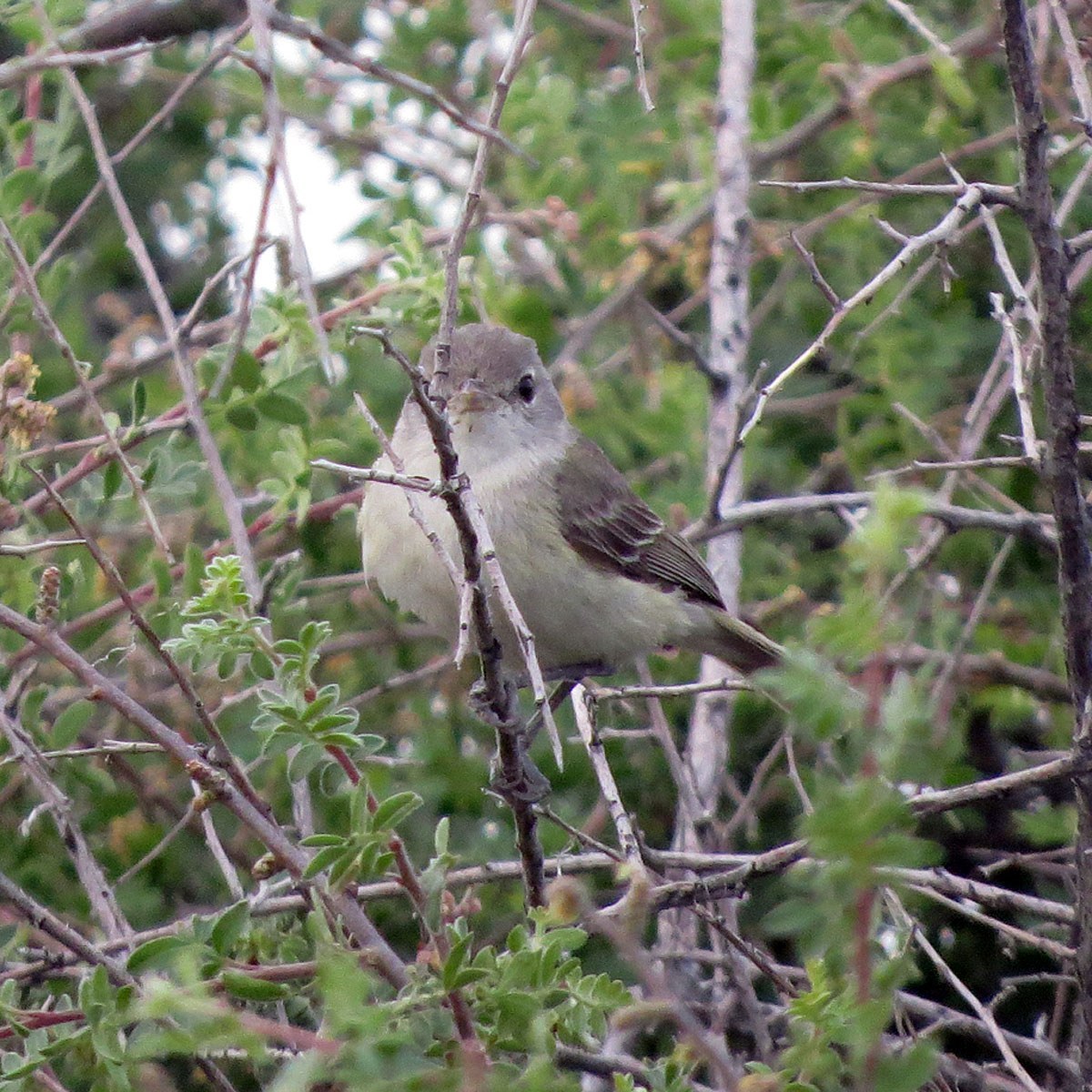
What Bell's Vireo's Feathers Look Like
Bell's Vireo is a small, plain, and somewhat nondescript songbird of dense shrubby habitat, and its feathers reflect that understated appearance. Upperpart contour feathers are dull olive-grey, without any bright or bold coloring. Underparts are whitish to pale yellowish, especially on the flanks, but overall contrast is subtle rather than sharp. Wing covert feathers show one or two faint, narrow white wingbars, often indistinct compared to the bold double wingbars of some other vireos. Around the eye, feathers form a partial, broken eye-ring (sometimes described as "spectacles") rather than a complete ring - this subtle facial marking, when identifiable on a very small facial feather, is a useful supporting clue. Tail feathers themselves are plain olive-brown without bold pattern.
Step-by-Step: Is This Feather From a Bell's Vireo?
- Check for dull, unremarkable coloring - olive-grey above and whitish-to-pale-yellow below, with no bright or bold hues.
- Look for faint wingbars - one or two narrow, indistinct pale bars on the wing coverts, not bold or crisp.
- Examine facial feathers for a broken eye-ring - a partial pale ring rather than a complete circle, if you have a feather from that area.
- Consider size - a very small songbird (about 11-13 cm), so feathers will be quite small and light.
- Assess overall plainness - the lack of any strong pattern or color is itself a clue, since Bell's Vireo is one of the drabber vireo species.
- Factor in habitat - dense willow, mesquite, or riparian shrub thickets in the central and southwestern US strongly support this identification.
Similar Species & How to Tell Them Apart
White-eyed Vireo, sharing similar dense scrub habitat in parts of its range, shows much bolder, brighter yellow spectacles and yellow-tinged flanks, a noticeably brighter bird overall than the plain Bell's Vireo. Warbling Vireo lacks wingbars almost entirely and shows a plainer face without the broken eye-ring, plus a slightly longer, more contrastingly patterned supercilium (eyebrow stripe). Ruby-crowned Kinglet, sometimes confused due to similar small size and plain coloring, shows a much shorter tail and, in males, a concealed red crown patch not present in any vireo.
Where & When You'll Find Them
Bell's Vireo breeds in dense shrubby thickets, especially willow and mesquite along riparian corridors, across the central and southwestern United States and into Mexico, wintering in Mexico and Central America. As a migratory species, it molts primarily on or near the wintering grounds after the breeding season, meaning feathers found in North American breeding habitat are most likely lost incidentally during the nesting season (roughly May-August) near dense shrub thickets, rather than from a major molt event on the breeding grounds themselves.
Frequently asked questions
What makes Bell's Vireo feathers hard to identify?
The species is notably plain and drab compared to many songbirds, lacking bold colors or strong patterns, so identification relies on subtle clues like faint wingbars and a broken eye-ring.
How is this different from a White-eyed Vireo feather?
White-eyed Vireo shows much bolder yellow spectacles and yellowish flanks, making it visibly brighter than the plain, subdued Bell's Vireo.
Is the broken eye-ring reliable from a single feather?
It can help if you have a facial feather showing a partial pale ring, but on its own it's a supporting clue rather than fully diagnostic - pair it with habitat and overall dullness.
When is the best time to find feathers near breeding habitat?
Roughly May through August, during the nesting season in dense willow or mesquite thickets, since major molt happens later on the wintering grounds.
Could a plain olive feather be a different small songbird entirely?
Yes, many small drab songbirds overlap in general appearance, so combining habitat (dense riparian shrub) with the faint wingbar and eye-ring clues improves confidence.