
How to Identify Bicknell's Thrush Feathers
A guide to the olive-brown, warm-tailed contour and flight feathers of Bicknell's Thrush and the careful comparisons needed to separate them from the nearly identical Gray-cheeked Thrush.
Read the full Bicknell's Thrush encyclopedia entry →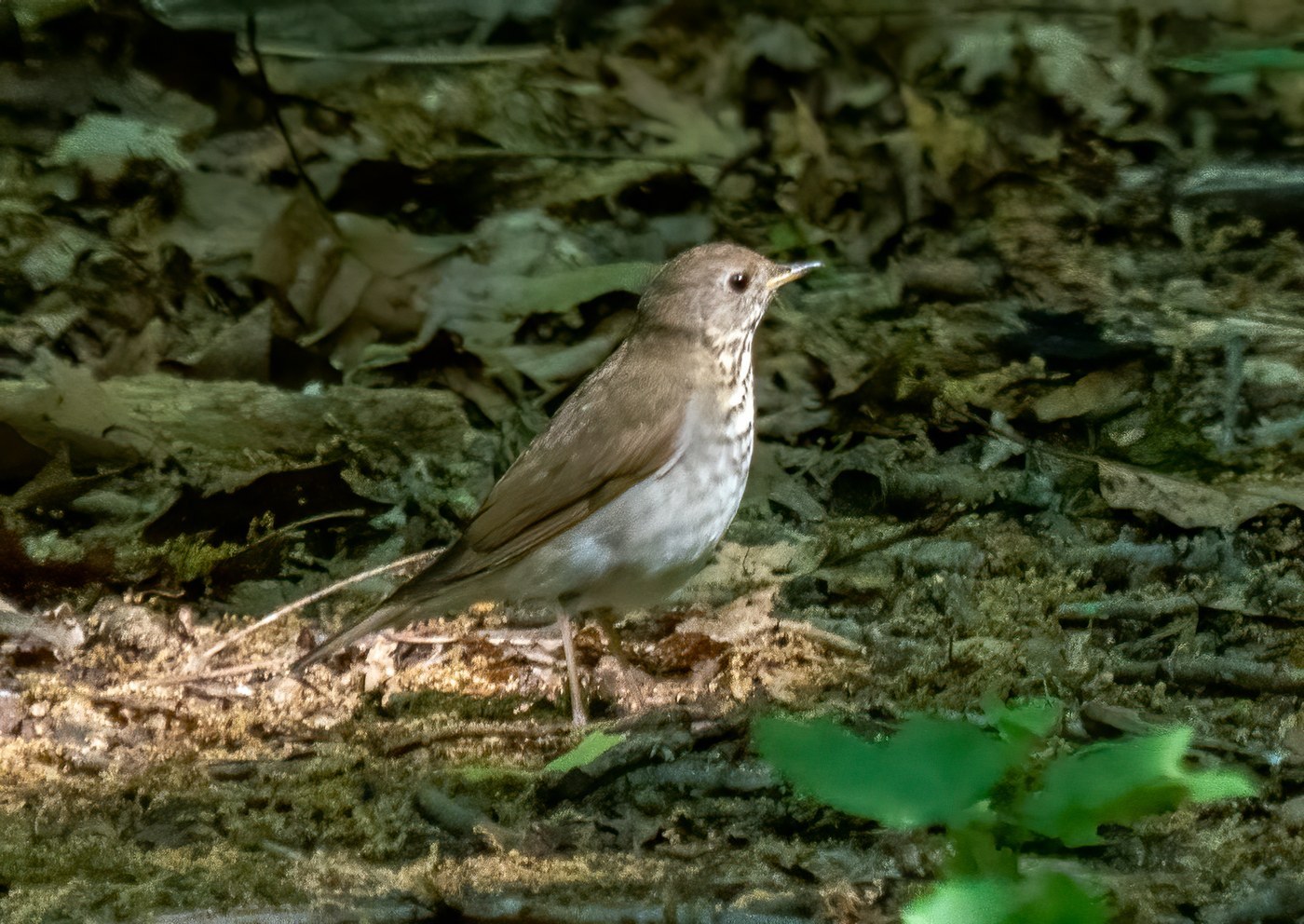
What Bicknell's Thrush's Feathers Look Like
Bicknell's Thrush is a small, compact thrush, and its feathers are correspondingly modest in size — body feathers around 2-3 cm, flight feathers up to about 8-9 cm. Upperparts feathers are a cool olive-brown, while the tail feathers show a distinctly warmer, reddish-brown to rufous cast that contrasts subtly with the back — this warm tail is one of the few reliable marks separating this species from its closest relative. The breast feathers are buffy with bold blackish-brown spotting, fading to plain white on the belly and undertail. A thin, indistinct buffy eye-ring is present but rarely useful on a loose feather. Flight feathers are plain grayish-olive-brown with no wing bars or strong pattern — typical of the "spot-breasted" Catharus thrushes.
Step-by-Step: Is This Feather From a Bicknell's Thrush?
- Check the tail-vs-back contrast. Lay a tail feather next to a back feather: if the tail is noticeably warmer/more rufous than the olive-brown back, that supports Bicknell's Thrush over its lookalikes.
- Measure overall size. Bicknell's is one of the smallest Catharus thrushes — feathers on the smaller end of the size range fit better than large samples.
- Look at breast spotting. Bold, discrete blackish spots on a buffy wash (not fine streaking) indicate a spot-breasted thrush group (Bicknell's, Gray-cheeked, Swainson's, Hermit) rather than a true thrush like American Robin.
- Rule out strong rufous overall. If the whole bird would have looked reddish (like Hermit Thrush, which shows a strongly rufous tail contrasting with a duller back too, but is larger with a bolder eye-ring and different range/habitat), reconsider.
- Factor in location and elevation. A thrush feather found in high-elevation fir forest in the northeastern mountains or a coastal thicket during migration season is consistent with Bicknell's.
Similar Species & How to Tell Them Apart
The single hardest identification challenge is the Gray-cheeked Thrush, which is essentially identical in plumage — slightly larger on average, with a somewhat grayer face and less warmth contrast between tail and back, but individual feathers cannot be reliably told apart without measurements, DNA, or a known geographic/breeding context; in practice, a loose feather from either species is often best labeled "Bicknell's/Gray-cheeked Thrush." Swainson's Thrush has a bold buffy eye-ring and buffy face that reads warmer overall, with less tail-back contrast. Hermit Thrush is easier to separate: it is somewhat larger, has a strongly rufous tail contrasting with an olive-brown back (an even bigger contrast than Bicknell's) and habitually pumps its tail, plus its range overlaps more broadly across North America rather than being restricted to high-elevation conifer forest.
Where & When You'll Find Them
Bicknell's Thrush breeds almost exclusively in dense, stunted high-elevation balsam fir and spruce forest on mountaintops of the northeastern U.S. (Adirondacks, White Mountains, Green Mountains) and southeastern Canada, then migrates to winter in mountain forests of the Caribbean, especially the Dominican Republic and Haiti (Hispaniola). Because its breeding range is so narrow and high-elevation, feathers are uncommon finds and turn up mainly on remote summit trails in June-August, or occasionally at lower elevations during the brief spring (May) and fall (September-October) migration windows, when molt-related feather loss and normal wear are most common.
Frequently asked questions
Can a single loose feather reliably separate Bicknell's from Gray-cheeked Thrush?
Not with certainty — the two species overlap almost completely in feather appearance; location, elevation, and season are your best additional clues.
What is the clearest feather-level difference from Hermit Thrush?
Hermit Thrush shows an even stronger rufous-tail-vs-olive-back contrast and is somewhat larger; Bicknell's contrast is present but more subtle.
Where would I most likely find a Bicknell's Thrush feather?
On or near high-elevation fir/spruce summit trails in the northeastern U.S. mountains during the breeding season, or at lower elevations during spring/fall migration.
Does breast spotting help identify the species?
It narrows the feather to the spot-breasted Catharus/thrush group but doesn't distinguish Bicknell's from Gray-cheeked or Swainson's on its own.
Is Bicknell's Thrush rare?
Yes, it has one of the most restricted breeding ranges of any North American songbird, so feather finds are inherently uncommon.