
How to Identify Black-backed Woodpecker Feathers
A guide to the unusually solid, unbarred black back feathers of the Black-backed Woodpecker, a fire-forest specialist, and how to separate them from other black-and-white woodpeckers.
Read the full Black-backed Woodpecker encyclopedia entry →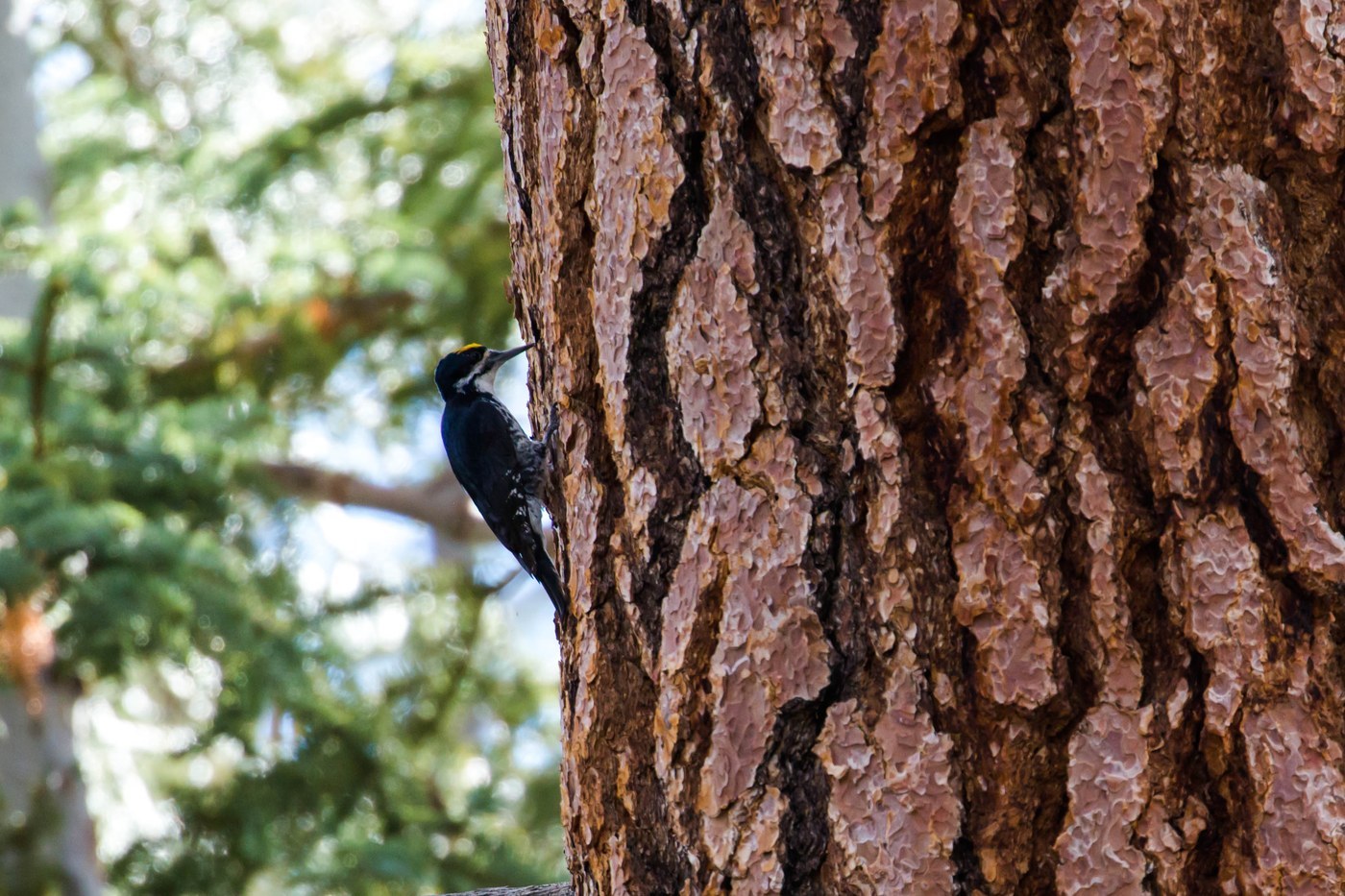
What Black-backed Woodpecker's Feathers Look Like
This species stands out among North American woodpeckers for what its back feathers lack: instead of the black-and-white barring seen in most look-alikes, the back and mantle feathers of Black-backed Woodpecker are solid, glossy black with no white barring at all, a genuinely diagnostic feature. Underparts feathers are clean white with bold black barring restricted to the flanks, while the central belly stays plain white. The male has a bright yellow crown patch — a small cluster of yellow feathers on the crown unlike any other North American woodpecker in overlapping range — while the female's crown is plain black. Wing (flight) feathers are black with white spotting on the flight feather edges, and the tail is black with white outer feathers, typical of ladder-backed woodpecker structure: stiff, pointed rectrices adapted for bracing against tree trunks.
Step-by-Step: Is This Feather From a Black-backed Woodpecker?
- Check the back feathers first. Solid, unbarred glossy black on a back/mantle feather is the single strongest clue — most similar woodpeckers show white barring here that this species lacks entirely.
- Look for a yellow crown feather. A small, bright yellow feather from the top of the head indicates an adult male of this species (or one of the few other yellow-crowned woodpeckers — see below).
- Examine flank feathers for barring. Bold black bars on white flanks, with the central belly staying clean, fits this species' pattern.
- Confirm stiff, pointed tail feather shape. A stiff-shafted, pointed black-and-white tail feather is consistent with a tree-clinging woodpecker.
- Note the habitat. A solid-black-backed woodpecker feather found in a recently burned conifer forest is a strong contextual match, since this species specializes in burn habitat.
Similar Species & How to Tell Them Apart
American Three-toed Woodpecker, its closest relative and the main confusion species, shows white barring across the back, not solid black — this is the clearest single difference between the two. Both sexes/species share a yellow-crowned male, so crown color alone won't separate them; the back pattern is decisive. Hairy Woodpecker and Downy Woodpecker both show a bold white or whitish stripe down the center of the back, quite different from either black-backed or barred-backed woodpecker patterns, and neither has a yellow crown. If the back feather in hand shows any white barring or a white central stripe, it is not Black-backed Woodpecker; only an unbroken black back feather qualifies.
Where & When You'll Find Them
Black-backed Woodpeckers are fire-forest specialists, strongly associated with recently burned coniferous forest (especially 1-8 years post-fire) across the boreal forest of Canada and Alaska and south through mountain conifer forests of the western U.S. and northern New England, where they feed on wood-boring beetle larvae in dead and dying trees. Because they concentrate so heavily in burn scars, feathers are disproportionately likely to be found in and around recent wildfire footprints. Molt occurs mainly after the breeding season, so worn feathers and molt-related losses peak in late summer through early fall, though feathers can be found in burned habitat in any season given the species' resident, non-migratory habits.
Frequently asked questions
What is the single best clue for Black-backed Woodpecker's back feather?
Solid, unbarred glossy black with no white markings at all — most other similar woodpeckers show white barring or a white stripe on the back.
How do I tell it from American Three-toed Woodpecker?
Three-toed Woodpecker shows white barring across the back; Black-backed Woodpecker's back is entirely black with no barring.
Does a yellow crown feather confirm the species?
It confirms an adult male of either Black-backed or Three-toed Woodpecker, both of which show yellow crowns — you still need the back pattern to distinguish the two.
What habitat should I search for this species' feathers?
Recently burned coniferous forest, ideally within about 1-8 years of a wildfire, is this species' preferred habitat.
Is this woodpecker migratory?
No, it's largely non-migratory and resident in its burn-forest habitat, though local movements track fresh burns.