
How to Identify Black-browed Albatross Feathers
A guide to the huge white body feathers and dark upperwing feathers of Black-browed Albatross, a Southern Ocean seabird, and how to separate them from other albatrosses.
Read the full Black-browed Albatross encyclopedia entry →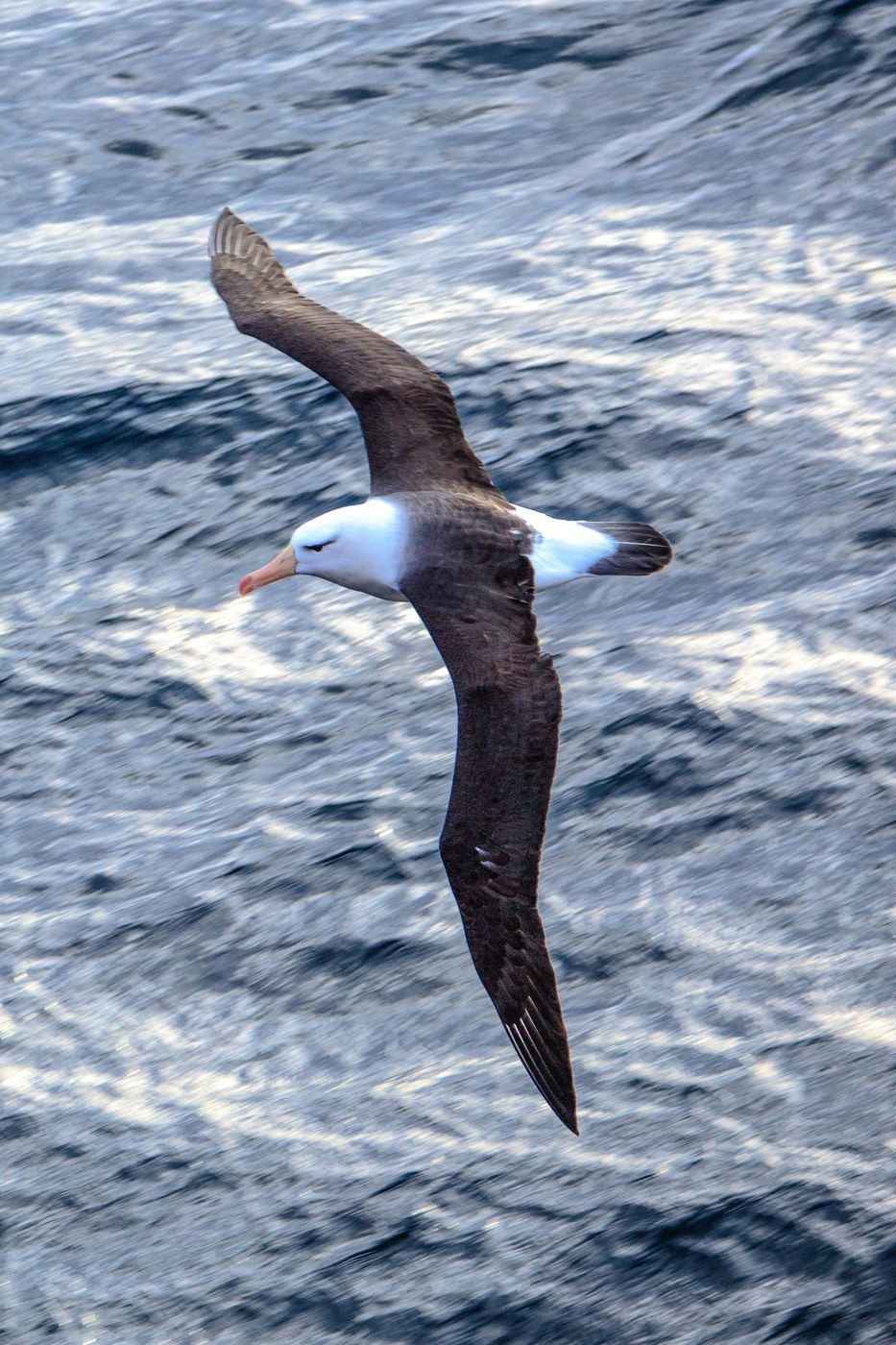
What Black-browed Albatross's Feathers Look Like
As one of the more commonly encountered albatrosses, Black-browed Albatross produces some of the largest feathers a beachcomber is likely to find: primaries can reach 30-40+ cm, and body/breast feathers are broad, dense, and notably stiff compared to a typical songbird or gull feather, reflecting the demands of sustained oceanic flight. Head, neck, and underparts feathers are clean white, while the standout facial feature — a dark, narrow line of feathers through and above the eye — gives the species its name; a small blackish feather from this "eyebrow" region is a useful, if subtle, clue. Upperwing (mantle and covert) feathers are a fairly uniform dark gray to blackish-brown, contrasting sharply with the white body — a classic albatross two-tone look. The underwing shows mostly white feathers broadly bordered in black along the leading and trailing edges, so an underwing covert can appear either clean white (center) or black-edged, depending on exactly where it grew.
Step-by-Step: Is This Feather From a Black-browed Albatross?
- Check for exceptional feather size and stiffness. Any primary feather approaching or exceeding 30 cm with a thick, rigid shaft points to a large seabird — most likely an albatross rather than a gull or shearwater.
- Look for the two-tone body pattern. Clean white body feathers paired with dark gray-blackish upperwing/mantle feathers fit the classic "mollymawk" (smaller albatross) pattern.
- Search for a dark eyebrow feather. A small blackish feather that would sit just above and through the eye region supports this species' distinctive facial mark specifically.
- Assess underwing pattern. White centers with black margins on underwing coverts match this species rather than the mostly-white underwings of larger great albatrosses.
- Factor in beach/coastal context. A very large, stiff, white-and-dark feather found washed up on a Southern Hemisphere coastline (or occasionally North Atlantic as a vagrant) is consistent with an albatross.
Similar Species & How to Tell Them Apart
Great albatrosses (Wandering, Royal) are considerably larger with feathers that can exceed 40-50 cm, and adults show far more white in the upperwing as they age, unlike Black-browed's consistently dark upperwing. Among the "mollymawks" (smaller albatrosses), Grey-headed Albatross shows a gray wash across the head and neck rather than a clean white head with just a dark eyebrow line, and its bill/facial pattern differs subtly. Shy Albatross and other mollymawks show a paler, grayer upperwing than the notably dark blackish-brown of Black-browed Albatross, and typically lack as bold a dark eyebrow contrast against an otherwise white face. Overall, the combination of a stark white head with only a thin dark eyebrow, a dark (not gray-washed) uniform upperwing, and large but not enormous size fits Black-browed Albatross best among commonly encountered albatross feathers.
Where & When You'll Find Them
Black-browed Albatrosses breed on subantarctic islands (Falklands, South Georgia, and others in the Southern Ocean) and range widely across the Southern Ocean and southern oceans generally, with occasional vagrants reaching the North Atlantic. Feathers are most often found washed ashore on beaches of the southern tips of South America, southern Africa, Australia, and New Zealand, as well as near breeding colonies, at any time of year since these are wide-ranging pelagic wanderers outside the breeding season. Molt in albatrosses is slow and often spread across more than a year, so feather loss and beach finds happen year-round rather than in one sharp seasonal pulse, though feather turnover often increases somewhat after the breeding season ends.
Frequently asked questions
How large should I expect this species' feathers to be?
Quite large — primaries can reach 30-40+ cm with a thick, stiff shaft, reflecting the demands of long-distance oceanic flight.
What is the key facial clue for this species?
A thin dark 'eyebrow' line of feathers through and above the eye on an otherwise clean white head.
How do I rule out a great albatross like Wandering Albatross?
Great albatrosses are larger, with feathers that can exceed 40-50 cm, and adults show much more white mixed into the upperwing as they age, unlike this species' consistently dark upperwing.
Where are feathers most likely to wash ashore?
Southern Hemisphere coastlines near the Southern Ocean — southern South America, southern Africa, Australia, and New Zealand — plus occasional North Atlantic vagrant records.
Is there a strong molt season for albatrosses?
Not really — molt is slow and spread across much of the year, so feather finds happen year-round rather than in one concentrated season.