
How to Identify Black-faced Bunting Feathers
A concise guide to the olive, grey, and black head feathers that identify this small East Asian bunting.
Read the full Black-faced Bunting encyclopedia entry →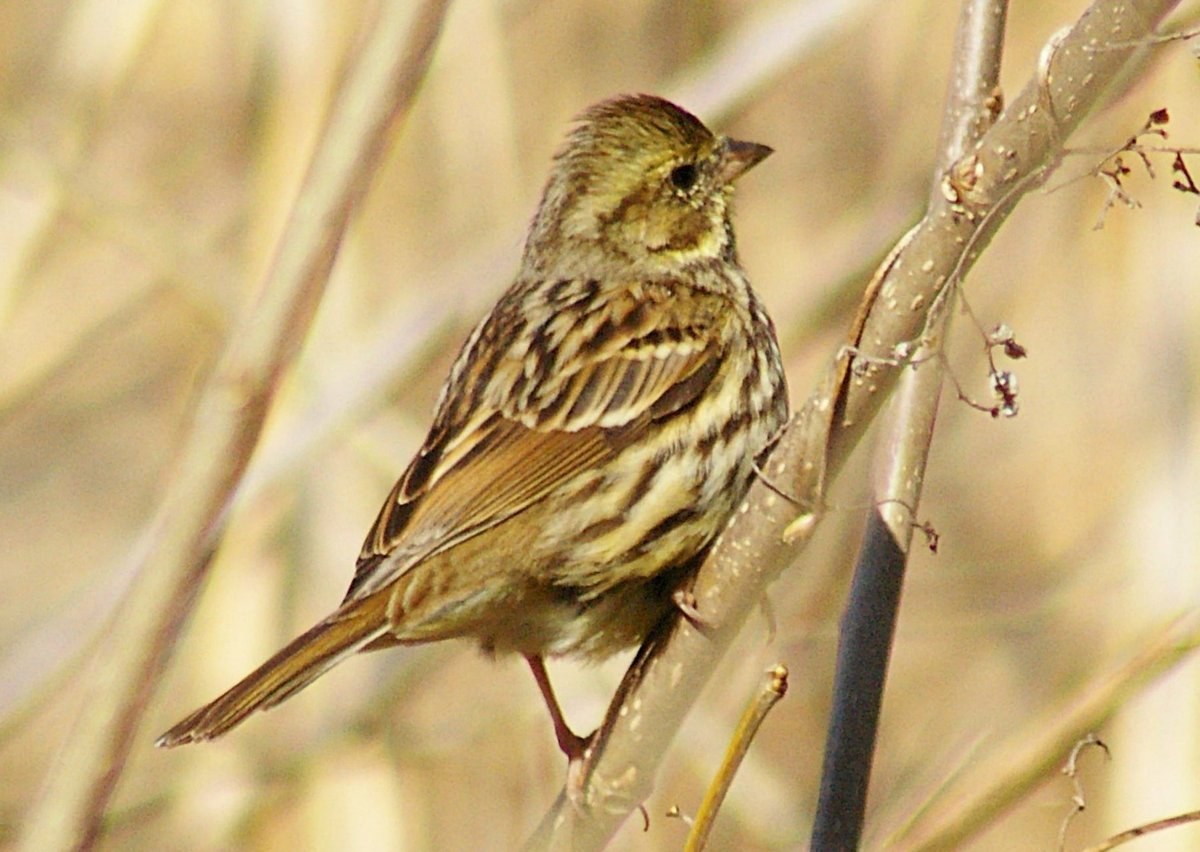
What Black-faced Bunting Feathers Look Like
This is a sparrow-sized songbird, so every feather is small — contour feathers run 2-4 cm, flight feathers rarely exceed 6-7 cm. Breeding males show a dark slate-grey to blackish head and throat contrasting with an olive-green to yellowish-olive breast and flanks, while the back is streaked brown and black, similar to many buntings and sparrows. Females and non-breeding males are much duller — greyish-olive overall with fine dark streaking on the crown and less obvious facial darkness, so a plain olive-brown streaked feather can still be this species outside the breeding season.
Flight feathers are dark brown with narrow pale edging, unremarkable compared to the diagnostic head feathers. The tail is fairly short and slightly notched, dark brown with paler outer edges. Because this is a small perching bird, feathers are soft, lightly built, with thin pale shafts — nothing stiff or heavy like a waterbird's plumage.
Step-by-Step: Is This Feather From a Black-faced Bunting?
- Check size first. Anything under about 7 cm and soft-textured is in the right range; this rules out all larger wetland, wading, and raptor species instantly.
- Look for slate-grey head feathers next to olive body feathers. This grey-over-olive combination on a tiny songbird is the strongest clue for a breeding male.
- Consider streaked brown as a fallback. Non-breeding birds and females show streaky olive-brown feathers much like many other buntings and sparrows, so treat this as supportive rather than definitive.
- Inspect the back for black streaking on brown. A boldly streaked back paired with plainer underparts fits typical bunting patterning.
- Rule out finches and true sparrows. Bunting feathers tend to have slightly more elongated, less rounded tips than House Sparrow-type feathers, though this distinction takes practice and comparison.
Similar Species & How to Tell Them Apart
Several Old World buntings overlap in range and look very similar in the hand. The Yellow-throated Bunting shows a black-and-yellow head pattern rather than solid grey-and-olive. The Grey Bunting lacks the olive wash entirely, appearing more uniformly grey-brown. Reed Buntings show a bolder black-and-white head pattern with a distinct white submoustachial stripe, which Black-faced Bunting lacks. Because so many small brown-and-olive songbirds overlap, a single loose feather from this species is genuinely hard to clinch without the surrounding context (location, other feathers, or a photographed bird) — the grey-head-with-olive-body combination is the best single cue.
Where & When You'll Find Them
Black-faced Buntings breed across temperate East Asia — Japan, Korea, and eastern Russia/China — in scrub, forest edge, and reedbeds, then migrate south to winter in southern China and Southeast Asia. Feathers are most likely to be found in scrubby thickets, reed margins, and agricultural hedgerows during migration stopovers or on the wintering grounds, when large numbers pass through or gather in mixed flocks. Molt occurs after breeding in late summer, so worn breeding-plumage feathers with fresher olive-grey ones can both be found in early autumn near stopover habitat.
Frequently asked questions
How small should I expect this feather to be?
Very small — contour feathers 2-4 cm and flight feathers under about 7 cm, consistent with a sparrow-sized songbird.
What's the single best clue for a male in breeding condition?
A slate-grey head feather paired with an olive-green body feather is the strongest indicator of a breeding male Black-faced Bunting.
Can I identify a single feather from a female or non-breeding bird confidently?
Not usually on its own — females and non-breeding males show streaky olive-brown feathers shared with several similar buntings, so treat the ID as tentative without more context.
How do I rule out Reed Bunting?
Reed Bunting has a bolder black-and-white facial pattern with a white submoustachial stripe, which this species lacks.
When are feathers most findable?
During migration stopovers and on wintering grounds in scrub and reedbeds, especially in early autumn after post-breeding molt.