
How to Identify Black Phoebe Feathers
A quick guide to the sooty-black-and-white feathers of this small streamside flycatcher, best known for its sharp two-tone contrast.
Read the full Black Phoebe encyclopedia entry →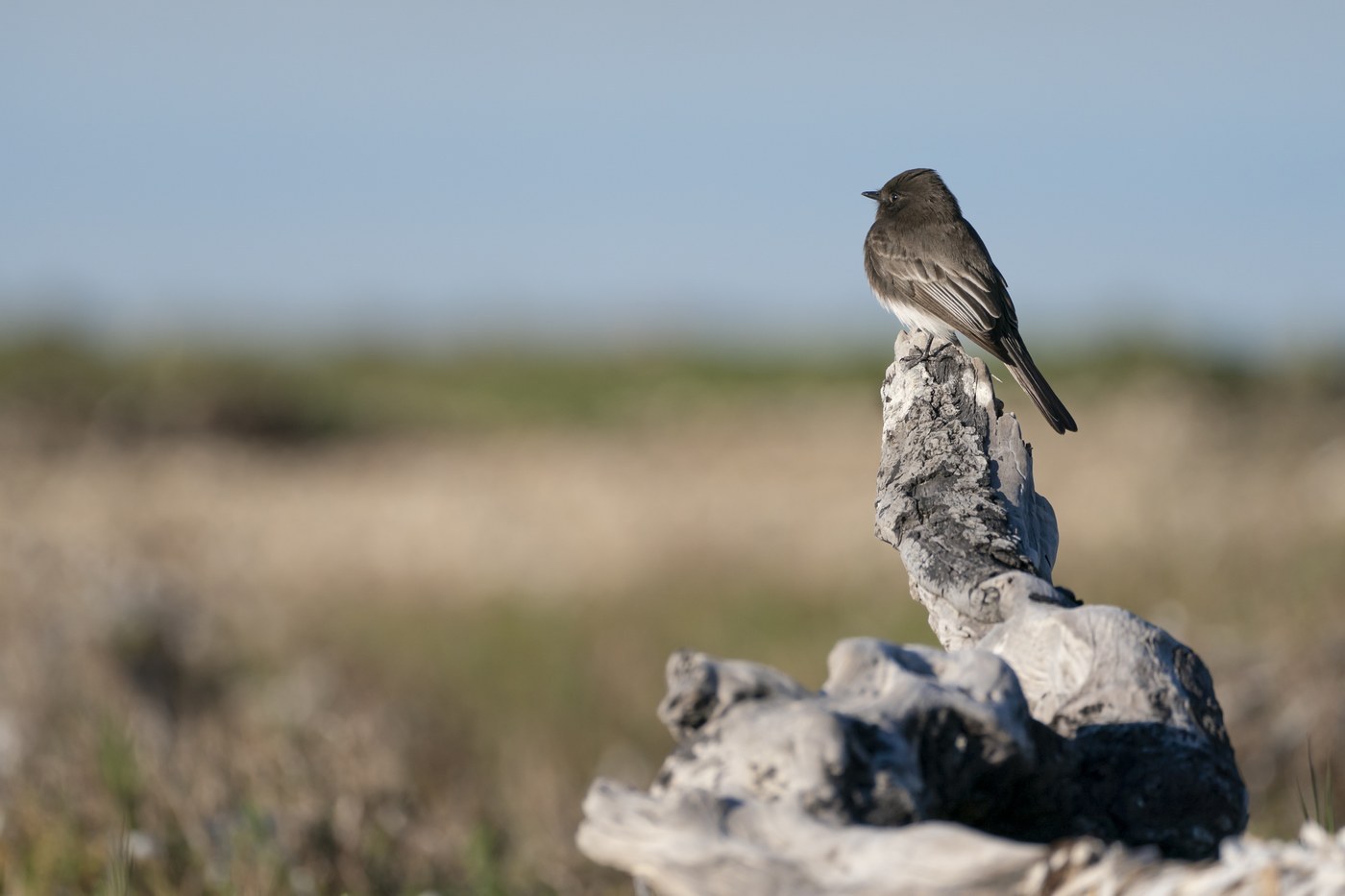
What Black Phoebe Feathers Look Like
Black Phoebe is a small flycatcher with a strikingly two-toned pattern: head, throat, breast, back, and wings are sooty blackish-gray, while the belly and undertail coverts are crisp white, creating a sharp, clean line between dark and light on any breast or flank feather. Contour feathers are small (2-3 cm), soft, with the transition from black to white often visible on a single feather as a dividing edge rather than a gradual fade. Flight feathers (primaries) are blackish-brown, fairly short at 6-8 cm given the bird's small size, with thin pale edging when fresh that wears off by late summer. Tail feathers are also blackish-brown, slightly notched at the tip, and entirely dark with no white — a key detail that separates this species from several similarly patterned songbirds.
Step-by-Step: Is This Feather From a Black Phoebe?
- Check for a sharp black-to-white transition. A small contour feather that's dark gray-black on one portion and crisply white on another, with a clean edge rather than a blend, strongly suggests this species.
- Measure it. Contour feathers 2-3 cm, primaries 6-8 cm — consistent with a small songbird-sized flycatcher, not a larger bird.
- Inspect the tail feathers. They should be entirely dark blackish-brown with no white edges or corners — an important check since several black-hooded songbirds do show white in the tail.
- Look at overall darkness. The upperparts should read as sooty black to blackish-gray, not brown — ruling out paler brownish flycatchers.
- Consider the setting. A feather found right at the edge of a stream, pond, or under a bridge or eave fits this species' strong habit of nesting and perching near water and structures.
Similar Species & How to Tell Them Apart
Eastern Phoebe and Say's Phoebe are close relatives but neither is truly black: Eastern Phoebe is grayish-brown above with a pale buffy wash below, and Say's Phoebe has a distinctive cinnamon-buff belly rather than white — so a feather with genuine black tones and a pure white (not buffy) belly points to Black Phoebe. Dark-eyed Junco, which can show a similarly dark hood in some forms, has white outer tail feathers that flash in flight, whereas Black Phoebe's tail is entirely dark — checking the outer tail feathers for white is the fastest way to separate the two.
Where & When You'll Find Them
Black Phoebes are closely tied to water, favoring streams, ponds, irrigation ditches, and ranch buildings from the southwestern United States down through Mexico and Central America into South America, where resident populations don't migrate. Look for feathers on the ground beneath mud nests built under bridges, eaves, or culverts, since this species often reuses the same nest sites year after year. Molt follows breeding, so late summer is the best window for finding freshly dropped feathers near these nesting structures.
Frequently asked questions
What does the black-to-white transition on the feather tell me?
A sharp, clean edge between dark gray-black and crisp white on one feather is a strong sign of Black Phoebe, whose plumage is sharply two-toned rather than gradually shaded.
How do I rule out a junco?
Check the tail feathers — juncos show white outer tail feathers that flash in flight, while Black Phoebe's tail is entirely dark with no white.
Could this be a Say's Phoebe feather?
Say's Phoebe has a cinnamon-buff belly, not white, so a pure white belly feather points to Black Phoebe instead.
Where are feathers most likely to turn up?
Near water — under bridges, eaves, and culverts where this species builds its mud nest, especially in late summer after breeding.
Are the flight feathers large?
No, they're short at only 6-8 cm, matching this bird's small flycatcher size.
Black Phoebe identified by the community
Recent Black Phoebe feathers identified with Feather Identifier.

