
How to Identify Black Redstart Feathers
A field guide to the sooty-gray body and vivid rust-orange tail feathers that make this Eurasian redstart easy to confirm.
Read the full Black Redstart encyclopedia entry →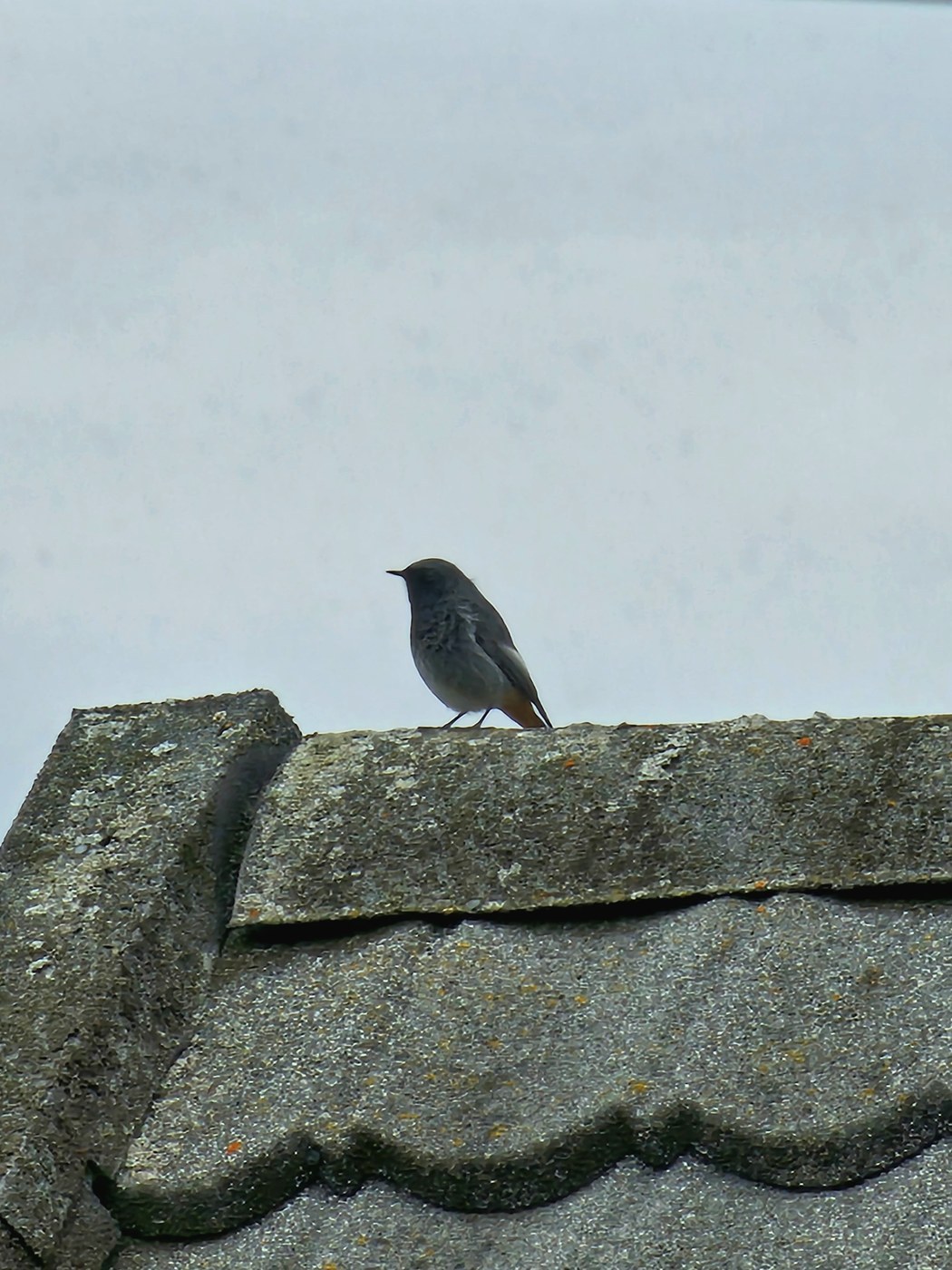
What Black Redstart Feathers Look Like
The single most useful feather from this species is the tail: Black Redstart tail feathers are bright rufous-orange with a darker blackish-brown central pair, a vivid, almost fiery color unlike the muted browns of most small songbirds. Body contour feathers on adult males are dark sooty gray to near-black across the throat, breast, and upperparts, while females and juveniles are duller grayish-brown but still carry that same telltale orange tail. Wing feathers are blackish-brown, some subspecies showing a small pale panel on the secondaries when fresh. Contour feathers are small, 2-3 cm, soft-textured; tail feathers run about 5-6 cm.
Step-by-Step: Is This Feather From a Black Redstart?
- Look first at any orange feather. A bright rufous-orange tail feather with a darker blackish-brown central pair is the strongest single clue for the redstart group as a whole.
- Check body color for darkness. Dark sooty gray to blackish body feathers (rather than gray with an orange breast) point specifically to Black Redstart rather than its close relative.
- Measure it. Small contour feathers 2-3 cm and tail feathers around 5-6 cm fit a small songbird, not a larger thrush.
- Note any pale wing panel. A faint whitish patch on the secondaries, if present, supports certain Black Redstart subspecies (present in males of some populations).
- Rule out robins. If the orange is confined to the breast and the tail feather itself is plain brown, you're likely looking at a different species (see below).
Similar Species & How to Tell Them Apart
Common Redstart is the closest look-alike and shares the same bright orange tail, but its body is much more contrasting overall — a gray back, black face mask, and a bright orange breast and belly — so a body feather with orange coloring on the underparts points to Common Redstart, while an all-dark or dark gray body feather (no orange below) points to Black Redstart. European Robin has a warm orange breast too, but its tail feathers are plain brown, not rufous-orange, which rules it out immediately if a tail feather is in hand.
Where & When You'll Find Them
Black Redstarts favor rocky terrain, cliffs, quarries, and increasingly urban buildings and industrial sites across Europe, North Africa, and Asia, often nesting in wall crevices and ledges rather than trees. Many populations are partial migrants, moving to milder areas or lower elevations in winter while some stay resident year-round in the mildest parts of the range. Molt happens after breeding in mid-to-late summer, so feathers are most often found around nest ledges, old buildings, and rocky outcrops at that time of year.
Frequently asked questions
What does the orange tail feather tell me?
A bright rufous-orange tail feather with a darker central pair is diagnostic for the redstart group; whether it's Black or Common Redstart depends on the body feather color.
How do I tell Black Redstart from Common Redstart?
Check the body: Black Redstart is dark sooty gray to black below, while Common Redstart has a bright orange breast and belly contrasting with a gray back.
Could this be a European Robin feather?
No — Robin has an orange breast but a plain brown tail, not the rufous-orange tail feather characteristic of redstarts.
Where do these birds nest?
In crevices on cliffs, quarries, and building ledges, which is where shed feathers most often accumulate.
When is molt season?
Mid-to-late summer, after breeding, which is the best time to find fresh feathers near nesting sites.