
How to Identify Black Rosy-Finch Feathers
A guide to the sooty-black body and rose-pink wing fringing that identifies this high-alpine finch of the Rocky Mountains.
Read the full Black Rosy-Finch encyclopedia entry →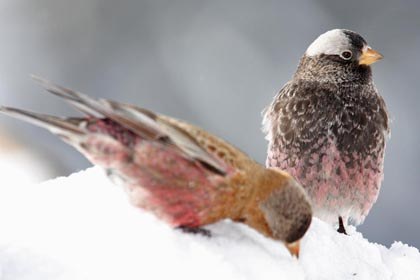
What Black Rosy-Finch Feathers Look Like
Black Rosy-Finch is the darkest of the three North American rosy-finches, and its feathers reflect that: body contour feathers are blackish-brown to sooty black, with a rosy-pink wash fringing the wing coverts, rump, and belly feathers. This pink edging is the group's signature feature and shows up clearly on shed feathers as a thin band of rose or salmon color along the edge of an otherwise dark feather. A pale gray patch occurs on the back of the head (nape), so contour feathers from that area may appear silvery-gray rather than black. Feathers are small, typical of a compact alpine finch — contour feathers around 2-2.5 cm, primaries around 7-8 cm.
Step-by-Step: Is This Feather From a Black Rosy-Finch?
- Look for pink fringing. A dark blackish-brown feather edged in rose-pink, especially from the wing coverts or rump, is the key rosy-finch signature.
- Assess overall darkness. Black Rosy-Finch is the blackest of the three rosy-finch species — if the base color reads as blackish-brown rather than warm brown, that favors this species.
- Check for gray on the head. A silvery-gray contour feather alongside blackish body feathers is consistent with this species' partial gray nape patch.
- Measure it. Small size (contour feathers ~2-2.5 cm) fits a compact high-alpine finch.
- Consider elevation. A feather found above treeline on rock or snow strongly favors a rosy-finch over other similarly sized songbirds, which rarely frequent such extreme habitat.
Similar Species & How to Tell Them Apart
Gray-crowned Rosy-Finch shares the pink wing fringing but has a more extensive gray crown patch and an overall browner, less blackish body tone. Brown-capped Rosy-Finch lacks gray on the head entirely and shows a warmer, plainer brown body with less pink overall. Comparing the base body color — blackish (Black), brown with limited gray (Gray-crowned), or warm brown with no gray (Brown-capped) — is the fastest way to separate the three species when a feather is found within their overlapping mountain ranges.
Where & When You'll Find Them
Black Rosy-Finches breed on high alpine tundra, cliffs, and snowfields above treeline in the Rocky Mountains, nesting in rock crevices and cracks in cliff faces. They descend to lower elevations and valleys in winter, so while feathers are found at high elevation in summer near breeding cliffs, they can also turn up at lower-elevation feeding areas and roost sites during the colder months. Molt occurs in late summer at high elevation shortly after the short alpine breeding season ends.
Frequently asked questions
What does the pink fringing on this feather mean?
A dark feather edged in rose-pink is the signature mark of the rosy-finch group as a whole; the base color then narrows it to a specific species.
How do I tell this apart from a Gray-crowned Rosy-Finch feather?
Black Rosy-Finch is blackish-brown overall with less gray, while Gray-crowned Rosy-Finch is browner with a more extensive gray crown patch.
What about Brown-capped Rosy-Finch?
Brown-capped lacks any gray on the head and is a warmer plain brown overall, without the blackish tone of this species.
Where would I find a feather in summer versus winter?
In summer, near high alpine cliffs and snowfields above treeline; in winter, at lower elevations where the birds move to feed.
When does molt happen?
Late summer, shortly after the short alpine breeding season, at high elevation near nesting cliffs.