
How to Identify Blue-crowned Conure Feathers
How to identify the green body feathers and pale sky-blue crown feathers of this South American parakeet, and tell them apart from similar green conures.
Read the full Blue-crowned Conure encyclopedia entry →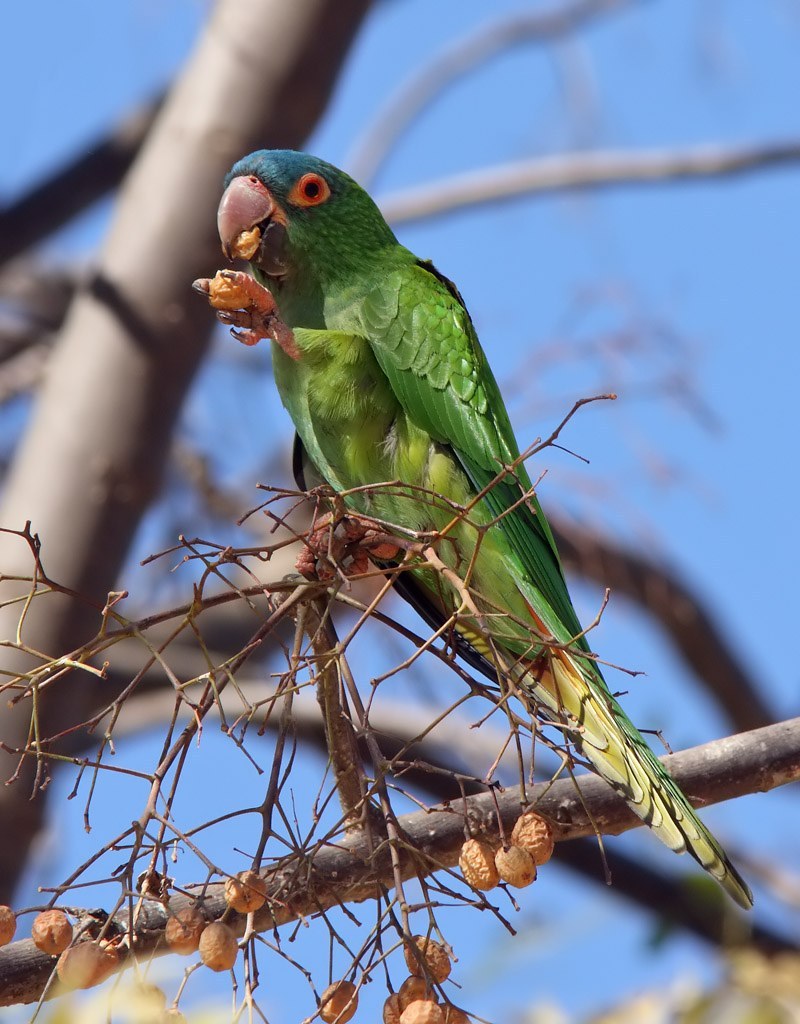
What Blue-crowned Conure's Feathers Look Like
Blue-crowned Conure (also called Blue-crowned Parakeet) is a mid-sized parakeet whose plumage is dominated by green but carries one unmistakable marker. Body, back, and wing feathers are bright grass-green, smooth and glossy on the exposed surface, with the wing feathers becoming slightly more olive or blue-tinged toward the flight edges. The diagnostic feature is on the head: crown feathers are a pale, chalky sky-blue, extending from the forehead back over the crown and nape, sharply contrasting with the green face and body. Flight feathers (primaries) show blue outer webs, more saturated than the pale crown blue, giving a two-tone blue effect between head and wing when compared side by side. Tail feathers are long, tapering, green above with a bluish or olive-tinged underside. Overall feather texture is typical parrot: fairly stiff, glossy, and moderately sized — flight feathers reach roughly 12-16 cm.
Step-by-Step: Is This Feather From a Blue-crowned Conure?
- Check for blue only on the crown/nape, with the rest of the head and body solidly green — a highly localized blue patch is the key clue.
- Compare shades of blue. Crown blue is paler and chalkier; if you have a flight feather, its blue should look a bit deeper/more saturated than a crown feather from the same bird.
- Confirm green tone. The body green should be a clean, bright grass-green rather than yellowish-green or dull olive.
- Measure size. Mid-sized parakeet feathers (flight feathers around 12-16 cm) rule out both small parrotlets and large macaws.
- Rule out an all-green bird — if there's no blue at all on the specimen, consider other regional green conures instead.
Similar Species & How to Tell Them Apart
Mitred Parakeet and Red-masked Parakeet show red on the face/head rather than blue, an easy distinguishing feature. Blue-headed Parrot, despite the similar name, is a heavier-bodied Amazon-relative with the entire head deep blue (not just the crown) and red undertail coverts — a much bolder blue extent than the pale crown patch of Blue-crowned Conure. White-eyed Parakeet and other all-green conures in the same range lack any blue crown patch entirely. The pale, chalky, crown-only blue patch against clean green body plumage is the most reliable single feature separating this species from its relatives.
Where & When You'll Find Them
Blue-crowned Conure ranges across open and semi-open woodland, savanna, and cultivated areas of central South America, and it has also established feral populations in warmer parts of the United States (including Florida and California) from escaped pet birds. Feathers are commonly found near roost trees, palm groves, and urban parks where flocks gather noisily at dusk. Because parrots molt gradually through the year rather than all at once, feathers can be found in any season, though slightly increased feather turnover often follows the breeding period in its native range.
Frequently asked questions
Where exactly is the blue on this bird's feathers?
Blue is confined mainly to the crown and nape, appearing as a pale, chalky sky-blue patch, with more saturated blue on the outer webs of the flight feathers.
What color is the rest of the body?
A clean, bright grass-green over the back, wings, and underparts.
How do I avoid confusing this with a Blue-headed Parrot feather?
Blue-headed Parrot has deep blue covering the entire head, not just the crown, and shows red undertail coverts — both features absent in Blue-crowned Conure.
Are feral populations found outside South America?
Yes, escaped pet birds have established feral flocks in warmer U.S. areas such as Florida and California, so feathers can turn up there too.
When are feathers most likely to be found?
Any time of year, since parrots molt gradually, though turnover is somewhat higher after the native breeding season.