
How to Identify Blue-crowned Motmot Feathers
A guide to the turquoise crown, green body feathers, and signature racket-tipped tail feathers of this Central and South American motmot.
Read the full Blue-crowned Motmot encyclopedia entry →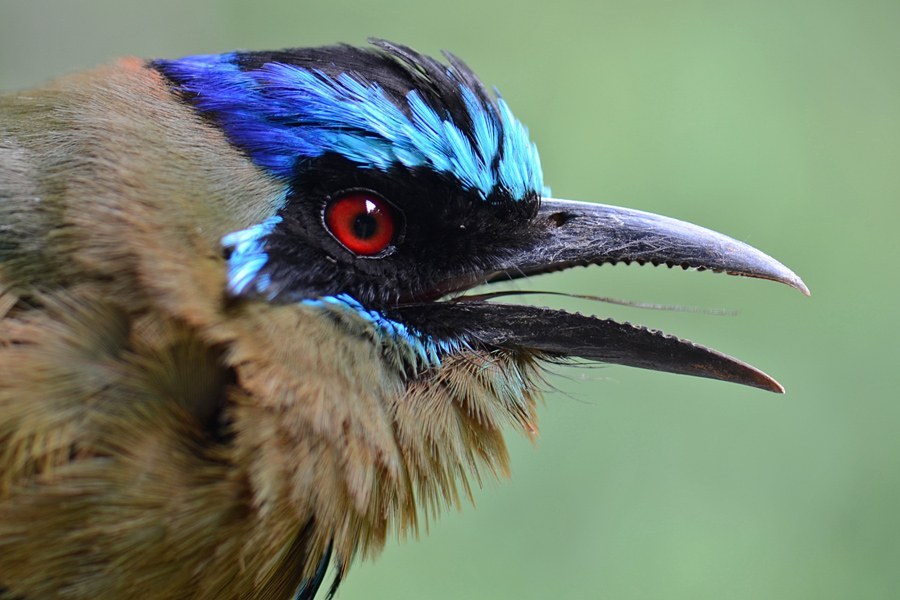
What Blue-crowned Motmot's Feathers Look Like
Blue-crowned Motmot is best known for its long, pendulum tail, and its feathers show several unmistakable features. Crown feathers form a cap of vivid turquoise-blue bordered by black, sharply set off from the rest of the head. Body feathers are a soft olive-green to turquoise-green, becoming more rufous or cinnamon on the belly in many populations, with a black facial mask (a stripe of black feathers through the eye) bordered by thin blue lines above and below. But the single most diagnostic feather is the central tail feather: it is unusually long, with a bare length of shaft near the tip (the barbs are weakly attached and fall away with wear and preening) ending in a small racket-shaped paddle of blue-black barbs — a structure found in very few bird families worldwide. Flight feathers are green above, more olive-brown below, moderately broad and rounded.
Step-by-Step: Is This Feather From a Blue-crowned Motmot?
- Look first for the racket-tipped tail feather. A long shaft that's bare in the middle and ends in a small blue-black paddle is essentially unmistakable and, if present, confirms a motmot immediately.
- Check crown color: bright turquoise-blue bordered in black is diagnostic for this species among motmots in most of its range.
- Note the black facial mask with thin blue overlining, visible on face feathers.
- Confirm green-to-turquoise body tone, richer and more saturated than a typical green songbird.
- Measure the tail feather — motmot tails are notably long relative to body size, often 20+ cm for the central pair.
Similar Species & How to Tell Them Apart
Other motmot species (e.g., Turquoise-browed Motmot, Whooping Motmot) also show racket tails, so range and crown color matter: Turquoise-browed Motmot has a rufous crown and turquoise brow line rather than an all-turquoise cap, and a more slender racket. Green parrots and green trogons found in the same forests lack the racket tail entirely and show different feather shapes (parrots have stiffer, more uniform feathers; trogons have softer, looser body feathers with distinct barred tails). Once a racket-tipped tail feather is found, the crown color and facial mask border pattern are usually enough to confirm Blue-crowned Motmot specifically over its regional relatives.
Where & When You'll Find Them
Blue-crowned Motmot inhabits forest edge, woodland, plantations, and gardens from Mexico south through Central America into northern South America, generally perching low and quietly along shaded understory. Feathers, especially the distinctive tail rackets, are often found near nest burrows dug into earthen banks or under favored low perches where the bird habitually sits and swings its tail. Because the racket shape actually results from the weakly attached barbs wearing away through normal preening and use (not true molt shedding of a special structure), worn or damaged racket feathers can be found on the ground at almost any time of year, with a modest increase after the breeding season when adults undergo their main molt.
Frequently asked questions
What is the single best clue to identify this species from a feather?
A long tail feather with a bare section of shaft near the tip ending in a small blue-black racket-shaped paddle — a structure unique to motmots.
How does the crown color help narrow it down?
Blue-crowned Motmot has an all-turquoise crown bordered in black, distinguishing it from relatives like Turquoise-browed Motmot, which has a rufous crown.
Does the racket tail form through molt or through wear?
Through wear — the barbs near the tip are weakly attached and fall away with normal preening and use, leaving the bare shaft and paddle shape.
What does the body plumage look like away from the crown?
Olive-green to turquoise-green overall, often becoming more rufous or cinnamon on the belly, with a black facial mask bordered by thin blue lines.
Where should I look for shed feathers?
Near earthen bank nest burrows or beneath the low, shaded perches this species favors in forest edge and garden habitat from Mexico to northern South America.