
How to Identify Bluethroat Feathers
Learn to recognize the small, warm-brown body feathers and plain wings of the Bluethroat, a secretive ground-loving chat with a famous throat patch that rarely appears in a found feather.
Read the full Bluethroat encyclopedia entry →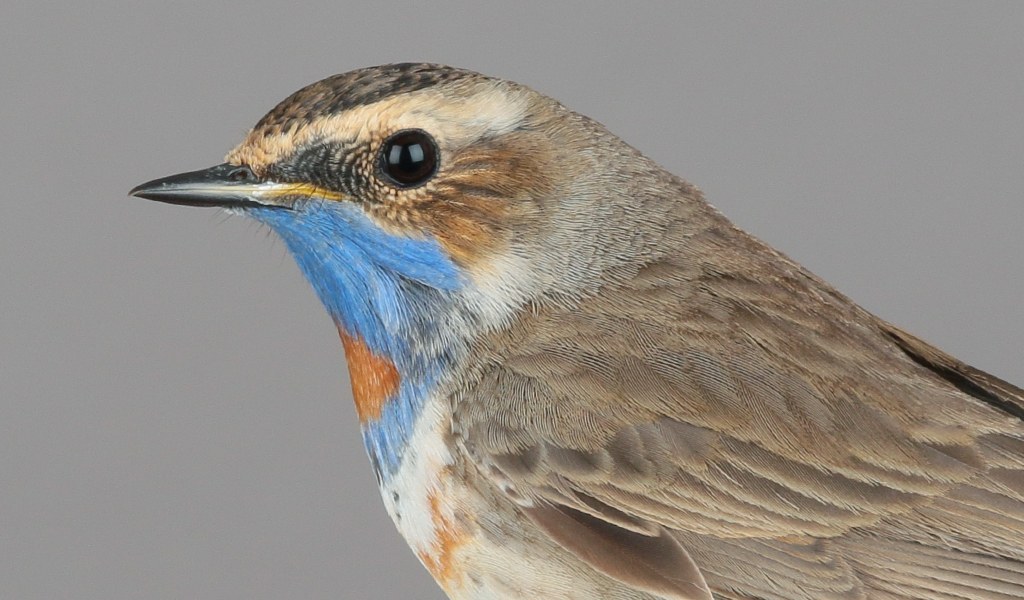
What Bluethroat Feathers Look Like
The Bluethroat is a small chat-like songbird (about 14 cm long), and nearly every feather you find from one will be modest and earth-toned rather than blue. The famous sky-blue-and-orange throat patch is made of small, dense contour feathers confined to the upper chest, so unless you find one of these directly it is easy to overlook the species entirely.
- Body/contour feathers: warm brown to olive-brown above, buffy-white to pale orange below, usually under 2 cm long, soft and rounded.
- Throat patch feathers (males, breeding): brilliant cobalt-blue bases with a chestnut or white central spot, bordered below by black and rufous bands — extremely distinctive if you find one, but tiny (often under 1 cm).
- Flight feathers (primaries/secondaries): plain dark brown with narrow paler brown edges, 4-6 cm long, no bold wing bars or white patches.
- Tail feathers: the single best clue on this species — dark brown with bold rufous-orange bases at the root of each tail feather, visible as an orange flash when the tail is spread. This orange base is retained even on a single shed tail feather.
- Shaft color: pale brown to whitish, unremarkable.
Step-by-Step: Is This Feather From a Bluethroat?
- Measure it. Body feathers under 2 cm and flight feathers under 6-7 cm point to a small songbird in Bluethroat's size class, not a thrush or shrike.
- Check for a rufous-orange base. If it's a tail feather, look for orange coloring at the base transitioning to dark brown at the tip — this is the most reliable Bluethroat field mark on a loose feather.
- Look for blue. If the feather has any blue, especially with a chestnut or white spot, it almost certainly came from a breeding-plumage male's throat.
- Rule out bold patterning. Bluethroat lacks wing bars, eye rings made of feathers, or spotting on the breast feathers (unlike young thrushes), so heavily marked feathers point elsewhere.
- Consider the setting. Feathers found in dense waterside scrub, reedbeds, or willow thickets near the ground fit Bluethroat's skulking habits.
Similar Species & How to Tell Them Apart
- Robin (European Robin): has an all-orange breast rather than blue-and-orange, and lacks the rufous tail base.
- Whinchat/Stonechat: both show more contrasting head patterns and lack the orange tail-base flash; Stonechat has darker, blacker head feathers.
- Nightingale: larger, with a warmer rufous overall tone and an entirely rufous tail (not just the base), and no blue ever appears.
- Female/juvenile Bluethroats: lack blue but still show the diagnostic rufous tail-feather bases, which separates them from similar brown chats.
Where & When You'll Find Them
Bluethroats breed across northern and central Eurasia and Alaska in wet scrub, willow thickets, reedbeds, and tundra edges, then migrate to Africa or South Asia for winter. Feathers are most likely to turn up on breeding grounds in early summer during the post-breeding molt, or in wintering wetlands and reedy ditches during the non-breeding season. Because the species is ground-dwelling and secretive, feathers are often found low in dense vegetation rather than in open areas.
Frequently asked questions
Why doesn't my feather have any blue on it?
Most Bluethroat feathers are plain brown — the blue is restricted to a small throat patch on breeding males, so a random contour or flight feather will look like an unremarkable brown songbird feather.
What is the single best clue for identifying a Bluethroat feather?
A rufous-orange base on an otherwise dark brown tail feather is the most reliable and species-typical mark, present in both sexes and most ages.
Could a brown Bluethroat feather be mistaken for a sparrow's?
Yes, plain brown contour feathers overlap with many small songbirds; check tail feathers for the orange base and consider habitat (wet scrub) to narrow it down.
Do female Bluethroats show any blue in their feathers?
Females typically show little or no blue and a duller throat, but they still usually retain the diagnostic rufous tail-feather bases.