
How to Identify Broad-billed Hummingbird Feathers
Learn the vivid emerald-green body feathers and deeply forked, blue-black tail feathers that identify a Broad-billed Hummingbird among the many small nectar-feeders of the southwestern deserts.
Read the full Broad-billed Hummingbird encyclopedia entry →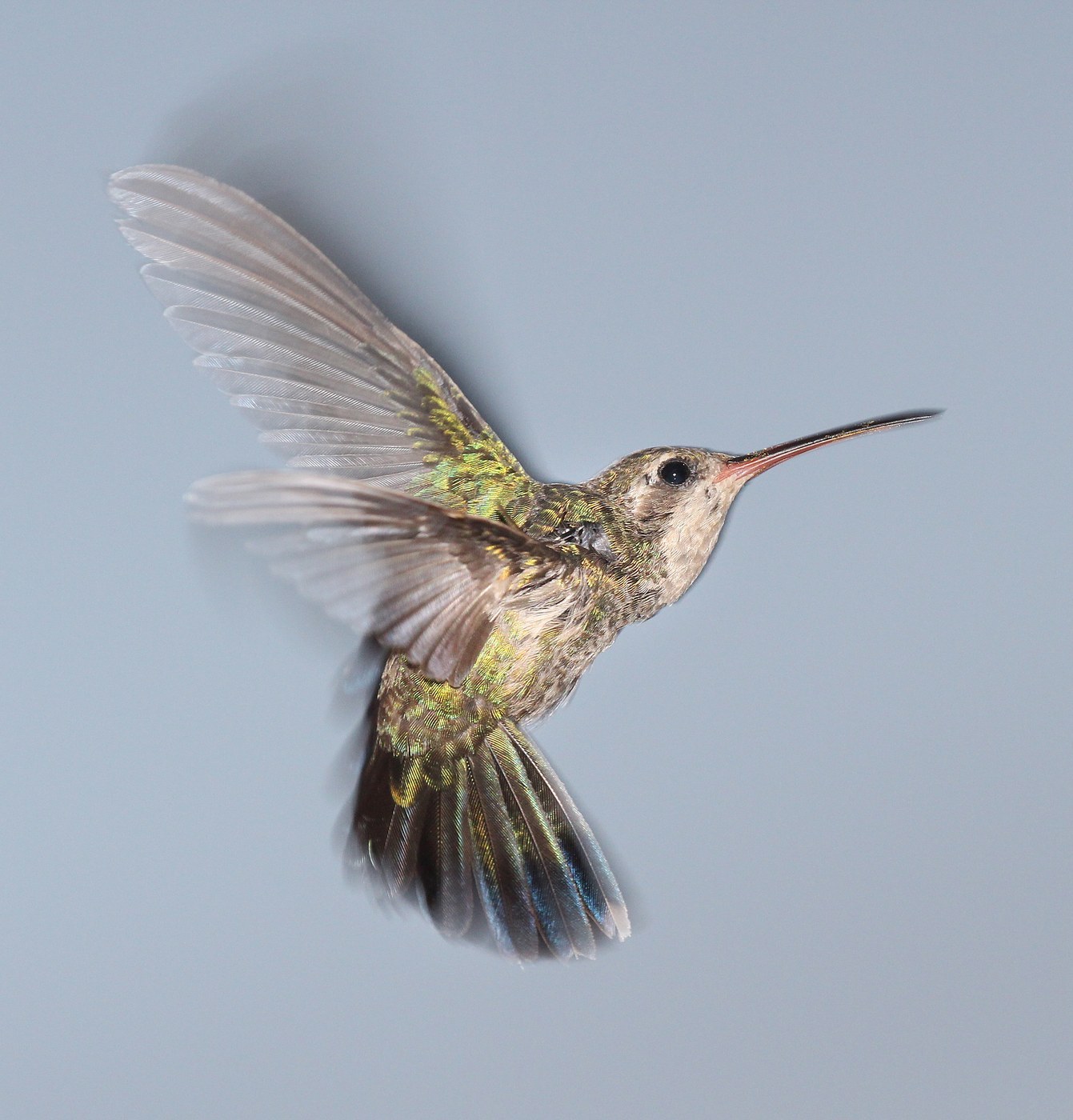
What Broad-billed Hummingbird Feathers Look Like
The Broad-billed Hummingbird is a small, vividly colored hummingbird of the US-Mexico borderlands, and its feathers show the intense, shifting iridescence typical of hummingbirds, with a few distinctive features of its own.
- Body/contour feathers: bright, glittering emerald to grass-green across the back and crown, tiny (under 1 cm), with the metallic, scale-like sheen typical of hummingbirds that shifts from green to gold depending on light angle.
- Throat (gorget) feathers (male): brilliant sapphire-blue to blue-violet, small and intensely iridescent — flashing blue or appearing dark/blackish depending on viewing angle, a classic hummingbird gorget feather.
- Underpart feathers: grayish to pale green, less saturated than the back, transitioning gradually and without bold contrast.
- Tail feathers: notably long and deeply forked for a hummingbird (a distinctive shape trait of this species), blue-black to blackish with a bronzy-green sheen at the base — the deep fork shape is a useful diagnostic if a full or partial tail is found.
- Flight feathers (primaries): tiny (2-3 cm), dark blackish-brown, narrow and stiff.
- Female/juvenile feathers: duller green above and paler grayish below, lacking the blue gorget, with a less deeply forked tail than adult males.
- Shaft color: dark brown to blackish.
Step-by-Step: Is This Feather From a Broad-billed Hummingbird?
- Check for a blue (not red, pink, or orange) gorget feather. A brilliant sapphire-blue throat feather is a strong clue for this species, since many other regional hummingbirds show red, magenta, or orange-red gorgets instead.
- Assess tail feather shape. A deeply forked tail feather, longer and more V-shaped than typical for a hummingbird this size, supports this species specifically.
- Look at overall body color. Bright emerald-green on the back with a grayer, less saturated underside fits Broad-billed Hummingbird's typical coloring.
- Measure size. All feathers should be tiny, consistent with a small hummingbird (body feathers under 1 cm, flight feathers 2-3 cm).
- Match to desert riparian habitat. Feathers found near desert streams, canyons, or shaded washes in the southwestern US (especially Arizona) and Mexico fit this species' preferred habitat.
Similar Species & How to Tell Them Apart
- Broad-tailed Hummingbird: despite the similar name, shows a rose-red (not blue) gorget in males and a much less deeply forked tail; the two are easily separated by both gorget color and tail shape.
- Black-chinned Hummingbird: shows a purple (not blue) band below a black throat and a shallowly notched (not deeply forked) tail, plus generally duller green upperparts.
- Violet-crowned Hummingbird: has a violet-blue crown but a plain white throat and underparts, quite different from Broad-billed Hummingbird's blue throat and greener body.
- Anna's Hummingbird: shows a rose-pink to magenta gorget and crown (in males), a very different color from the sapphire-blue of Broad-billed Hummingbird.
Where & When You'll Find Them
Broad-billed Hummingbirds breed in desert canyons, riparian washes, and shaded streamside vegetation across the southwestern US borderlands (especially southeastern Arizona) and much of Mexico, with northern populations migrating short distances south for winter while Mexican populations remain largely resident. Feathers are most likely found near desert streams and canyon bottoms during the breeding season (spring through summer), with additional feather turnover during the late-summer molt before migration. Look near flowering agave, ocotillo, or other nectar sources in canyon and streamside habitat.
Frequently asked questions
What color is the throat feather, and why does it matter?
A brilliant sapphire-blue, which helps separate this species from many similar hummingbirds that show red, magenta, or orange-red throats instead.
How is the tail different from other hummingbirds?
It's notably long and deeply forked — more V-shaped than the tails of most similarly sized hummingbirds, which tend to be shorter and only shallowly notched.
How do I tell this apart from a Black-chinned Hummingbird feather?
Black-chinned Hummingbird shows a purple (not blue) throat band below a black chin, and its tail is only shallowly notched rather than deeply forked.
Where should I look for these feathers?
Desert canyons, washes, and streamside vegetation in the southwestern US borderlands (especially Arizona) and Mexico, particularly near flowering plants during the breeding season.