
How to Identify Cedar Waxwing Feathers
A practical guide to Cedar Waxwing feathers, from the silky cinnamon-brown body to the diagnostic yellow tail band and red waxy wingtips.
Read the full Cedar Waxwing encyclopedia entry →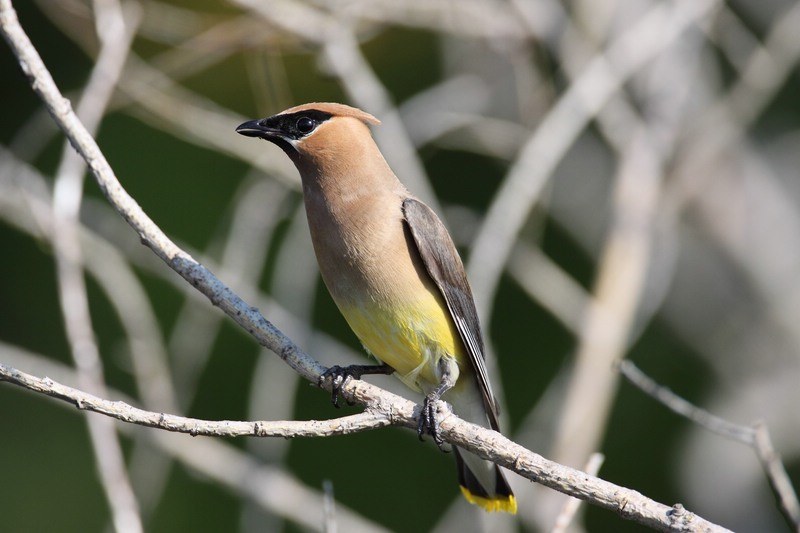
What Cedar Waxwing's Feathers Look Like
Cedar Waxwing has some of the most distinctive feathers of any North American songbird. Body contour feathers are silky and soft, colored a warm cinnamon-brown on the head and chest that fades to soft gray on the back and pale yellow on the belly — a smooth gradient rather than sharp color blocks. The tail feathers are gray-brown with a bright yellow band across the tip, usually 2–4 mm wide, which is one of the clearest diagnostic features available even from a single molted tail feather. Some secondary flight feathers bear small, waxy, red teardrop-shaped tips — the "wax" that gives the species its name — though not every bird or every feather shows them. Primaries are plain gray-brown without waxy tips. Undertail coverts are soft pale yellow to whitish.
Step-by-Step: Is This Feather From a Cedar Waxwing?
- Check tail feathers first. A gray-brown tail feather with a crisp yellow tip is the single best diagnostic clue for this species.
- Feel the texture. Cedar Waxwing feathers are notably soft and silky compared to most songbirds.
- Look for red wax tips. If present on a secondary feather, a small red, plastic-like droplet at the tip all but confirms a waxwing.
- Check color gradient. Cinnamon-brown fading smoothly into gray and pale yellow, with no sharp streaking or barring, matches this species.
- Note the undertail color. Pale yellow to white undertail coverts support Cedar Waxwing over its larger relative.
- Rule out barring or streaks. Waxwing feathers are smooth and unmarked; streaked feathers belong to a different bird.
Similar Species & How to Tell Them Apart
- Bohemian Waxwing is the main look-alike, but it is larger and grayer overall with chestnut (rufous) undertail coverts instead of Cedar Waxwing's pale yellow, and it shows bold white and yellow patches on the primary flight feathers that Cedar Waxwing lacks — Cedar Waxwing's wings are comparatively plain.
- The yellow tail tip is shared by both waxwing species, so use undertail color and wing patterning to separate them, not the tail alone.
- No other North American songbird combines silky cinnamon-gray-yellow body feathers with a yellow-tipped tail, so once you rule out Bohemian Waxwing you can be confident in the ID.
Where & When You'll Find Them
Cedar Waxwings favor open woodlands, orchards, and forest edges, moving nomadically in flocks to follow fruiting trees and shrubs — their range and timing can be unpredictable because they go wherever the berries are. Feathers are most likely encountered near berry-heavy trees (cedar, hawthorn, mountain ash, crabapple) where flocks feed in fall and winter. The complete post-breeding molt happens in late summer, typically July through August, after nesting, so fresh feathers turn up most often in late summer and into the fall feeding season.
Frequently asked questions
What's the single most reliable Cedar Waxwing feather clue?
A tail feather with a bright yellow band across the tip — this is present on nearly every individual and is rarely matched by other songbirds except Bohemian Waxwing.
Do all Cedar Waxwing feathers have red wax tips?
No. The red waxy tips only occur on some secondary feathers and not every individual bird develops them, so their absence doesn't rule out the species.
How do I tell a Cedar Waxwing tail feather from a Bohemian Waxwing tail feather?
The yellow tip looks similar on both, so check the undertail coverts instead: pale yellow means Cedar Waxwing, rich chestnut means Bohemian Waxwing.
Are Cedar Waxwing feathers stiff or soft?
Distinctly soft and silky, unlike the stiffer feathers of many similarly sized songbirds.
When are Cedar Waxwing feathers easiest to find?
Late summer through fall, near fruiting trees where flocks gather to feed, coinciding with their post-breeding molt.
Cedar Waxwing identified by the community
Recent Cedar Waxwing feathers identified with Feather Identifier.


