
How to Identify Chestnut-fronted Macaw Feathers
A guide to identifying Chestnut-fronted (Severe) Macaw feathers by the maroon forehead patch and reddish underwing on an otherwise green body.
Read the full Chestnut-fronted Macaw encyclopedia entry →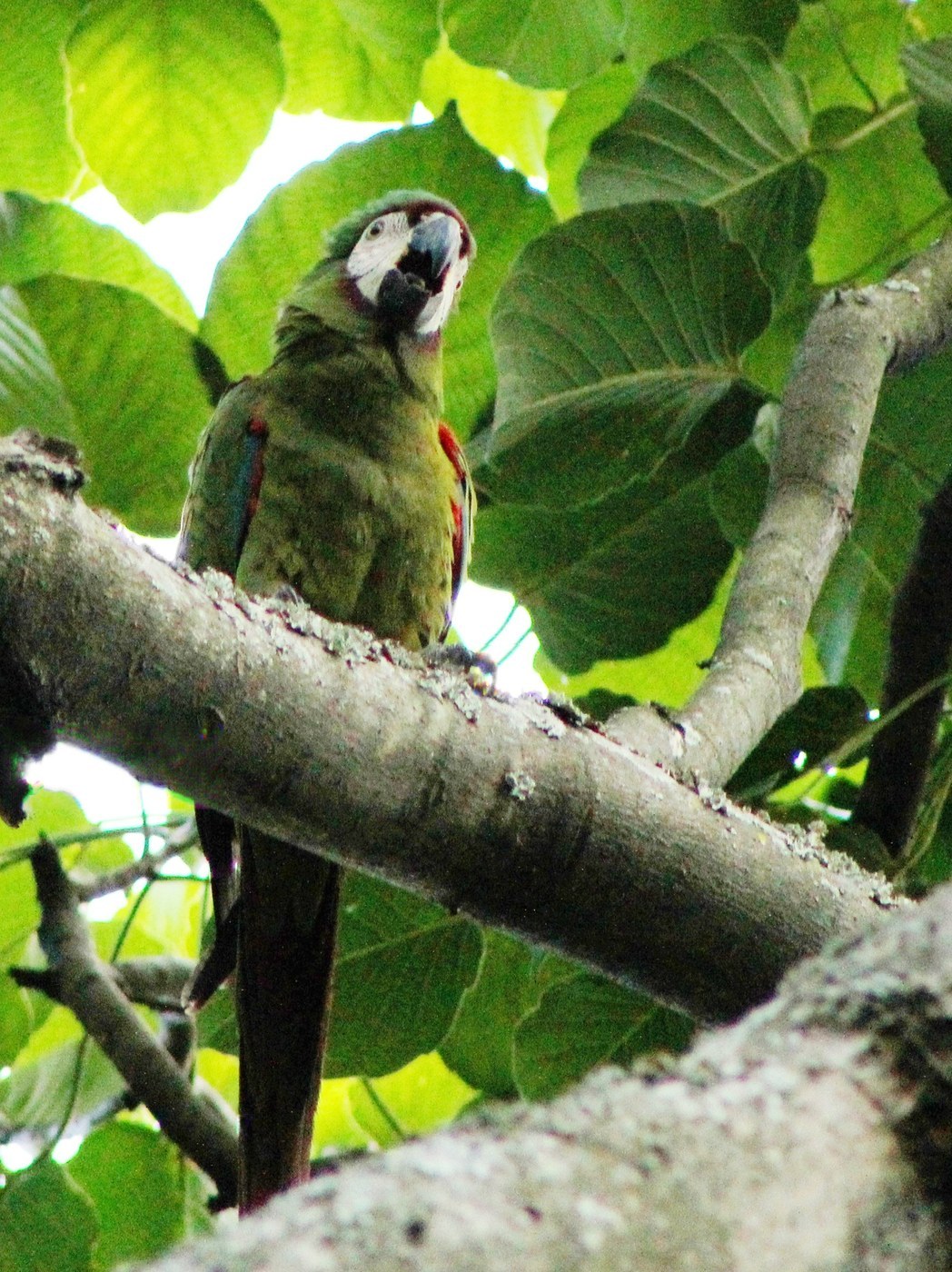
What Chestnut-fronted Macaw's Feathers Look Like
Chestnut-fronted Macaw (also called Severe Macaw) is a smallish macaw whose defining feature is right in its name: a chestnut-brown to maroon forehead patch, contrasting with an otherwise green body. Body contour feathers are a rich, even green throughout the back, wings, and underparts. The primary flight feathers show blue tones, visible mainly in flight or on a spread wing. The underwing coverts and bend-of-wing feathers are reddish-orange, a useful supporting clue when a feather from that area is found. Tail feathers are long and green, often tipped with blue and red toward the end. The bare facial skin is whitish with thin lines of small feathers crossing it — a much less fully feathered face than in larger macaws, though that's about skin exposure rather than the feathers themselves.
Step-by-Step: Is This Feather From a Chestnut-fronted Macaw?
- Check the forehead region first. A chestnut/maroon-brown feather, distinctly different from the green body color, from the forehead area is the most diagnostic clue.
- Assess overall body color. Even green contour feathers throughout the back and underparts support this species.
- Look at flight feathers. Blue-toned primaries support macaw identification generally; combine with the chestnut forehead for this species specifically.
- Check underwing/wing-bend feathers. Reddish-orange coloring here is a useful supporting sign.
- Measure size. Moderate size for a macaw — smaller than the large blue-and-gold or scarlet macaws, but larger than a typical parrot.
- Consider range. Central American to South American lowland forest and edge habitat, from Panama through Brazil and Bolivia, supports this species.
Similar Species & How to Tell Them Apart
- Red-shouldered Macaw is smaller still and shows a much less pronounced forehead patch, with the forehead closer to the same green as the rest of the head rather than a bold chestnut block — the strength of the forehead color contrast is the key separator.
- Military Macaw is considerably larger and shows a red forehead (not chestnut-brown) along with more extensive blue in the plumage — size and forehead hue both help rule it out.
- The specific combination of small-to-medium macaw size + chestnut/maroon forehead + green body + reddish underwing is diagnostic for Chestnut-fronted Macaw.
Where & When You'll Find Them
Chestnut-fronted Macaw ranges widely through Central and South American lowland forest and forest edge, from Panama south through Colombia, Venezuela, Brazil, and Bolivia. As a tropical, non-migratory resident, it molts gradually and continuously throughout the year, with feathers most likely found near nest cavities in large trees or beneath fruiting/feeding trees in forest edge habitat.
Frequently asked questions
What's the single best clue for a Chestnut-fronted Macaw feather?
A chestnut or maroon-brown forehead feather contrasting sharply with the otherwise green body plumage.
How do I rule out Military Macaw?
Military Macaw is considerably larger and has a red forehead patch, not chestnut-brown, plus more extensive blue in its plumage.
What about Red-shouldered Macaw?
It's smaller and its forehead is much less strongly contrasted — closer to the green of the rest of the head rather than a bold chestnut block.
Are there other color clues besides the forehead?
Yes, reddish-orange underwing coverts and blue-toned primary flight feathers support the identification.
When and where should I look for these feathers?
Year-round, since molt is gradual for this tropical resident, in lowland forest and edge habitat from Panama through Brazil and Bolivia.