
How to Identify Cockatiel Feathers
Identify a Cockatiel feather by its distinctive long, tapering erectile crest, bold white wing patch, and orange-red cheek spot — while keeping in mind that captive color mutations can look very different from the wild gray form.
Read the full Cockatiel encyclopedia entry →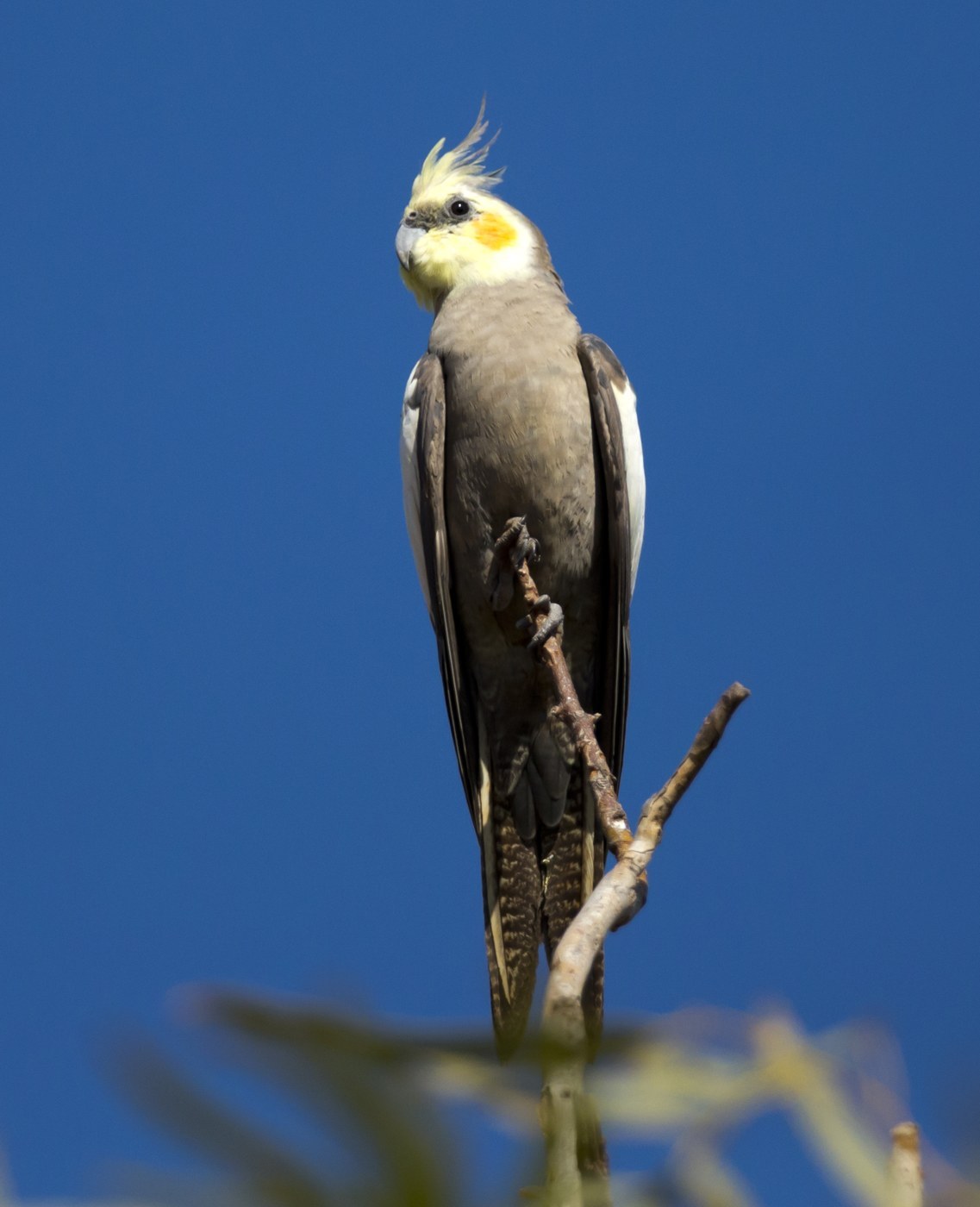
What Cockatiel Feathers Look Like
Cockatiels are small, crested parrots native to Australia but also one of the world's most popular pet birds, so a feather could come from a wild Australian bird or an escaped/released pet almost anywhere. In the wild-type ("normal gray") color form, the body is an overall soft gray, with males showing a bright yellow face and crest and both sexes showing a round orange-red cheek patch.
The single most distinctive feather type is the crest feather: long, narrow, and tapering to a point, capable of being raised or lowered — a shape unlike the rounded contour feathers of most small parrots. Another strong clue is the bold white patch on the wing coverts, a large, clean white panel that shows up in nearly all color varieties, even mutations. Tail feathers are long and tapering, gray with faint yellow barring visible on the underside in females.
Because Cockatiels are bred in many color mutations — lutino (all pale yellow/white), pied, white-faced, cinnamon, and more — a feather that doesn't match the "normal gray" description isn't necessarily a different species; it may simply be a captive-bred color morph.
Step-by-Step: Is This Feather From a Cockatiel?
- Look for a crest feather: long, narrow, and tapering to a point, able to erect — a shape essentially unique among small parrots you'd commonly encounter.
- Check for the white wing patch: a bold, clean white panel on the wing coverts persists across most color mutations, making it a reliable clue even on unusually colored feathers.
- Look for an orange-red cheek patch feather: round and rosy-orange, present in both sexes though brighter in males.
- Consider the setting: found outdoors in Australia points to a wild bird; found elsewhere in the world, it's very likely an escaped or released pet.
- Keep mutations in mind: an all-white or all-yellow feather doesn't rule out Cockatiel if the white wing patch and crest shape are still present.
Similar Species & How to Tell Them Apart
- Galah and other cockatoos: have a different crest shape (broader, more rounded rather than a single tapering point) and pink/gray or white coloring without Cockatiel's bold white wing patch.
- Budgerigar: much smaller, has no crest at all, and shows fine barring across the back and wings — easily distinguished by size and the total absence of a crest.
- Cockatiel color mutations vs. other species: if a crest-shaped feather and white wing patch are both present, it's very likely a Cockatiel regardless of unusual overall color, since few other commonly kept parrots combine both features.
Where & When You'll Find Them
In the wild, Cockatiels are nomadic birds of arid and semi-arid scrub and grassland across inland Australia, following rainfall and seed availability rather than a fixed migration schedule. As a widely kept pet species, however, feathers may be found virtually anywhere in the world near homes, aviaries, or areas where birds have escaped. Wild Australian birds molt primarily after breeding, tied to rainfall-driven breeding seasons, while captive birds tend to molt gradually and continuously year-round rather than on a strict seasonal cycle.
Frequently asked questions
I found an all-white or all-yellow feather with a crest shape — is this still a Cockatiel?
Very likely yes. Captive Cockatiels come in many color mutations (lutino, pied, white-faced, and more), but the tapering crest feather shape and the bold white wing patch usually persist across these varieties.
How can I tell if a Cockatiel feather came from a wild bird or an escaped pet?
Location is the best clue — a feather found in inland Australian scrub or grassland is likely from a wild bird, while one found anywhere else in the world (a park, backyard, or city) is almost certainly from an escaped or released pet.
What's the easiest way to distinguish a Cockatiel feather from a Budgerigar's?
Cockatiels are noticeably larger with a distinctive tapering crest feather, while Budgerigars are much smaller, lack a crest entirely, and show fine barring across the back and wings.
Does the orange-red cheek patch appear on both males and females?
Yes, though it's typically brighter and more vivid on males; females and juveniles usually show a more muted, duller version of the same cheek patch.
Cockatiel identified by the community
Recent Cockatiel feathers identified with Feather Identifier.


