
How to Identify Common Blackbird Feathers
A guide to recognizing the smooth, jet-black or dark brown feathers of this familiar Eurasian thrush and telling them apart from crows and starlings.
Read the full Common Blackbird encyclopedia entry →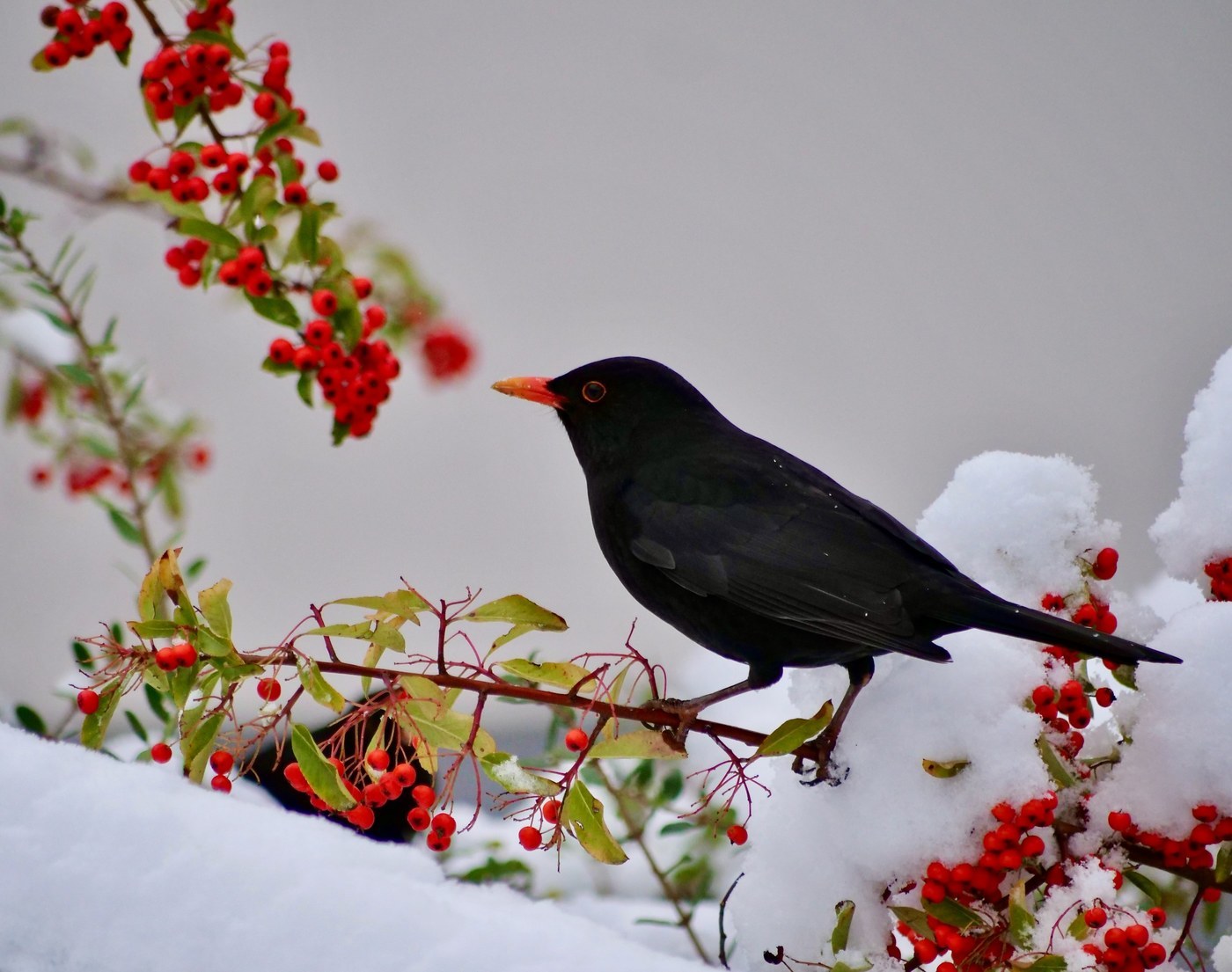
What Common Blackbird's Feathers Look Like
The Common Blackbird is a familiar garden thrush across Europe, western Asia, and parts of Australia, and its feathers reflect a bird built for hopping through leaf litter and low shrubs rather than soaring. Male body feathers are uniformly glossy black with a subtle sheen in good light, smooth and slightly rounded rather than iridescent or patterned. Females and juveniles are quite different — sooty dark brown overall, often with faint mottling or spotting on the throat and breast, closer to a warm chocolate-brown than true black.
Flight feathers (primaries and secondaries) are a plain matte blackish-brown, without barring, spotting, or wing bars of any kind — a useful negative clue, since many similarly sized birds show at least some wing pattern. The tail is of moderate length and slightly rounded at the tip, uniform blackish-brown with no white edges or bands. Feather texture is soft and slightly loose compared to a starling's tighter, glossier plumage, and the shafts are dark brown to blackish along their whole length, not pale as in many songbirds.
Step-by-Step: Is This Feather From a Common Blackbird?
- Measure it. Flight feathers run about 9–13 cm and tail feathers 10–13 cm — solidly thrush-sized, smaller than a crow feather but larger than a sparrow's.
- Check for pattern (or lack of it). Completely plain black or plain dark brown, with no spots, bars, or pale edges, points strongly toward this species.
- Assess the gloss. A male's feather should show a soft, even sheen rather than strong iridescent blues, greens, or purples.
- Look at brown feathers carefully. A dark chocolate-brown feather with faint, diffuse mottling (not bold streaks) likely came from a female or juvenile rather than an adult male.
- Feel the texture. Soft, slightly loose barbs rather than a stiff, glossy surface fit a thrush rather than a starling or crow.
- Consider the source. A feather found on a lawn, under a hedge, or near garden shrubbery fits this species' ground-foraging habits better than a woodland-canopy or open-field origin.
Similar Species & How to Tell Them Apart
The Common Starling is a frequent source of confusion since both are dark garden birds, but starling feathers show obvious iridescent green-purple sheen and, outside breeding season, pale spangled tips — features absent on a true blackbird feather. Crows and jackdaws produce much larger, stiffer feathers with stronger iridescence and thicker shafts. Female Blackbirds can be confused with other thrushes like the Song Thrush, but Song Thrush feathers show warm buff tones and bold dark spotting on the underparts, quite different from a Blackbird's diffuse mottling. The introduced Common Myna (where ranges overlap, e.g., parts of Australia) has brown body feathers too, but with a more contrasting pattern and white wing patches, unlike the Blackbird's plain wings.
Where & When You'll Find Them
Common Blackbirds are widespread and often abundant in gardens, parks, woodland edges, and hedgerows throughout their range, foraging on lawns and in leaf litter for much of the day — which is exactly where dropped feathers are most often found. Most populations undergo a complete molt after breeding in mid-to-late summer, so body feathers are especially common on lawns and under shrubs from July through September. Resident populations shed feathers gradually year-round, while more northerly or migratory populations concentrate their molt into this late-summer window before any onward movement.
Frequently asked questions
How can I tell a male from a female Blackbird feather?
Male feathers are essentially uniform glossy black; female and juvenile feathers are dark chocolate-brown, often with faint, diffuse mottling, especially on feathers from the throat and breast.
What separates a Blackbird feather from a starling feather?
Starling feathers show clear iridescent green-purple sheen and, outside the breeding season, pale spotted tips, while Blackbird feathers are plain black or brown with only a soft, even gloss and no spangling.
Why don't Blackbird feathers have any wing bars or spots?
The species' plumage is simply plain overall by design — a useful negative diagnostic, since patterned wing feathers point you toward a different species.
When is the best time of year to find Blackbird feathers?
Late summer, roughly July through September, when most birds undergo their post-breeding molt and shed feathers heavily around gardens and lawns.
Could a dark thrush feather be a Song Thrush instead?
Yes if it shows warm buffy tones with bold, well-defined dark spotting on the underparts — Blackbird mottling is fainter and less crisply patterned than Song Thrush spotting.