
How to Identify Common Pochard Feathers
How to identify the finely vermiculated grey body feathers and chestnut head feathers of the Common Pochard, and separate them from Redhead, Canvasback, and Ferruginous Duck.
Read the full Common Pochard encyclopedia entry →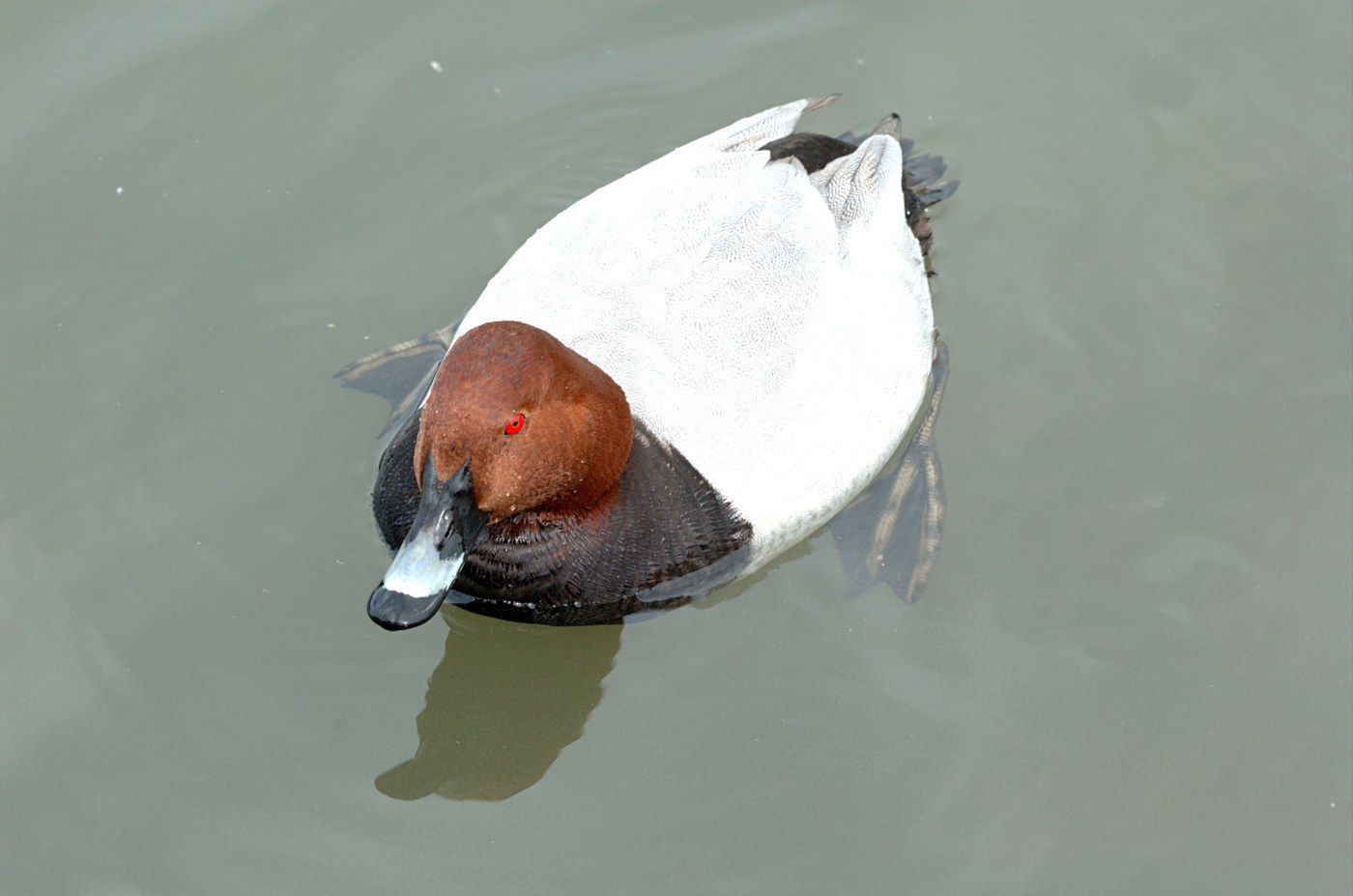
What Common Pochard Feathers Look Like
The Common Pochard is a medium-sized diving duck best known for its males' rounded chestnut-red head. Head feathers on the male are a rich, warm chestnut-red, rounded overall in shape — importantly, Pochard has no crest, so head feathers lie smooth and compact rather than tufted or shaggy. Breast feathers are solid black, contrasting sharply with the chestnut head above and pale body below. Flank and back feathers on the male are the species' real diagnostic feature: they are pale grey with extremely fine, dense dark vermiculations (a fine wavy line pattern), which from a short distance reads as a pale silvery-grey rather than showing obvious barring — up close under magnification, though, the fine wavy dark lines are visible and distinguish it from a plain grey feather.
Flight feathers are a fairly uniform grey with slightly darker tips and lack a bold, brightly colored speculum patch — the wing stripe is subtle grey-on-grey rather than a bright contrasting band, which itself is a useful negative clue (ruling out species with bold wing patches). Female Pochard feathers are a duller version overall: brown head and breast rather than chestnut/black, with paler grey-brown, less crisply vermiculated flank feathers.
Step-by-Step: Is This Feather From a Common Pochard?
- Check the wing for a bold speculum. If the flight feathers are plain greyish without a bright contrasting wing-stripe, that supports Pochard over many other ducks.
- Examine flank/back feather pattern. Very fine, dense dark vermiculations on a pale grey ground, appearing silvery at a glance, is the core Pochard field mark.
- Look at head shape and color. A smoothly rounded (non-crested) chestnut-red head feather indicates an adult male Pochard.
- Check for a black breast. Solid black breast feathers contrasting against the chestnut head and pale grey body support the ID.
- Assess female-type feathers. Duller brown head/breast with less crisp grey vermiculation on the flanks fits a female or eclipse-plumage bird.
- Consider the habitat. Feathers found around lakes, reservoirs, and slow rivers with reedy margins fit Pochard's preferred habitat.
Similar Species & How to Tell Them Apart
Redhead (the North American counterpart) looks similar with a chestnut head and grey body, but its head is rounder still with a steeper forehead and its range doesn't overlap much with Common Pochard, so location is often the deciding factor. Canvasback has a distinctly sloped, wedge-shaped head-and-bill profile (visible even in isolated head feather shape/contour) and a noticeably whiter, less vermiculated body than Pochard. Ferruginous Duck is darker and richer chestnut all over the body (not just the head), shows a white eye in life, and has bold white undertail covert feathers, unlike Pochard's grey body and lack of white undertail contrast.
Where & When You'll Find Them
Common Pochards breed on lakes, ponds, and slow rivers with abundant reed cover across temperate Europe and Asia, and winter in large numbers on lakes, reservoirs, and sheltered estuaries further south and west. They are one of many diving ducks that undergo a flightless wing molt on large, undisturbed waterbodies in late summer, when the birds gather in significant numbers and shed all flight feathers simultaneously — this period, plus the general autumn-to-spring wintering season on open water, is when Pochard feathers are most likely to be found along lake and reservoir shorelines.
Frequently asked questions
What is the single best clue to identify a Common Pochard flank feather?
Look for very fine, dense dark vermiculations on a pale grey background that appear silvery-grey from a distance but show a wavy fine-line pattern up close — this is the species' core diagnostic feature.
Why doesn't my duck feather have a bright colored wing stripe?
That's expected for Common Pochard. Unlike many ducks, it lacks a bold, brightly colored speculum, showing only a subtle grey-on-grey wing pattern instead.
How do I tell a Common Pochard feather from a Canvasback feather?
Canvasback has a distinctly sloped, wedge-shaped head profile and a whiter body with less vermiculation, whereas Pochard has a smoothly rounded head and finer grey vermiculated flanks.
Is a solid rich chestnut-brown feather (not just the head) still a Pochard?
Probably not — Common Pochard confines its rich chestnut color mainly to the head, with a grey vermiculated body. A body feather that's chestnut all over points more toward Ferruginous Duck.
When are Common Pochard feathers most abundant?
During the species' late-summer flightless wing molt on large lakes and reservoirs, and generally through the autumn-to-spring wintering season on open water.