
How to Identify Common Quail Feathers
A practical guide to the tiny, buff-streaked camouflage feathers of the Common Quail and how to separate them from Japanese Quail and young partridges.
Read the full Common Quail encyclopedia entry →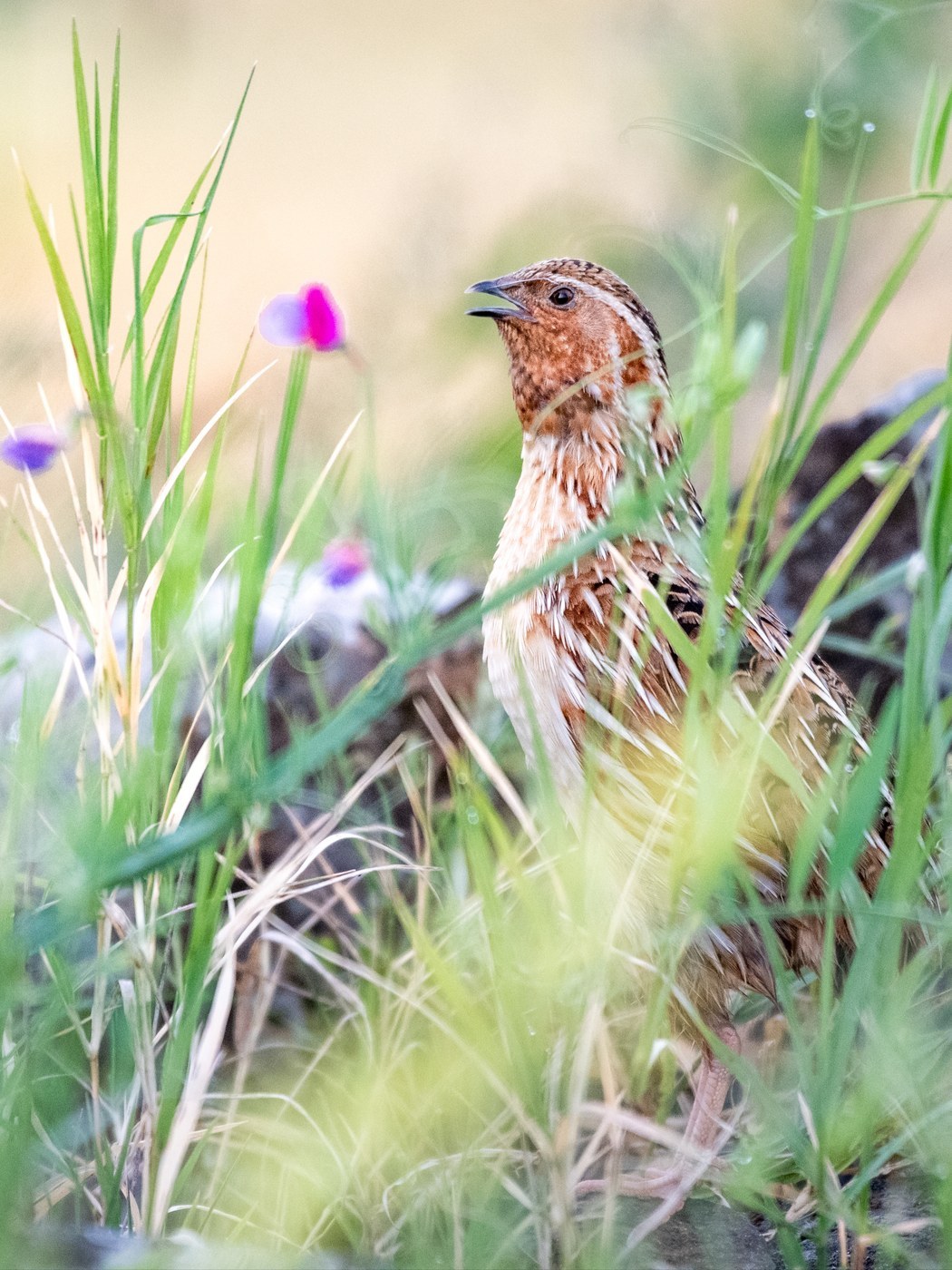
What Common Quail Feathers Look Like
The Common Quail is one of the smallest gamebirds you're likely to encounter feather evidence from, and every feather reflects its life as a secretive, ground-dwelling bird in dense grass and crop fields. Body (contour) feathers are heavily patterned buff, brown, and blackish, with fine pale shaft-streaks running down the center of each feather that create a striped, camouflaged look against dry grass and cereal stems — this streaked-not-barred pattern is a useful first clue, since many similarly sized gamebirds show barring instead. Males show a distinctive blackish, anchor- or Y-shaped marking on the throat, so a small feather with this dark marking against a pale buff background is a strong sign of an adult male quail.
Flight feathers are short and rounded, reflecting the quail's weak, whirring flight style rather than sustained soaring — primaries rarely exceed about 8-9 cm. The tail is very short, often barely visible in the field, and tail feathers are correspondingly tiny, buff-brown with faint dark barring near the tips. Overall, quail feathers are delicate, soft, and small compared to partridges or true pheasants, fitting the bird's compact, rounded body shape.
Step-by-Step: Is This Feather From a Common Quail?
- Check the size first. Very small, delicate feathers (flight feathers under 9 cm) with fine streaking point toward quail rather than a larger gamebird.
- Look at the pattern type. Fine pale shaft-streaks running lengthwise down a buff-brown feather (streaking, not bold barring) support quail.
- Look for a throat marking. A small blackish anchor- or Y-shaped feather patch suggests an adult male quail's throat.
- Assess the tail. Very short, buff-brown tail feathers with only faint barring near the tip fit quail's stubby tail.
- Rule out partridge. If flank feathers show broad chestnut bars or larger overall size, you likely have a partridge, not a quail.
- Consider the habitat and season. Feathers found in open grassland, cereal fields, or steppe, especially in later summer, fit Common Quail's ecology and migration timing.
Similar Species & How to Tell Them Apart
Japanese Quail, now widely farmed and sometimes escaping into the wild, is extremely similar in feather pattern and size to Common Quail, since the two are closely related — reliable separation from feathers alone is difficult, and context (proximity to farms or game-release sites) is often the best clue rather than plumage detail. Young Grey Partridge or Red-legged Partridge chicks can show a superficially similar buff-brown streaked down, but adult partridge flank feathers are notably larger with bold chestnut or black bars rather than fine buff streaking, and partridge tail feathers are longer and more rufous. Button-quails (unrelated to true quail despite the name) show similarly small, cryptic feathers, but typically with even finer, more speckled patterning and different regional distribution.
Where & When You'll Find Them
Common Quail breed in grassland, steppe, and agricultural land — especially cereal and hay fields — across Europe, western Asia, and North Africa. They are unusual among gamebirds in being long-distance migrants, wintering in sub-Saharan Africa and South Asia. Their secretive habits mean feathers are rarely found through direct observation of the living bird; most feather evidence turns up from predation remains or during the pre-migratory molt in late summer, when birds gathering in stubble fields and grassland before their southward journey shed body feathers most heavily.
Frequently asked questions
How small should a Common Quail feather be?
Quite small — flight feathers rarely exceed about 8-9 cm, and body feathers are correspondingly tiny and delicate compared to most other gamebirds.
What does the throat marking on a male quail feather look like?
A distinctive blackish anchor- or Y-shaped patch against pale buff, found on the throat area — a strong sign of an adult male if you find a feather with this marking.
Can I reliably tell a Common Quail feather from a Japanese Quail feather?
Not easily from plumage alone, since the two species are closely related and very similar in feather pattern and size. Location context, such as proximity to farms, is often more useful than the feather itself.
Why does my small streaked feather look different from a partridge feather?
Common Quail feathers show fine pale streaking down the shaft rather than the bold chestnut or black barring typical of adult partridge flank feathers, and quail feathers are notably smaller overall.
When are Common Quail feathers most likely to be found?
In late summer, when quail gather in stubble fields and grassland ahead of their long-distance migration to sub-Saharan Africa or South Asia and undergo their pre-migratory molt.