
How to Identify Common Swift Feathers
A guide to the long, scythe-shaped flight feathers of the aerial Common Swift, and how they differ from swallow and martin feathers.
Read the full Common Swift encyclopedia entry →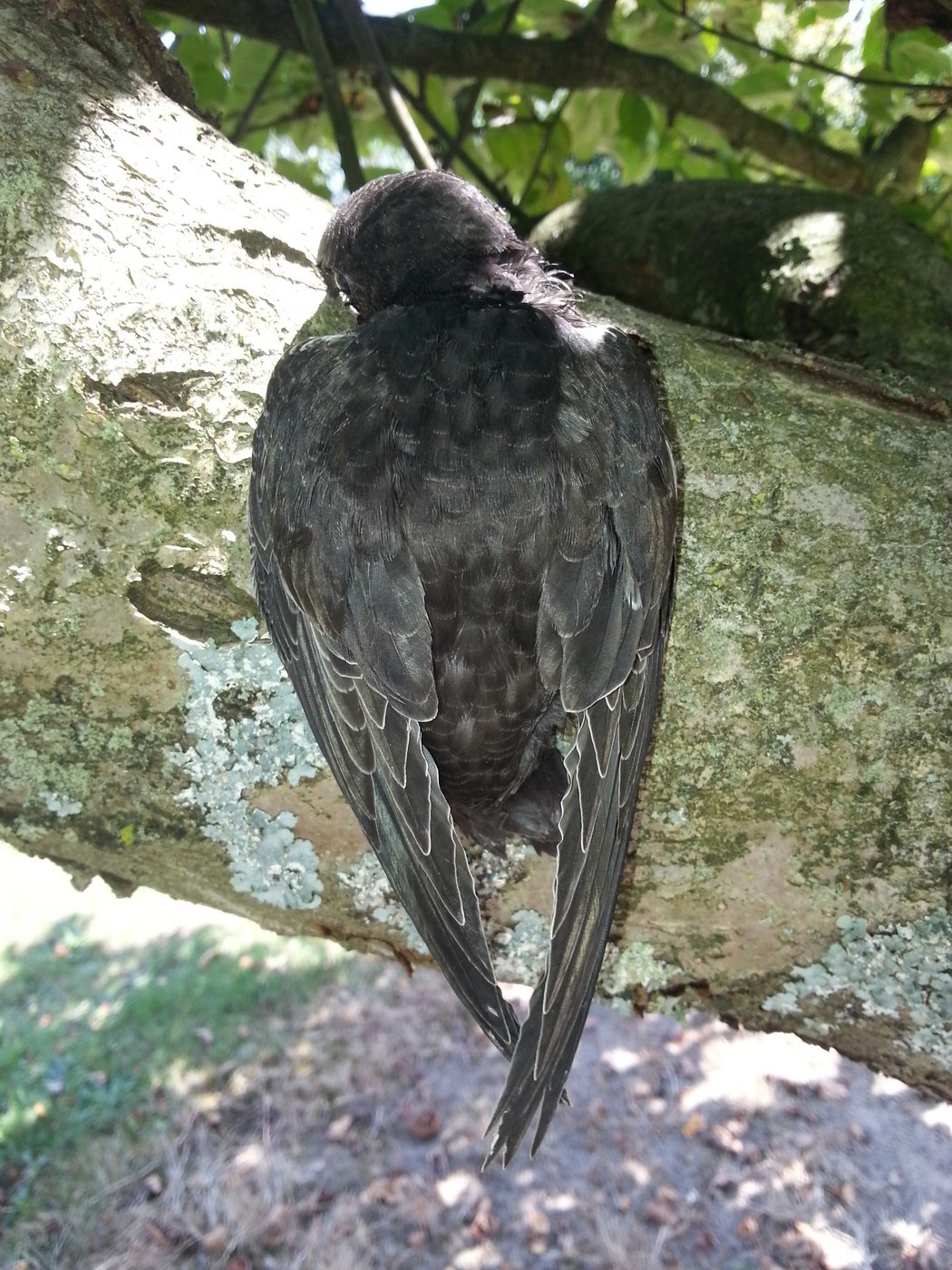
What Common Swift Feathers Look Like
The Common Swift is built for a life spent almost entirely in the air, and its feathers reflect this more than almost any other landbird's. Flight feathers (primaries) are extremely long, narrow, and stiff, curving into a distinctive scythe-like shape — proportionally, these feathers are far longer relative to the bird's small, compact body than in most other songbird-sized species, an adaptation for sustained, high-speed flight since swifts rarely land except at the nest. The stiffness and rigidity of these primaries, combined with their sharply tapering, pointed tips, is one of the clearest single feather clues for this species.
Body feathers are a sooty, dark brown that reads as black at any distance, dense and compact against the small body. A pale, whitish-buff throat patch is present, so a small feather from the throat area may look distinctly paler than the rest of the body's dark plumage. The tail is short and forked, with stiff, pointed tail feathers that, like the wings, are built more for aerodynamic efficiency than display. Overall, swift feathers feel notably rigid for their size compared to a similarly small songbird feather, which is often much softer and more flexible.
Step-by-Step: Is This Feather From a Common Swift?
- Check flight feather proportions. Very long, narrow, stiff primaries relative to what would be a small body size, with a scythe-like curve, strongly suggest swift.
- Feel the rigidity. Flight feathers that are notably stiffer than expected for the bird's small size fit swift's constant-flight adaptation.
- Assess body feather color. Sooty dark brown reading as black, dense and compact, is consistent with swift.
- Look for a pale throat patch. A whitish-buff feather from the throat area against otherwise dark body feathers supports the ID.
- Check tail shape. A short, forked tail with stiff, pointed feathers fits swift, distinct from a softer songbird tail.
- Consider the context. Feathers found near building eaves, church towers, or cliff nest sites in the breeding range fit swift's nesting habits; feathers are otherwise rare finds given how little time swifts spend near the ground.
Similar Species & How to Tell Them Apart
Swallows and martins are not closely related to swifts despite superficially similar aerial lifestyles, and their feathers show real structural differences: swallow and martin flight feathers are comparatively less stiff and less sharply scythe-curved, and their tails are typically more deeply forked, with barn swallows in particular showing elongated outer tail streamers and house martins showing a bold white rump patch — features entirely absent in Common Swift. Pallid Swift, a close relative in parts of the shared range, is paler brown overall with a larger, more extensive pale throat patch, though the difference is subtle and best judged alongside other clues like range and season.
Where & When You'll Find Them
Common Swifts breed across Europe and western Asia, nesting in crevices in buildings, church towers, and cliffs, and undertake a long migration to spend the northern winter in sub-Saharan Africa. Remarkably, swifts spend the vast majority of their lives airborne, even sleeping on the wing, and molt mostly gradually on their African wintering grounds rather than near the breeding range — as a result, fresh flight feathers are rarely found near European breeding sites. Most feather evidence near nest sites instead comes from body feathers shed around nesting crevices, or occasionally from fledglings and nestlings found on the ground.
Frequently asked questions
Why does this flight feather feel unusually stiff for such a small bird?
Common Swifts spend nearly their entire lives in flight, so their primary feathers are unusually long, narrow, and rigid relative to their small body size — a clear adaptation for constant aerial life.
How can I tell a swift feather from a swallow feather?
Swift flight feathers are stiffer and more sharply scythe-curved, while swallow and martin feathers are comparatively softer, and swallows typically show more deeply forked tails with features like elongated streamers that swifts lack.
Why is it rare to find fresh swift flight feathers near their nest sites?
Common Swifts do most of their molting gradually on their African wintering grounds rather than near their European breeding sites, so fresh flight feathers are uncommon finds near nests.
What does the pale patch on a swift's throat feather look like?
A distinctly whitish-buff feather from the throat area, standing out against the otherwise sooty dark brown body plumage.
How is Common Swift different from Pallid Swift in terms of feathers?
Pallid Swift is paler brown overall with a larger, more extensive pale throat patch, though the difference is subtle and best confirmed alongside range and season.