
How to Identify Crested Oropendola Feathers
A guide to identifying the glossy black body feathers and bright yellow outer tail feathers of the Crested Oropendola, and separating them from Montezuma Oropendola and cacique feathers.
Read the full Crested Oropendola encyclopedia entry →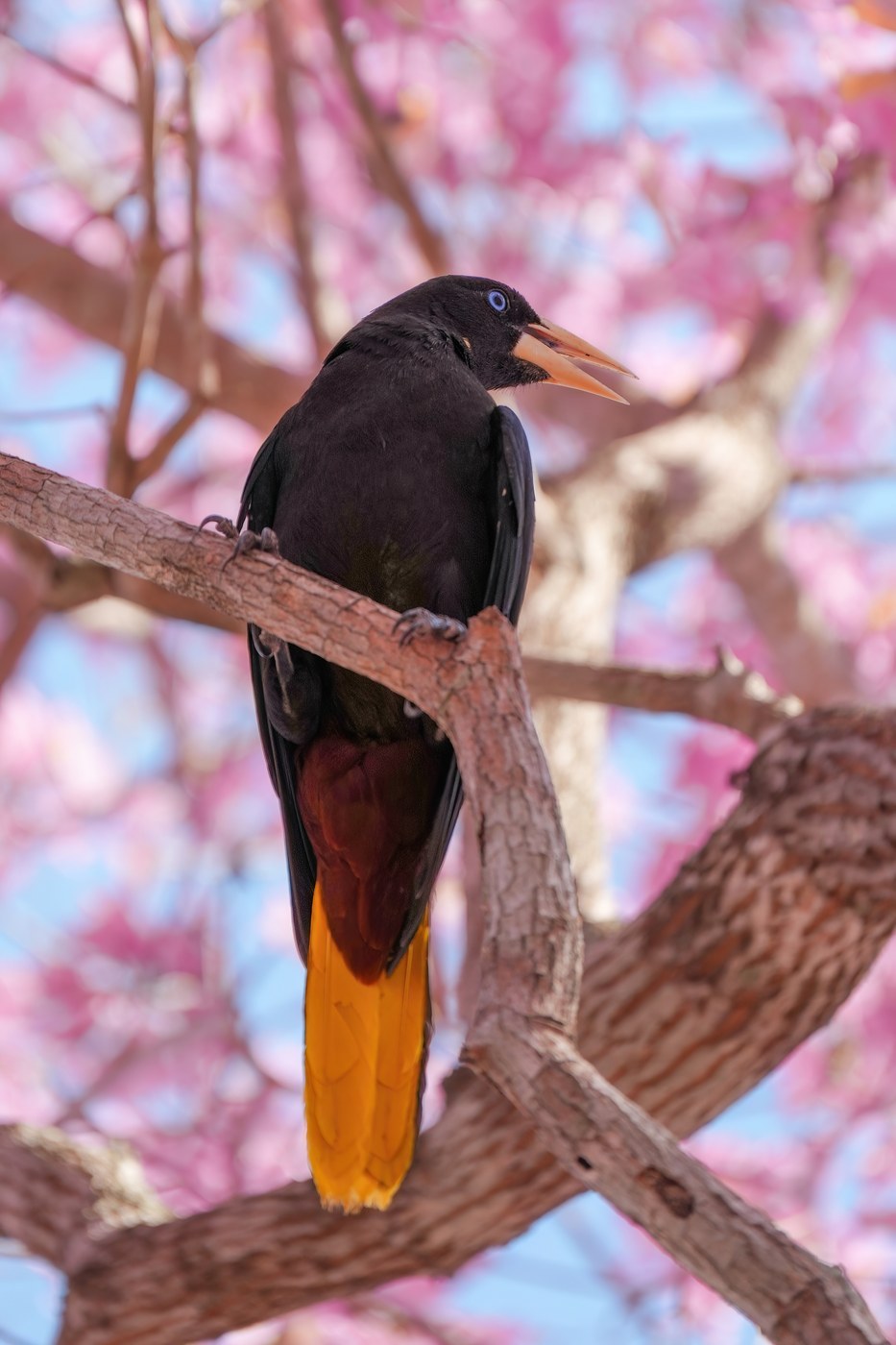
What Crested Oropendola Feathers Look Like
The Crested Oropendola is a large, striking Icterid, and most of its body feathers are a deep, glossy black, with a subtle sheen in good light. The rump and undertail coverts show a contrasting chestnut-maroon wash that breaks up the otherwise uniform black body. The single most useful feather to find is a tail feather: the central pair are black, but the outer tail feathers are a bright, clean yellow, so a two-toned tail feather — black on one side transitioning to vivid yellow — is highly diagnostic for this species.
A small, often hard-to-notice crest of slightly elongated feathers sits on the crown, though it's far less prominent than crests in other groups and easy to miss on a single feather. Males are considerably larger than females, so feather size can vary quite a bit between the sexes even within the same species. Flight feathers are plain glossy black, unremarkable aside from their size in males.
Step-by-Step: Is This Feather From a Crested Oropendola?
- Check for a black-and-yellow tail feather — black centrally, bright yellow on the outer edges/feathers, is the strongest single clue.
- Look at the rump area — a chestnut-maroon tone contrasting with black body feathers supports this species.
- Assess overall gloss — smooth, glossy black body feathers rather than dull or matte black.
- Consider size range — larger feathers indicate a male, smaller ones a female, both plausible for this species.
- Rule out an all-chestnut body — a mostly chestnut-brown body feather points to a different oropendola species instead.
- Factor habitat — lowland tropical forest edge with hanging woven nests nearby supports this ID.
Similar Species & How to Tell Them Apart
Montezuma Oropendola is the classic look-alike since it also shows a bright yellow tail, but its body is chestnut-brown rather than black, so a chestnut body feather paired with a yellow tail feather points to Montezuma, while an all-black body with a yellow tail points to Crested Oropendola. Various caciques sharing the same forest habitat are smaller overall, and while some show yellow in the tail or rump, their body feathers and proportions are noticeably more compact, and the yellow patterning is usually more limited than the Crested Oropendola's clean two-toned tail. Overall size is a helpful general clue too, since oropendolas run considerably larger than caciques.
Where & When You'll Find Them
Crested Oropendolas live in lowland tropical forest edges, plantations, and semi-open woodland across much of Central and South America, nesting colonially with dozens of long, hanging woven nests dangling from a single tree. As tropical residents, they don't undergo a sharply defined seasonal molt window, but feathers are most likely to be found near active colony trees, especially during and shortly after the breeding season when adults are most active around the nests and natural wear-and-tear molt is at its peak.
Frequently asked questions
What's the single best clue for a Crested Oropendola feather?
A tail feather that's black in the center and bright yellow on the outer portions — a two-toned pattern shared by few other birds in the same range.
How do I tell Crested Oropendola apart from Montezuma Oropendola?
Body color is the key: Crested Oropendola's body feathers are glossy black, while Montezuma Oropendola's body feathers are chestnut-brown, even though both species show yellow in the tail.
Are Crested Oropendola feathers the same size for males and females?
No, males are considerably larger than females, so feather size can vary quite a bit even within the same species.
Where would I find Crested Oropendola feathers?
Near active colony trees with hanging woven nests in lowland tropical forest edges and semi-open woodland across Central and South America, especially during and after the breeding season.