
How to Identify Double Yellow-headed Amazon Feathers
How to identify the yellow head, red shoulder patch, and scaled green body feathers of this large Amazon parrot.
Read the full Double Yellow-headed Amazon encyclopedia entry →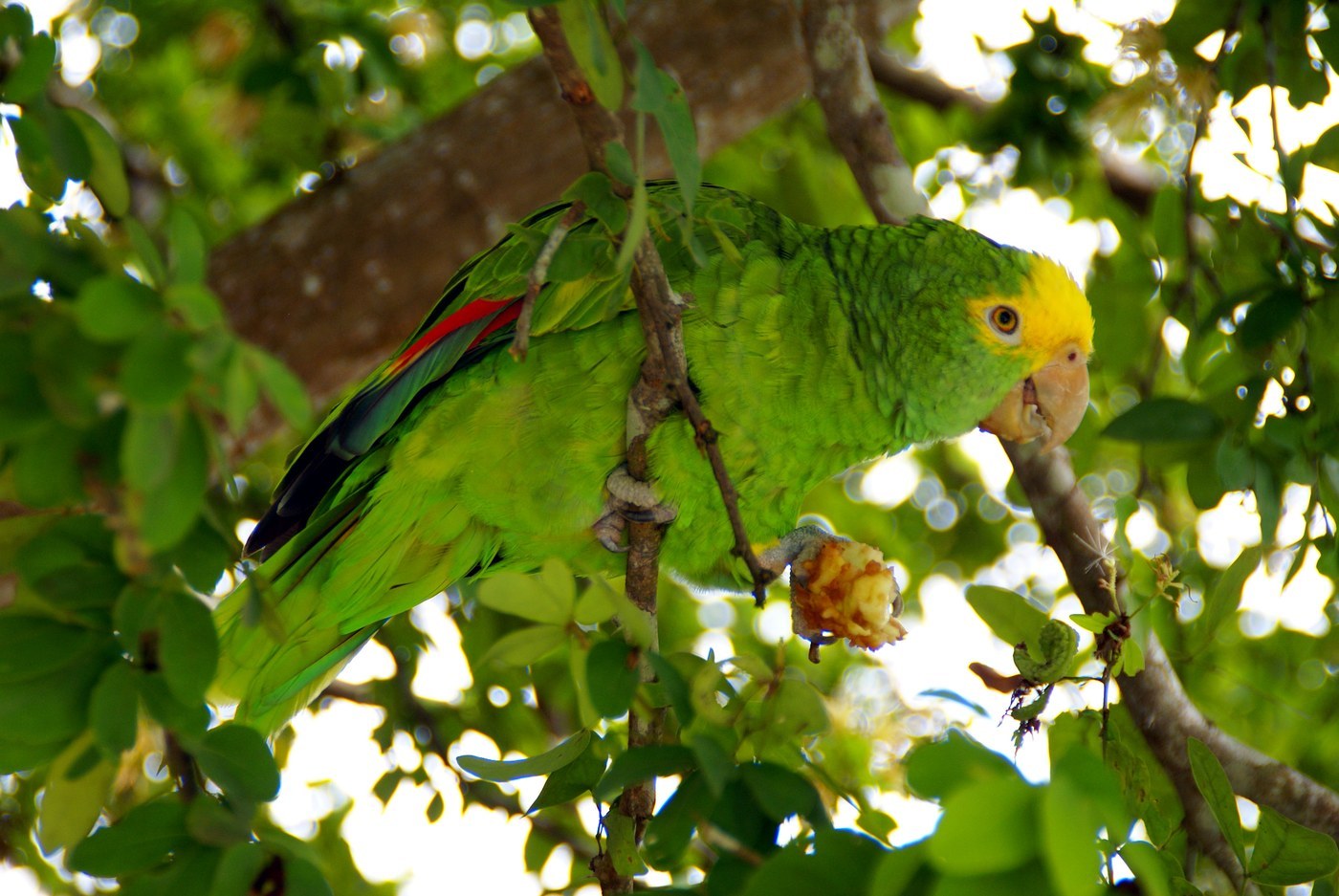
What Double Yellow-headed Amazon Feathers Look Like
This large, well-known Amazon parrot shows a body dominated by rich green feathers, each with a narrow black edge, creating a subtle scaled or scalloped texture across the back and breast when feathers are viewed together — a common pattern among Amazon parrots but useful to confirm the genus. The defining feature, as the name suggests, is the yellow head, which in mature adults can extend from the crown down over the entire head and sometimes onto the upper neck (the exact extent increases with age, with young birds showing only a small yellow patch on the forehead that expands over several years). A small but distinctive red patch at the bend of the wing (the "shoulder") stands out against the green body and is present in most individuals. Flight feathers are green with blue tips on the outer primaries, adding a contrasting color note when the wing is spread, and the tail is green with some yellow-green terminal coloring on the outer feathers. Overall feather size is large (flight feathers 12–18 cm), reflecting this species' status as one of the bigger Amazon parrots.
Step-by-Step: Is This Feather From a Double Yellow-headed Amazon?
- Look for a solid yellow head feather. A feather that's yellow rather than green, if from the head/crown area, is the most direct clue, though the amount of yellow varies with the bird's age.
- Check for black-edged green body feathers. A green feather with a thin dark edge, creating a scaled look, fits the Amazon parrot group generally and supports the body-feather identification.
- Look for a small red patch feather. A red feather noticeably smaller than the surrounding green body feathers, consistent with a shoulder/wing-bend patch, is a useful supporting clue.
- Check flight feather tips. Blue coloring at the tip of an otherwise green flight feather supports this species' wing pattern.
- Assess overall size. Large, robust flight feathers (12–18 cm) fit a big-bodied Amazon parrot rather than a smaller parakeet.
Similar Species & How to Tell Them Apart
The Yellow-headed Amazon (sometimes treated as a subspecies or close relative) is extremely similar, typically showing yellow restricted to a smaller area of the head rather than the more extensive yellow (sometimes covering the whole head and nape) seen in fully mature Double Yellow-headed Amazon — extent of yellow coloring, along with range, is the main distinguishing factor, and separation can be genuinely difficult. Yellow-crowned Amazon, a related but distinct species, shows yellow confined mainly to the crown with the rest of the head green, differing clearly from the more extensively yellow head of Double Yellow-headed Amazon. Other green Amazon parrots without any yellow head coloring and without the red shoulder patch can generally be ruled out quickly, since the yellow head plus red shoulder combination is a fairly specific identifying feature within the group.
Where & When You'll Find Them
Double Yellow-headed Amazons are native to lowland forest, forest edge, and semi-open woodland in parts of Mexico and Central America, though wild populations have declined significantly due to habitat loss and capture for the pet trade, while escaped or released birds have also established feral populations in parts of the southern United States and elsewhere. As a non-migratory resident species, feathers can be found year-round within its native or feral range, most often near tall trees used for roosting and nesting. Molt is gradual rather than sharply seasonal, but feather turnover tends to be heavier following the breeding season, making late-season searches near known roost or nest trees somewhat more productive.
Frequently asked questions
Why does the amount of yellow on the head vary?
Yellow head coloring increases with age — young birds show only a small yellow patch on the forehead, which expands over several years to eventually cover the whole head and sometimes the neck in mature adults.
What is the fastest way to confirm this is an Amazon parrot feather?
Look for green body feathers with a thin black edge creating a scaled look, combined with a small red shoulder patch feather — this combination is characteristic of the Amazon parrot group, including this species.
How do I distinguish this from a Yellow-crowned Amazon?
Yellow-crowned Amazon shows yellow confined mainly to the crown with the rest of the head green, while Double Yellow-headed Amazon shows more extensive yellow that can cover the whole head in mature adults.
Could I find this species' feathers outside its native range?
Yes — escaped or released birds have established feral populations in parts of the southern United States and elsewhere, so feathers can occasionally turn up outside the native Mexican/Central American range.
When are feathers most likely to be found?
Year-round near tall roosting and nesting trees, since the species doesn't migrate, though feather turnover is somewhat heavier following the breeding season.