
How to Identify Eurasian Curlew Feathers
How to recognize this large shorebird's streaky brown feathers, white rump, and lack of head striping compared to the similar Whimbrel.
Read the full Eurasian Curlew encyclopedia entry →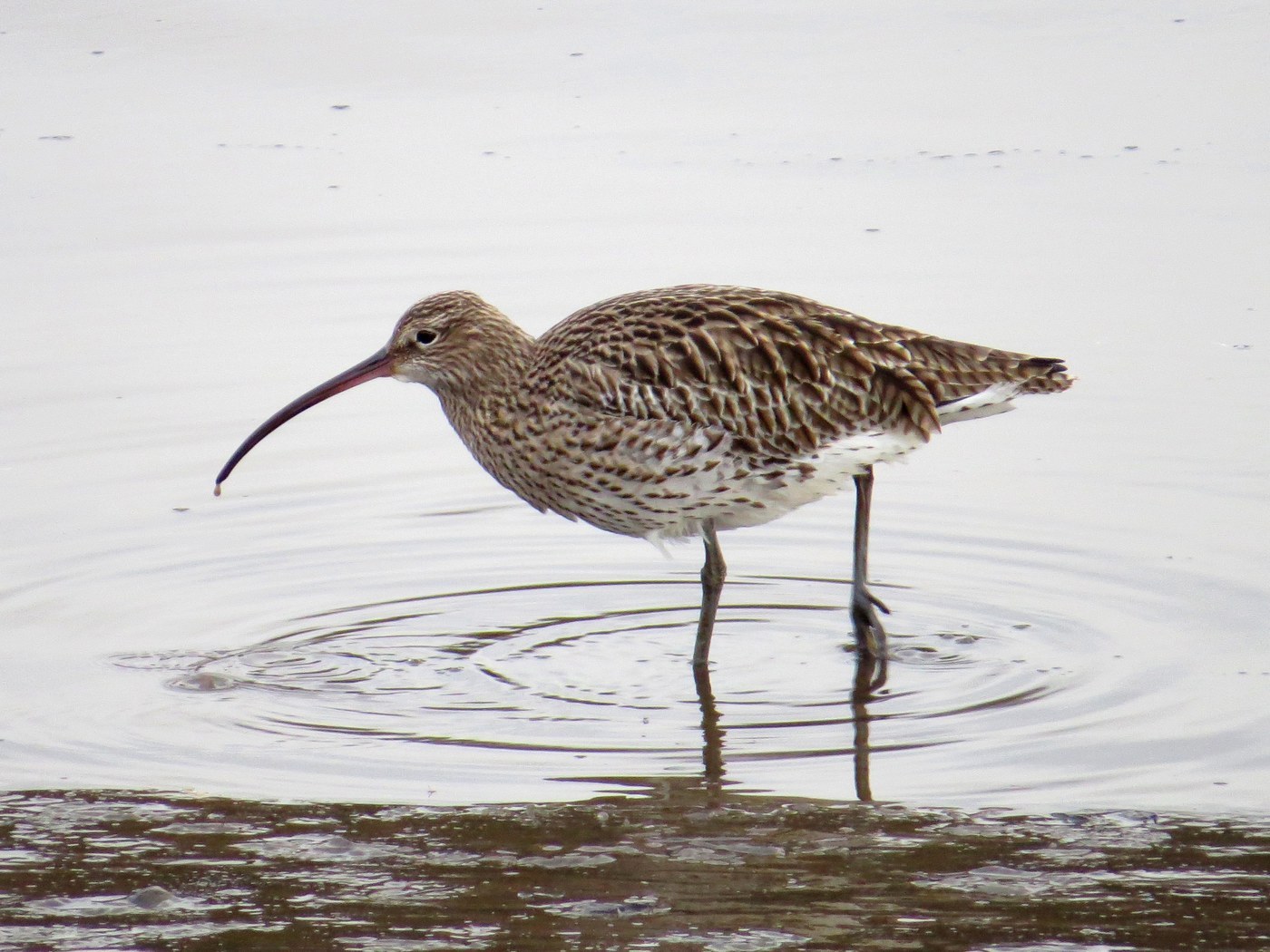
What Eurasian Curlew Feathers Look Like
As Europe's largest shorebird, the Eurasian Curlew has correspondingly large feathers, and its plumage is built around cryptic camouflage rather than bold markings.
- Body feathers: overall buffy-brown, densely marked with dark brown streaking and barring throughout — a mottled, camouflaged look with no bold, clean patches.
- Flight feathers: dark brown, quite large — primaries can reach 15 cm or more, reflecting the bird's substantial size.
- Rump/lower back: a distinctive white patch, visible in flight and useful if you find a feather from this specific area.
- Underwing: pale with fine barring, less heavily marked than the upperside.
- Head: plain, streaky brown without bold contrasting stripes.
Step-by-Step: Is This Feather From a Eurasian Curlew?
- Check the size. Large flight feathers (well over 10 cm) point toward a large shorebird like Curlew rather than a smaller sandpiper or plover.
- Assess the pattern. Dense, even streaking and barring across the whole feather (not concentrated in bold blocks) fits Curlew's cryptic style.
- Look for a white rump feather. A clean white feather from the lower back, if present, supports Curlew (and several other large shorebirds).
- Examine head feathers for stripes. Plain, streaky brown without strong dark crown stripes helps separate Curlew from its closest relative.
- Factor in habitat. A large, streaky brown feather found on an estuary mudflat or upland moor fits this species' known habitats well.
Similar Species & How to Tell Them Apart
The Whimbrel is the classic look-alike but is notably smaller, and critically, shows bold dark stripes bordering a pale central crown stripe on the head — a striking pattern the plainer-headed Curlew entirely lacks. Bar-tailed Godwit shows finer, neater barring and warmer rufous tones overall, especially in breeding plumage, rather than the Curlew's coarser, more diffuse streaking. Size is a helpful first filter, since Curlew is among the largest shorebirds likely to be encountered, but head pattern is the most decisive feature when comparing to Whimbrel specifically.
Where & When You'll Find Them
Eurasian Curlews breed on upland moorland and wet grassland across Europe and parts of Asia, then move to coastal estuaries and mudflats for the winter, where they probe deep mud for invertebrates with their long, downcurved bills. Most of the population undergoes its complete post-breeding molt on the wintering estuaries, roughly August through November, making autumn the prime season for finding shed feathers along tidal mudflats and saltmarsh edges rather than on the breeding moors. Because flocks often roost communally at high tide on the same stretch of saltmarsh or shingle bank day after day, these traditional roost sites tend to accumulate far more shed feathers over the autumn and winter than the wider feeding grounds, making them a particularly productive place to search.
Frequently asked questions
What's the fastest way to separate a Curlew feather from a Whimbrel feather?
Check any head feathers for stripes — Whimbrel shows bold dark crown stripes bordering a pale central stripe, while Curlew's head feathers are plain and evenly streaky without that contrasting pattern.
Why are Curlew feathers so large?
The Eurasian Curlew is the largest shorebird in its range, with a correspondingly large body and wingspan, so its flight feathers are proportionally larger than those of smaller sandpipers and plovers sharing the same mudflats.
Is the white rump patch unique to Curlew among shorebirds?
No, several large shorebirds including godwits also show pale rump patches, so this feature helps narrow things down but should be combined with size and head pattern for a confident identification.
Why would I be more likely to find Curlew feathers on an estuary than a moor?
Because the main molt period happens after the birds move to their wintering estuaries in autumn, feathers accumulate there in much greater numbers than on the breeding moorland, where adults are present only in spring and summer with less molting activity.
Do juvenile Curlews have differently patterned feathers?
Juveniles show a similar overall streaky brown pattern but often with slightly neater, more uniform feather edging than adults, a subtle difference that's easier to see on a fresh, unworn feather.
Eurasian Curlew identified by the community
Recent Eurasian Curlew feathers identified with Feather Identifier.

