
How to Identify Eurasian Hobby Feathers
How the rufous 'trousers' and heavily streaked underparts of this fast, scythe-winged falcon separate it from Peregrine, Merlin, and Eleonora's Falcon.
Read the full Eurasian Hobby encyclopedia entry →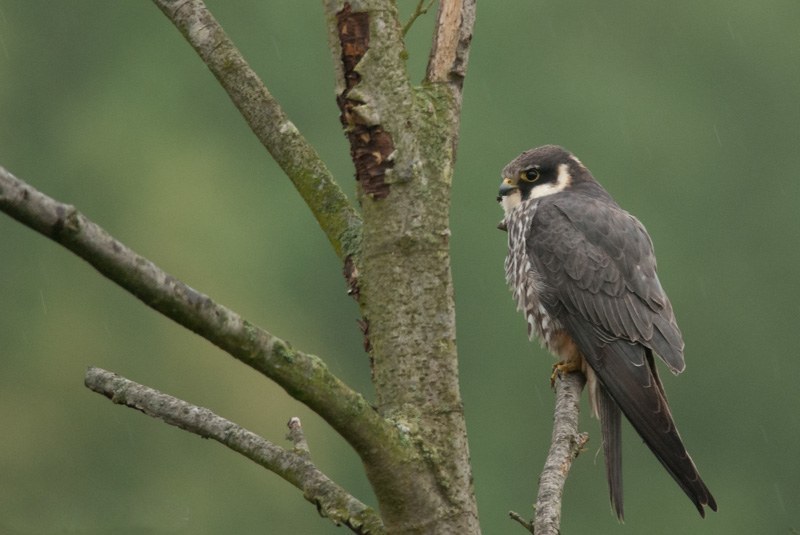
What Eurasian Hobby Feathers Look Like
The Eurasian Hobby is a compact, fast-flying falcon of open country, and one feature in particular makes it easy to recognize even from a single feather.
- Undertail coverts and thigh feathers: bright rufous-red — the famous "red trousers" that give this species its most distinctive single feather clue.
- Underparts (breast/belly): white to buffy, heavily marked with bold black streaking running the length of each feather.
- Upperparts: slate-gray, plain and unmarked compared to the boldly patterned underside.
- Flight feathers: long, pointed, and narrow — classic scythe-shaped falcon wings — barred on the underside.
- Tail: gray with fine, even dark barring.
Step-by-Step: Is This Feather From a Eurasian Hobby?
- Look for rufous "trousers" feathers. A bright rufous-red feather from the thigh or undertail area is one of the most distinctive single clues among European falcons.
- Check underpart streaking. Bold black streaks (not barring) on a white-to-buff ground supports Hobby.
- Assess upperpart color. Plain slate-gray, without strong patterning, is consistent with this species.
- Examine wing shape if the feather is intact enough to judge. Long, narrow, and pointed fits a fast-flying falcon rather than a broader-winged hawk.
- Rule out barring on the underside. If the underparts show bold barring instead of streaking, consider Peregrine Falcon instead.
Similar Species & How to Tell Them Apart
Peregrine Falcon is larger and shows barred, not streaked, underparts, and entirely lacks the rufous thigh patch that defines Hobby. Eleonora's Falcon is larger overall with a longer tail, and its dark morph is uniformly blackish-brown rather than showing the Hobby's contrasting streaked-and-rufous pattern. Merlin is smaller and more compact, with browner overall tones in females and no rufous thigh patch at all. The combination of bold black streaking on the underparts plus rufous "trousers" is essentially unique to the Hobby among these look-alikes.
Where & When You'll Find Them
Eurasian Hobbies favor open farmland, heathland, and country with scattered trees across much of Europe and Asia, hunting dragonflies and small birds on the wing with spectacular aerial agility. They are long-distance migrants, wintering in sub-Saharan Africa. Because flight-feather molt is largely suspended during the breeding season and completed after arrival on the African wintering grounds, feathers found on European breeding territories tend to be older and more worn, while freshly molted feathers are more associated with the wintering range — so a crisp, fresh Hobby feather found in Europe in spring is likely one retained from the previous year rather than newly grown. Hobbies typically arrive late on their breeding grounds, often not until May, timing their return to coincide with the emergence of dragonflies and the fledging of small songbirds, so a feather found on a European heath in early spring before this arrival window is much more likely to belong to a resident species than to this late-arriving migrant.
Frequently asked questions
Why are the rufous 'trousers' such a reliable clue?
Very few falcons sharing the Hobby's range and general size combine rufous thigh/undertail feathers with heavily streaked (rather than barred) underparts, making this combination almost unique to the species.
How do I quickly separate a Hobby feather from a Peregrine's?
Check the underparts pattern: Hobby shows bold black streaking, while Peregrine shows barring, and Peregrine also lacks the rufous thigh patch entirely.
Does the rufous coloring appear on juveniles too?
Juveniles show a duller, more buffy version of the thigh coloring that develops into the fuller rufous tone as they mature into adulthood.
Why would a Hobby feather found in Europe in spring look worn rather than fresh?
Because the species largely completes its flight-feather molt on the wintering grounds in Africa rather than in Europe, birds often arrive back on breeding territory with feathers that are a year old and correspondingly more worn.
Is Hobby wing shape distinguishable from a swift's, since they're sometimes compared in flight?
Yes, despite superficial resemblance in flight silhouette, Hobby feathers are far larger and show falcon-typical color patterning, unlike a swift's much smaller, plain sooty-brown feathers.