
How to Identify European Bee-eater Feathers
A guide to the vividly colored, elongated feathers of this brilliantly patterned migrant, and how to confirm an ID from its unmistakable color combination.
Read the full European Bee-eater encyclopedia entry →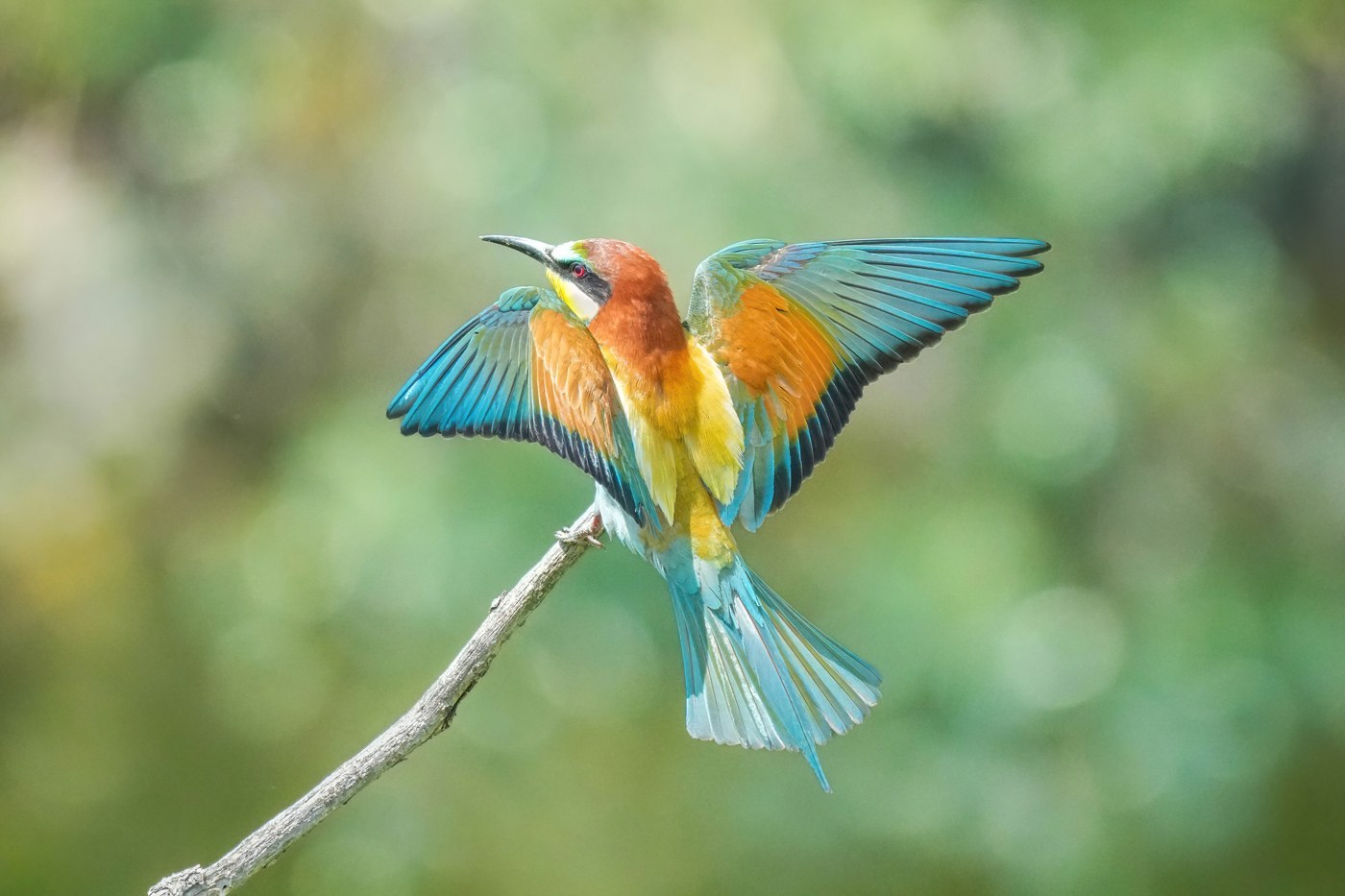
What European Bee-eater Feathers Look Like
Few European birds produce feathers as vividly colored as the European Bee-eater, making this one of the more straightforward species to confirm from a single feather. Back feathers show a rich chestnut-to-golden-brown tone, transitioning toward a golden-yellow on the shoulder and upper back region. Throat feathers are a bright, saturated yellow, bordered below by a thin black band where they meet the underparts. Underpart and belly feathers are a clear turquoise-to-greenish-blue, a color combination essentially unique among European breeding birds. A black stripe runs through the eye onto face feathers, providing another confirming patch of solid black amid all the color. Flight feathers are more subdued — blue-green above, with a rufous-orange wash visible on the underside of the primaries in flight, though this is more visible on the whole spread wing than a single loose feather. Adults show elongated, thin, streamer-like central tail feathers projecting well beyond the rest of the tail, especially pronounced in breeding season.
Step-by-Step: Is This Feather From a European Bee-eater?
- Check for turquoise/blue underparts color. This alone rules out nearly every other European bird and is the fastest positive signal.
- Look for a chestnut-to-gold back feather paired with a yellow throat feather. This three-tone combination (chestnut/gold back, yellow throat, blue belly) is essentially unique to this species in Europe.
- Look for elongated, thin central tail feathers. Thin streamer-type feathers projecting past the rest of the tail support an adult Bee-eater in breeding condition.
- Check for a black eye-stripe feather. A solid black facial stripe feather supports the ID alongside the color elsewhere.
- Consider habitat and season. Found near sandy riverbanks or dry earth cliffs (nesting burrows) in warm months strongly supports Bee-eater given its specific nesting requirements.
Similar Species & How to Tell Them Apart
- European Roller feathers are a vivid blue overall with a chestnut/brown back, but lack Bee-eater's yellow throat and turquoise belly, showing instead blue on the body and head rather than a chestnut-gold-yellow-blue combination.
- Common Kingfisher feathers show electric blue upperparts with orange underparts, a two-tone combination quite different from Bee-eater's more complex multi-band coloring, and Kingfisher lacks the elongated streamer tail feathers.
- Hoopoe feathers show pinkish-cinnamon body plumage with bold black-and-white barred wings, an entirely different pattern without any turquoise or true yellow.
- No other regularly occurring European species combines chestnut/gold, yellow, and turquoise in the way Bee-eater does, making misidentification among common species unlikely once underparts color is checked.
Where & When You'll Find Them
European Bee-eaters are long-distance migrants, wintering in sub-Saharan Africa and arriving in southern and parts of central Europe from late April through May to breed, departing again by September. They nest colonially in burrows excavated into sandy banks, cliffs, or even flat sandy ground near rivers and quarries, and forage over open country, catching bees, wasps, and other flying insects on the wing. Feathers are most findable in late spring through summer, directly around active nesting colonies where dozens of pairs burrow into the same sandy bank, and molt-related feather loss plus general wear from squeezing in and out of narrow tunnels concentrates feathers at colony entrances. A vividly colored feather matching this description found in winter in Europe would be very unusual, since the species is absent from the continent outside the breeding season.
Frequently asked questions
What single color check confirms a Bee-eater feather fastest?
Turquoise-to-greenish-blue underparts color — this combination is essentially unique among European birds and is the quickest confirming check.
How is Bee-eater different from European Roller in feather color?
Roller is a more uniform vivid blue with a chestnut back but no yellow throat or turquoise belly, while Bee-eater shows a distinct three-tone combination of chestnut/gold back, yellow throat, and turquoise underparts.
Why would I find many Bee-eater feathers in one sandy bank?
Bee-eaters nest colonially in burrows dug into sandy banks or cliffs, so an active colony concentrates feather wear and loss from dozens of birds in one small area.
Are Bee-eater feathers ever found in winter in Europe?
Essentially no — the species migrates entirely to sub-Saharan Africa for winter, so feather finds in Europe are a spring-through-summer phenomenon.
What do the elongated tail feathers indicate?
They're the thin, streamer-like central tail feathers grown by adults in breeding condition, a further confirming feature alongside the vivid body coloration.