
How to Identify European Green Woodpecker Feathers
A guide to the olive-green body feathers, yellow rump, and red crown of this ground-foraging woodpecker, and how to separate it from other green-toned birds.
Read the full European Green Woodpecker encyclopedia entry →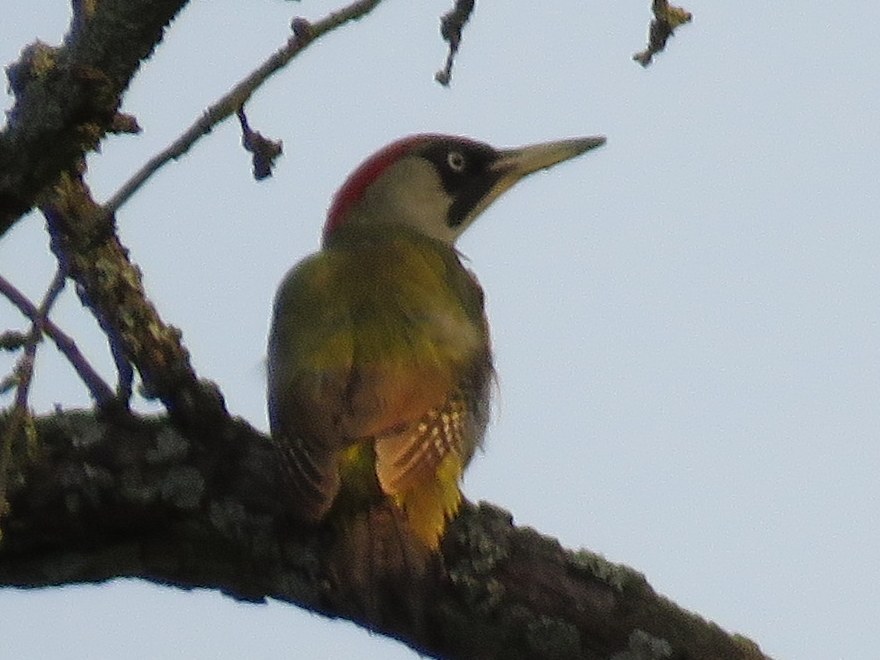
What European Green Woodpecker Feathers Look Like
European Green Woodpecker feathers stand out immediately for their color: body and back feathers are a rich olive-green, unlike the black-and-white patterning of most European woodpeckers. The rump feathers are a bright, contrasting yellow-green, often described as almost lime or chartreuse, and are highly conspicuous in flight — this rump patch is one of the best confirming feathers if found loose. Crown feathers on both sexes show a solid bright red patch, with males additionally showing a red center to the black "moustache" stripe feather below the eye (females show an all-black moustache stripe with no red). Underparts feathers are a paler dull green-gray, unbarred. Flight feathers are duller olive-brown with faint darker barring, structurally stiff and pointed like all true woodpeckers, built for bracing against bark, though this species actually spends unusually large amounts of time foraging on the ground for ants compared to most woodpeckers.
Step-by-Step: Is This Feather From a European Green Woodpecker?
- Check for olive-green body color. This is immediately distinctive — no other common European woodpecker shows a green body.
- Look for a bright yellow-green rump feather. If present, this near-fluorescent patch is one of the most reliable single confirming feathers for this species.
- Check for a red crown feather. Present in both sexes; combined with green body color this is essentially conclusive.
- Look at the moustache stripe feather if available. All-black in females, with a red center in males — a useful way to sex the feather.
- Confirm feather stiffness. A stiff, pointed tail or wing feather confirms the woodpecker family generally, supporting the color-based ID.
Similar Species & How to Tell Them Apart
- Grey-headed Woodpecker, found in parts of continental Europe, is similar in overall green tone but has a gray head (not showing the bold red crown patch across the whole crown — red is reduced to a small forehead patch in males only, absent in females), making head color the key separator.
- European Bee-eater feathers can show golden-green tones too, but Bee-eater additionally shows turquoise underparts and a yellow throat, an entirely different color combination, and lacks stiff woodpecker-type tail feathers.
- Eurasian Jay feathers are pinkish-buff with a blue-and-black barred wing patch, not green at all, ruling out confusion once overall body tone is checked.
- Great Spotted Woodpecker feathers show classic black-and-white barring with red patches only on the nape/undertail, an entirely different, non-green pattern.
Where & When You'll Find Them
European Green Woodpeckers favor open woodland edges, parkland, orchards, and grassland with scattered trees across much of Europe, and are unusual among woodpeckers for spending long periods foraging directly on the ground, probing anthills and lawns with a long, sticky tongue for ants. They are non-migratory residents, so feathers can be found year-round, particularly around old nest holes in mature trees and near favored ground-foraging spots such as anthill-rich pasture, parkland, and lawns. Feather finds may increase slightly in late spring during the nesting period, when adults make frequent trips between ground foraging sites and the nest hole, and again in late summer through autumn following the post-breeding molt.
Frequently asked questions
What's the fastest way to confirm a Green Woodpecker feather?
Olive-green body color combined with a bright yellow-green rump feather — this rump patch is highly distinctive and rarely confused with anything else.
How do I sex a Green Woodpecker feather?
Check the black moustache stripe feather below the eye — males show a red center within the black stripe, while females show an all-black stripe with no red.
How is this species different from Grey-headed Woodpecker?
Grey-headed Woodpecker has a gray head with, at most, a small red forehead patch in males, while European Green Woodpecker shows a full bright red crown in both sexes.
Why does this woodpecker's habitat differ from typical woodpecker habitat?
It forages heavily on the ground for ants in open grassland and parkland rather than staying mostly on tree trunks, so feathers often turn up on lawns and pasture rather than deep woodland.
Is the yellow rump feather ever absent or hard to see?
It's typically quite vivid and conspicuous, but on worn or faded feathers the contrast may be reduced — cross-check with crown color and overall green body tone if the rump feather isn't available.