
How to Identify Fish Crow Feathers
A guide to the smaller, slimmer glossy black feathers that distinguish this coastal crow from the larger American Crow.
Read the full Fish Crow encyclopedia entry →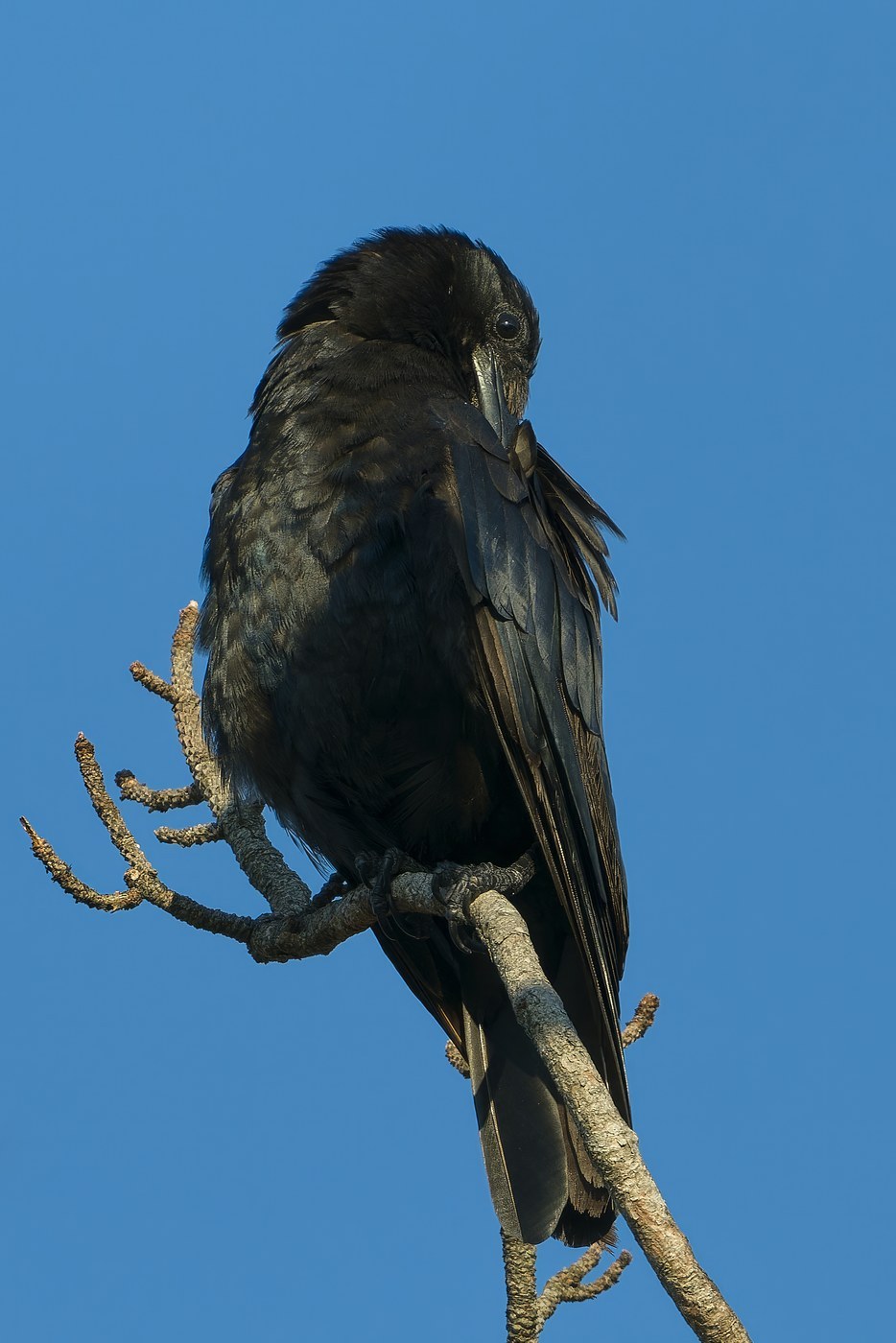
What Fish Crow's Feathers Look Like
Fish Crow feathers look, at first glance, essentially identical to those of the more familiar American Crow: both are solid glossy black with a blue-purple sheen and lack any pattern or pale markings. The key differences are subtler and mostly a matter of scale and proportion rather than color. Fish Crow is noticeably smaller and more slender-bodied than American Crow, so its feathers, while sharing the same glossy black coloring, run smaller overall, with shorter flight feathers and a more streamlined shape. The bill is more slender than American Crow's, and while bill shape is not a feather feature, it corresponds with a generally more delicate build reflected in narrower, less robust individual feathers. Tail feathers are proportionately similar in shape to American Crow's but again reduced in scale. Gloss and sheen quality are essentially the same between the two species, so color alone cannot separate them.
Step-by-Step: Is This Feather From a Fish Crow?
- Measure carefully: if you can compare against a known American Crow feather of the same type (e.g., a primary), a notably smaller, more slender feather supports Fish Crow, since size is the main distinguishing feature.
- Assess overall build: a feather that seems slim and lightweight relative to what you'd expect from a large crow may indicate the smaller-bodied Fish Crow.
- Consider habitat and locality: Fish Crow is strongly tied to coastal areas, tidal rivers, and waterways in the eastern and southeastern United States, so a crow feather found along the immediate coast or a major tidal river in that region has a reasonable chance of being Fish Crow.
- Rule out other black bird groups: confirm the feather is crow-sized and shaped (not a grackle or blackbird feather, which are notably smaller and differently proportioned) before applying the size comparison with American Crow.
- Recognize the limits of feather-only ID: because gloss, color, and basic shape overlap heavily between the two species, a single feather without size context or known locality often cannot be identified with full certainty.
Similar Species & How to Tell Them Apart
American Crow is the primary and most difficult confusion species, distinguished mainly by its larger overall size and correspondingly larger feathers; there is no reliable color or pattern difference between the two crows at the individual feather level. Common Raven, found in some overlapping regions, is much larger still, with a wedge-shaped tail and shaggy throat "hackle" feathers, both larger and more pronounced than in either crow species. Common Grackle and other blackbirds show a similar glossy black sheen but are considerably smaller with longer, more keeled tail feathers (grackles) or entirely different body proportions, and grackles often show a more iridescent bronze or purple gloss concentrated differently across the body than the more uniform gloss of crows.
Where & When You'll Find Them
Fish Crow is closely tied to coastal areas, tidal marshes, rivers, and beaches along the Atlantic and Gulf coasts of the United States, and has been expanding inland along major river systems in recent decades. Feathers are most likely to be found on beaches, tidal flats, coastal parking lots and picnic areas (where the birds scavenge food scraps), and around fish processing or seafood-related human activity, reflecting its opportunistic, coastal-scavenging habits. Molt occurs in late summer (roughly July-September), after breeding, which is the most productive time to find dropped feathers in and around coastal roosting and feeding sites, though as a non-migratory resident throughout most of its range, feathers can be found in suitable coastal habitat across much of the year.
Frequently asked questions
Can a single feather reliably tell Fish Crow from American Crow?
Not with full certainty; the two species share identical glossy black coloring, so size and slenderness, along with locality, are the main clues, and confidence is often limited.
What size difference should I look for?
Fish Crow is smaller and more slender-bodied than American Crow, so its feathers, including flight feathers, run correspondingly smaller and lighter.
Does habitat help with identification?
Yes, Fish Crow is strongly associated with coastal areas, tidal marshes, and major rivers in the eastern and southeastern US, which can support an identification when paired with feather size.
How does Common Raven differ from either crow species?
Common Raven is much larger, with a wedge-shaped tail and pronounced shaggy throat hackle feathers not found on either crow.
When is the best time to find Fish Crow feathers?
Late summer, roughly July through September, during the post-breeding molt, though feathers can be found near coastal habitat throughout much of the year since the species is largely resident.