
How to Identify Fork-tailed Sunbird Feathers
A guide to spotting the tiny, iridescent, forked-tail feathers of the male Fork-tailed Sunbird and telling them apart from other Asian sunbirds.
Read the full Fork-tailed Sunbird encyclopedia entry →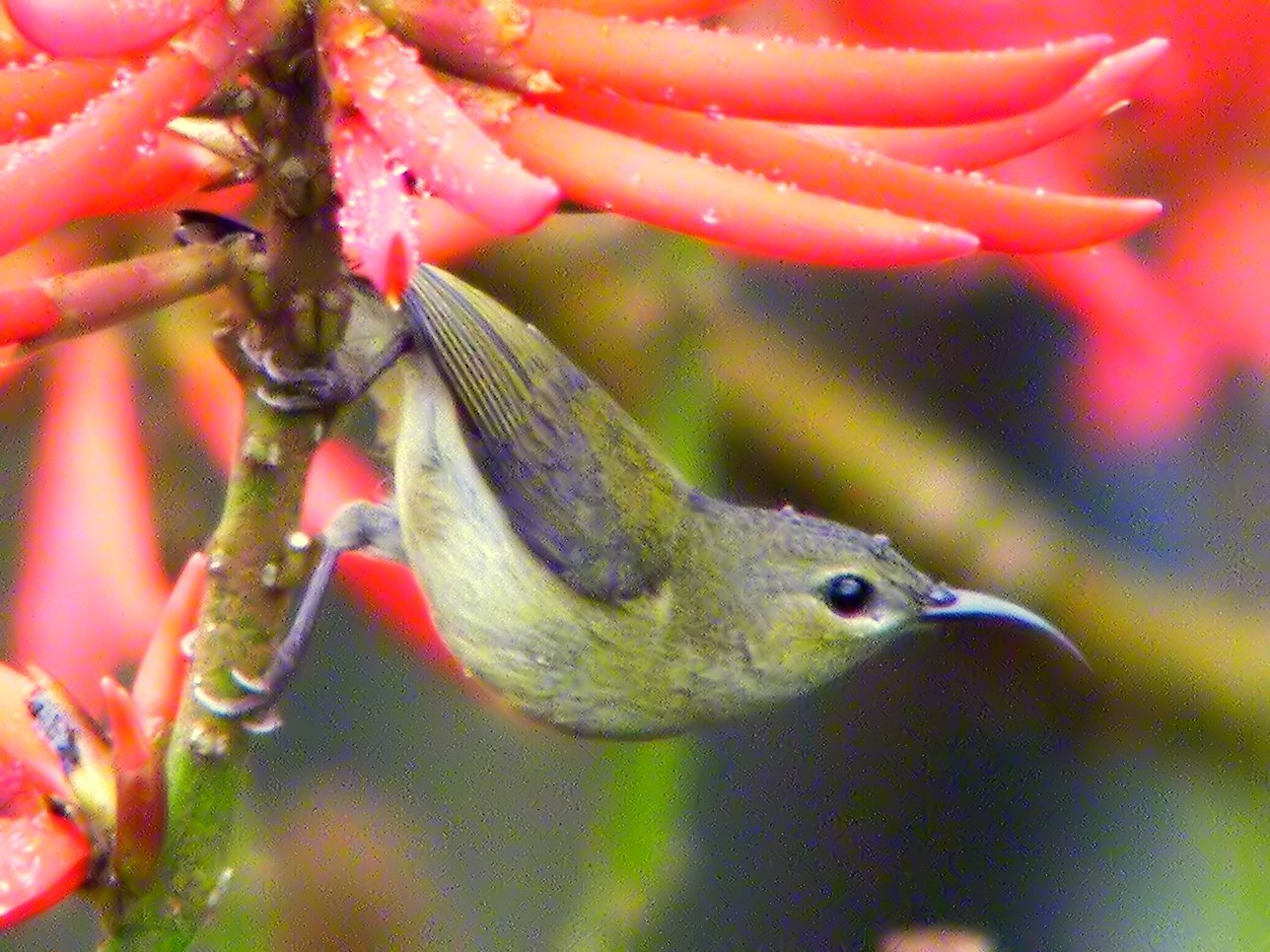
What Fork-tailed Sunbird Feathers Look Like
This is a tiny bird — total length under 10cm — so every feather is correspondingly small and delicate. Male Fork-tailed Sunbirds are the showpiece: their crown and throat feathers are iridescent metallic green, shifting to blue-green depending on the light angle, while the back and breast carry a deep maroon-red wash. The belly is soft pale yellow. The signature feature is the elongated central pair of tail feathers, which are narrow, pointed, and metallic blue-green, extending well past the rest of the tail to create the forked or streamer-like silhouette that gives the species its name.
Female and non-breeding feathers look completely different and much plainer: olive-green above and dull yellowish below, with no iridescence and no elongated tail streamers — the tail feathers are short, evenly shaped, and uniformly olive-brown. Because sunbird body feathers are so small and fine-barbed, they rarely survive intact on the ground for long, so intact tail streamers or crown feathers are the most identifiable finds.
Step-by-Step: Is This Feather From a Fork-tailed Sunbird?
- Check the size. Any feather over about 8cm is too large — this species is one of the smallest birds in its range, so feathers should be correspondingly tiny.
- Look for iridescence. A shimmering metallic green or blue-green sheen on a small feather strongly suggests a sunbird rather than a plain songbird.
- Identify elongated tail feathers. A narrow, pointed feather noticeably longer and more tapered than a typical tail feather, with a metallic blue-green sheen, points to an adult male's central tail streamers.
- Note the color pairing. Metallic green crown/throat plus maroon-red back/breast plus yellow belly is a very specific combination not shared by many other small birds in the region.
- Consider sex and season. A plain olive-and-yellow small feather without iridescence could still be this species (female or non-breeding male) but is harder to confirm without the diagnostic streamer.
Similar Species & How to Tell Them Apart
Several other Aethopyga sunbirds share the iridescent-green-and-red look, including Mrs. Gould's Sunbird and the Green-tailed Sunbird, both of which also have elongated tail streamers. The key differences are streamer color (blue-green in Fork-tailed vs. more purely metallic green or with yellow rump patches in relatives) and the extent of red on the underparts. Non-sunbird small iridescent birds in the same range, like certain flowerpeckers, lack the elongated tail feathers entirely and have much shorter, blunter tails.
Where & When You'll Find Them
Fork-tailed Sunbirds inhabit subtropical and tropical lowland-to-mid-elevation forest edge, scrub, and gardens in southern China and northern Vietnam, where they feed on nectar and small insects. They are largely resident with only local elevational movement. Feathers are most likely to turn up near flowering shrubs and forest edges after the post-breeding molt, when males may also briefly lose their long tail streamers before regrowing them for the next breeding season.
Frequently asked questions
Why does the color of the feather seem to change when I move it?
That's structural iridescence — a normal feature of sunbird feathers where microscopic feather structure reflects different colors depending on the viewing angle.
What is the long, thin feather with a metallic tip I found?
That's likely an elongated central tail streamer from an adult male, unique to breeding-plumage sunbirds like this species.
Do female Fork-tailed Sunbirds have the same colorful feathers?
No, females are plain olive above and dull yellow below without iridescence or elongated tail feathers.
How do I tell this species from other Aethopyga sunbirds?
Compare streamer color and the extent of maroon-red on the underparts, since several related sunbirds share a similar overall pattern but differ in these details.
Do male sunbirds lose their long tail feathers outside the breeding season?
Some males show reduced or absent tail streamers between breeding cycles as feathers wear and are replaced during molt.