
How to Identify Glaucous Gull Feathers
How to identify Glaucous Gull feathers by their entirely white wingtips with no black, and distinguish them from Iceland Gull and Glaucous-winged Gull.
Read the full Glaucous Gull encyclopedia entry →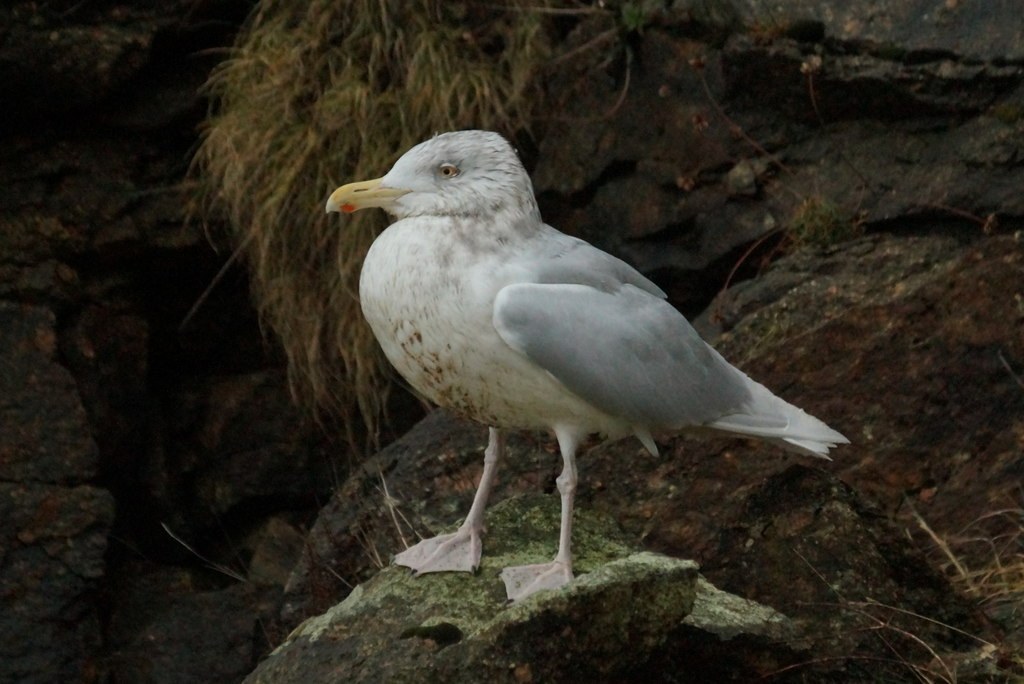
What Glaucous Gull Feathers Look Like
The Glaucous Gull is one of the largest gulls in the Arctic and is famous among birders for one simple feather trait: its wingtips have no black at all. In adults, the primary feathers are pale gray to white, matching or only slightly darker than the pale gray mantle, so a primary feather from this species will look plain and pale from base to tip rather than showing the dark tip found on almost every other large gull. Mantle and back feathers are a soft pale gray, and body feathers are clean white.
Immature and first-winter birds are even paler overall — a creamy white to pale buff tone with only faint, fine brown checkering across the body and wing covert feathers, and the primaries show translucent whitish tips rather than any dark pigment. The bill in life is bicolored pink-and-black in immatures, though that detail doesn't transfer to a loose feather. Because Glaucous Gull is also physically large, feather size is a helpful secondary clue: primaries and tail feathers are notably long and broad, consistent with one of the bulkiest gulls in its range.
Step-by-Step: Is This Feather From a Glaucous Gull?
- Check the wingtip for black. A primary feather that is entirely pale gray or white, with no black pigment anywhere along its length, is the single most reliable Glaucous Gull clue.
- Assess overall paleness. Immature feathers that look creamy white to pale buff with only faint, fine brown checkering (rather than bold barring) support this species.
- Measure size. Large, broad primary and tail feathers fit this species' bulky build, one of the largest gulls in its range.
- Compare mantle tone. A pale gray mantle feather that's close in shade to the wingtip color (rather than contrasting with a darker wingtip) supports Glaucous Gull.
- Confirm range/season. Feathers found on Arctic coasts in summer, or temperate coastlines in winter, fit this species' circumpolar breeding and southward winter movement.
Similar Species & How to Tell Them Apart
The Iceland Gull shares the same "no black in the wingtip" trait but is noticeably smaller and more slender, with a more rounded head shape and a finer bill — so if a pale-wingtipped gull feather seems small and delicate, Iceland Gull is more likely than Glaucous Gull. The Glaucous-winged Gull looks similar at a glance but actually shows pale gray (not white) wingtips, blending only slightly darker than the mantle rather than matching it exactly, and it is found along the Pacific coast rather than in the high Arctic. Immature Herring Gulls, in contrast, are considerably browner overall with clearly darker, blackish primaries showing real contrast — quite different from Glaucous Gull's pale, low-contrast wingtip.
Where & When You'll Find Them
Glaucous Gulls breed on Arctic coasts and tundra around the pole, then move south to temperate coastlines in winter, including the Pacific Northwest, Great Lakes, and North Atlantic coasts of North America and Eurasia. Feathers are most likely to be found on Arctic breeding cliffs and coastal areas in summer, and on wintering coastlines, harbors, and landfills further south in the colder months. The complete post-breeding molt occurs in late summer and fall, replacing both flight and body feathers before the southward movement.
Frequently asked questions
What is the single best clue for identifying a Glaucous Gull feather?
A primary feather with no black pigment at all — entirely pale gray to white from base to tip, unlike almost all other large gulls.
How is this different from an Iceland Gull feather?
Iceland Gull also lacks black wingtips but is noticeably smaller and more slender, with a finer bill and more rounded head, so feather size is the key separator.
How is this different from a Glaucous-winged Gull feather?
Glaucous-winged Gull shows pale gray (not white) wingtips that blend only slightly darker than the mantle, while Glaucous Gull wingtips are white or match the mantle exactly.
What do immature Glaucous Gull feathers look like?
Creamy white to pale buff overall with only faint, fine brown checkering and translucent whitish primary tips, much paler than an immature Herring Gull.
When do Glaucous Gulls molt?
A complete post-breeding molt occurs in late summer and fall, replacing flight and body feathers before their southward winter movement.