
How to Identify Golden Conure Feathers
A guide to recognizing Golden Conure feathers by their vivid all-yellow body plumage set against sharply contrasting green flight feathers.
Read the full Golden Conure encyclopedia entry →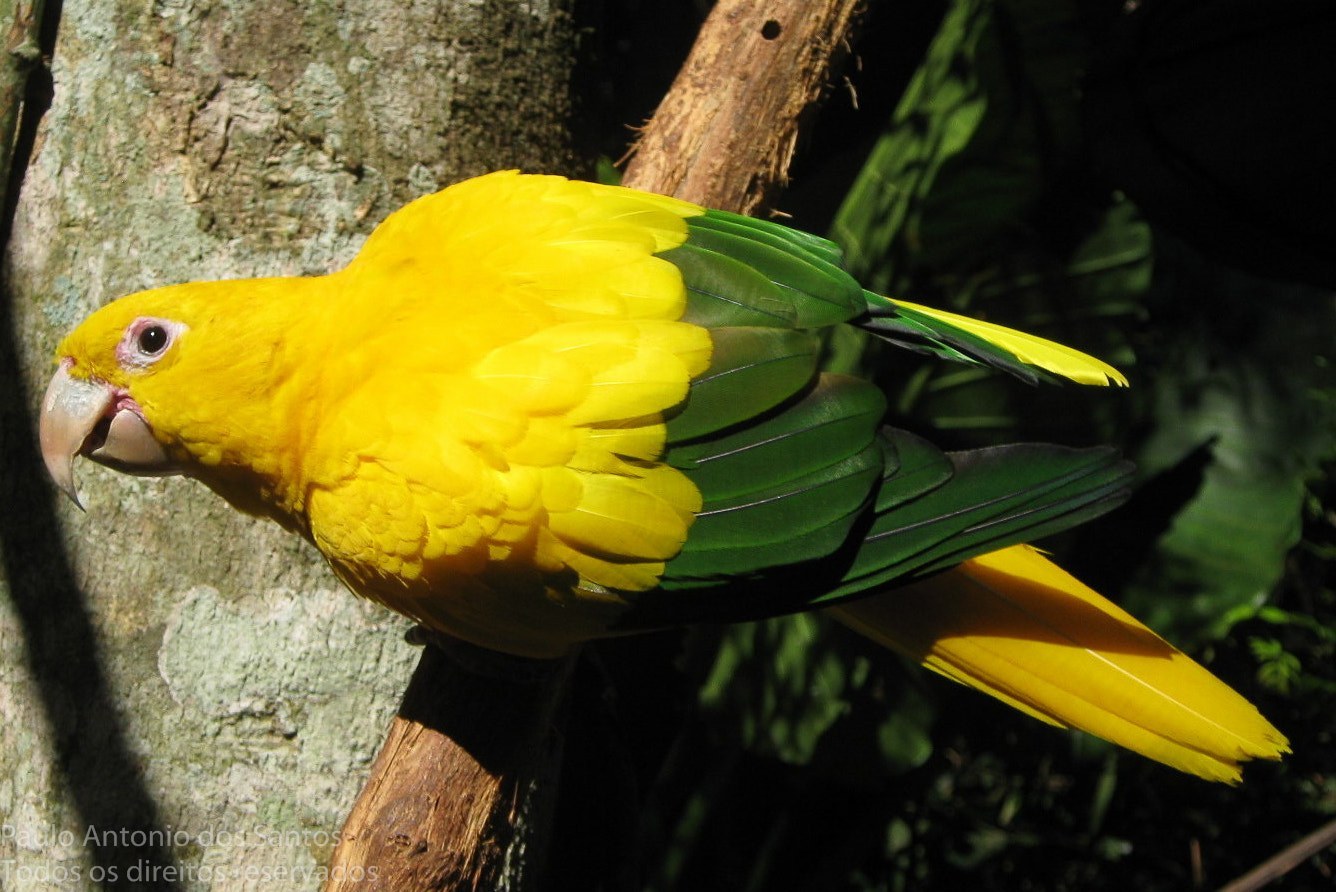
What Golden Conure's Feathers Look Like
The Golden Conure is one of the most visually striking parrots in the Americas, and its feathers show why: nearly the entire body — head, neck, chest, belly, and wing coverts — is covered in brilliant, saturated golden-yellow, unbroken by barring, streaking, or a second body color. The sharp contrast comes from the flight feathers, which are solid green, creating a bold two-tone effect between the yellow body and green wingtips that is highly distinctive when the wing is spread or when a shed feather is compared against the body plumage. Primaries and secondaries are moderately broad and fairly long for a mid-sized parrot, typically 12-16 cm, with a glossy green surface and a pale to yellowish shaft. Tail feathers are long and tapering, mostly yellow-green with green tips. Body feathers are soft, rounded, and dense, without any powder-down dusting (unlike cockatoos), reflecting its more typical parrot preening habits.
Step-by-Step: Is This Feather From a Golden Conure?
- Check for solid, unmarked yellow. A body feather that is entirely golden-yellow with no orange tint, barring, or green flecking is the strongest single clue.
- Look at any wing feathers found nearby. Green (not blue-green or orange-tipped) flight feathers found alongside yellow body feathers support this species specifically.
- Measure the flight feathers. A green primary or secondary in the 12-16 cm range fits a mid-sized conure rather than a small parakeet or a large macaw.
- Rule out orange tones. If the yellow feather has any orange wash, especially on the face or chest, reconsider — Golden Conure's yellow runs cleaner and less orange than several similar species.
- Consider the source. Because this species is heavily bred in captivity, a feather found outside Brazil is most likely from an aviary or pet bird.
Similar Species & How to Tell Them Apart
- Sun Conure: Shows a strong orange wash across the face and chest along with blue tips on some flight feathers, distinguishing it from the cleaner, more uniform yellow of the Golden Conure.
- Jandaya Conure: Has a green back and orange-yellow head and belly rather than an almost entirely yellow body, with blue-green in the wings.
- Other all-yellow captive parrots (e.g., lutino mutations): Can superficially resemble Golden Conure but typically lack the crisp, natural green flight-feather contrast and instead show pale or washed-out wing feathers from selective breeding.
Where & When You'll Find Them
In the wild, Golden Conures are restricted to a limited area of the eastern Amazon in Pará, Brazil, where feathers would be found in lowland rainforest and forest edge. Because the species is popular in aviculture and conservation breeding programs worldwide, feathers are just as often found near aviaries, zoos, and private collections far outside its native range. Captive individuals molt gradually through the year rather than on a strict season, so feathers can turn up at any time near regular perching, nesting, or bathing areas.
Frequently asked questions
How can I be sure a yellow feather isn't from a canary or other yellow bird?
Check the feather's size and structure — parrot feathers, including this species', are noticeably broader, stiffer, and more strongly veined than the fine, soft feathers of a small songbird like a canary.
Is the green-yellow contrast always sharp?
In healthy adult plumage, yes, the boundary between yellow body and green flight feather is usually crisp; worn or faded feathers may look duller but should still show the same basic two-tone pattern.
What's the easiest way to rule out Sun Conure?
Look for orange on the face and chest feathers and any blue in the wing — Golden Conure lacks both, staying essentially yellow-and-green throughout.
Would I realistically find this feather in the wild?
Only within a small part of Pará, Brazil; almost everywhere else, a Golden Conure feather points to a captive or aviary source given the species' popularity.