
How to Identify Gray Vireo Feathers
How to spot the plain gray plumage, faint wing bar, and bold white eye-ring that identify Gray Vireo feathers.
Read the full Gray Vireo encyclopedia entry →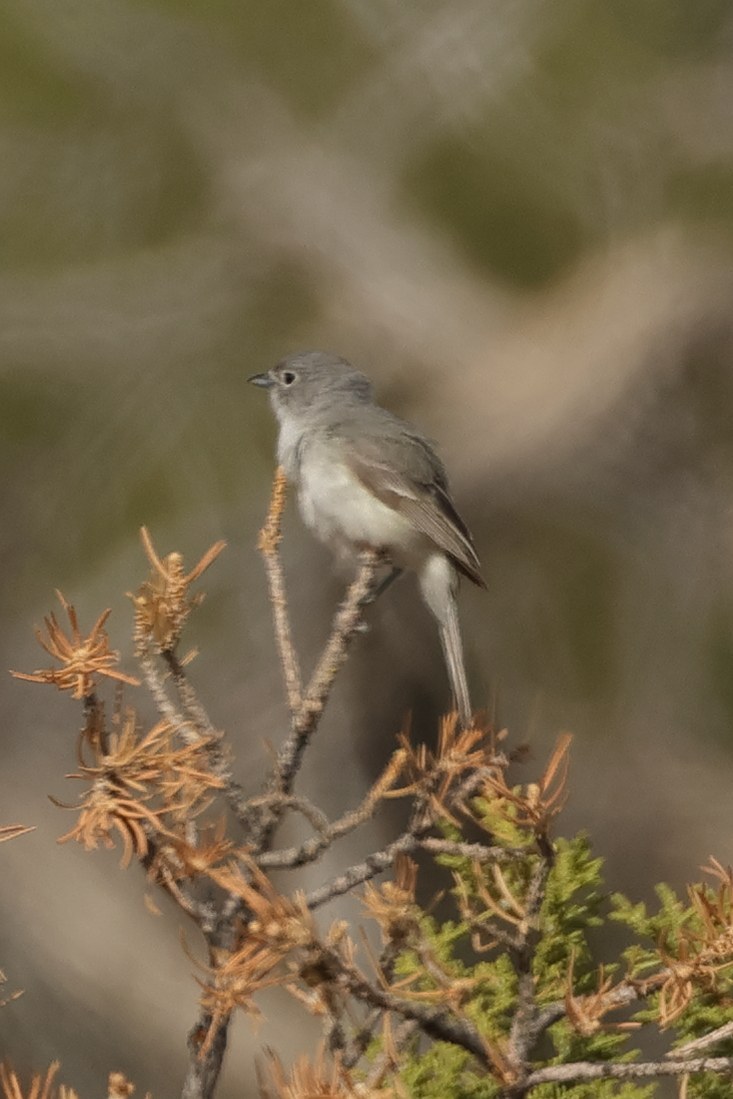
What Gray Vireo's Feathers Look Like
Gray Vireo is defined almost as much by what it lacks as by what it has. Upperpart contour feathers are a uniform plain gray, with underparts fading to a very pale gray-white — there's no olive or yellow wash anywhere on the body, unlike most other vireos. The wing shows at most a single faint, indistinct wing bar formed by pale tips on the greater coverts; some individuals show barely a trace of it at all. The standout feature is the face: a bold, crisp white eye-ring ("spectacles") stands out sharply against the plain gray face, and is often the most identifiable single feather-adjacent clue if you're looking at a study skin or photo rather than a loose feather. Tail feathers are proportionally a bit longer than in most vireos and show narrow whitish edges on the outer feathers. The bill, though not a feather, is small and only lightly hooked, consistent with the delicate look of the whole plumage.
Step-by-Step: Is This Feather From a Gray Vireo?
- Check for plainness. A small songbird feather that is uniform gray with no yellow, olive, or green wash is a strong starting point.
- Look for a wing bar — or the near-absence of one. At most a single faint pale bar; two bold white bars point elsewhere.
- Search for white eye-ring evidence. If a facial feather or head fragment shows a crisp white ring shape, that fits this species strongly.
- Note tail feather length. Slightly longer, narrower tail feathers with pale outer edges fit better than the shorter tails of other similarly sized vireos.
- Consider habitat. A plain gray feather found in arid pinyon-juniper woodland or desert chaparral supports this ID over vireos of wetter, greener habitats.
Similar Species & How to Tell Them Apart
- Plumbeous Vireo — bulkier, with bolder, more obvious white spectacles and two distinct white wing bars, versus Gray Vireo's faint single bar.
- Bell's Vireo — shows a subtle olive or yellowish wash on the flanks and a different, brushier habitat preference (streamside thickets rather than dry scrub).
- Warbling Vireo — browner-olive overall with no wing bars at all, and typically found in broadleaf riparian trees rather than arid scrub.
The near-total plainness of Gray Vireo — lacking both strong wing bars and any yellow-green tones — is the most reliable way to separate it from its relatives.
Where & When You'll Find Them
Gray Vireo breeds in arid pinyon-juniper woodland and juniper-oak chaparral across the interior Southwest — parts of Arizona, New Mexico, Utah, Nevada, Colorado, and Texas — extending into northern Mexico, with populations wintering in Mexico. Feathers are most likely to be found on the ground beneath juniper and scrub oak, where the birds forage low and nest close to the ground. Molt occurs after breeding in late summer, so the best window for finding shed feathers is August through September, before birds depart for their wintering range.
Frequently asked questions
What makes Gray Vireo feathers hard to spot compared to other vireos?
Their extreme plainness — no yellow or olive wash and only a faint single wing bar — means they lack the bold markings that make many other vireo feathers easier to pick out.
How is this different from a Plumbeous Vireo feather?
Plumbeous Vireo shows two bold white wing bars and more obvious white spectacles, while Gray Vireo has at most one faint wing bar and a more subtle facial pattern.
Does Gray Vireo ever show yellow or greenish tones?
No, its plumage is uniformly gray to pale gray-white, without the olive or yellow wash seen in species like Bell's or Warbling Vireo.
Where should I search for feathers?
Beneath junipers and scrub oak in dry, rocky chaparral or pinyon-juniper woodland of the interior Southwest, where the birds forage and nest close to the ground.
When is the best time to find shed feathers?
Late summer, roughly August through September, following the post-breeding molt and before migration to Mexico.