
How to Identify Greater Sage-Grouse Feathers
A guide to recognizing the mottled grey-brown feathers, black belly patch, and spiked tail feathers of North America's largest grouse.
Read the full Greater Sage-Grouse encyclopedia entry →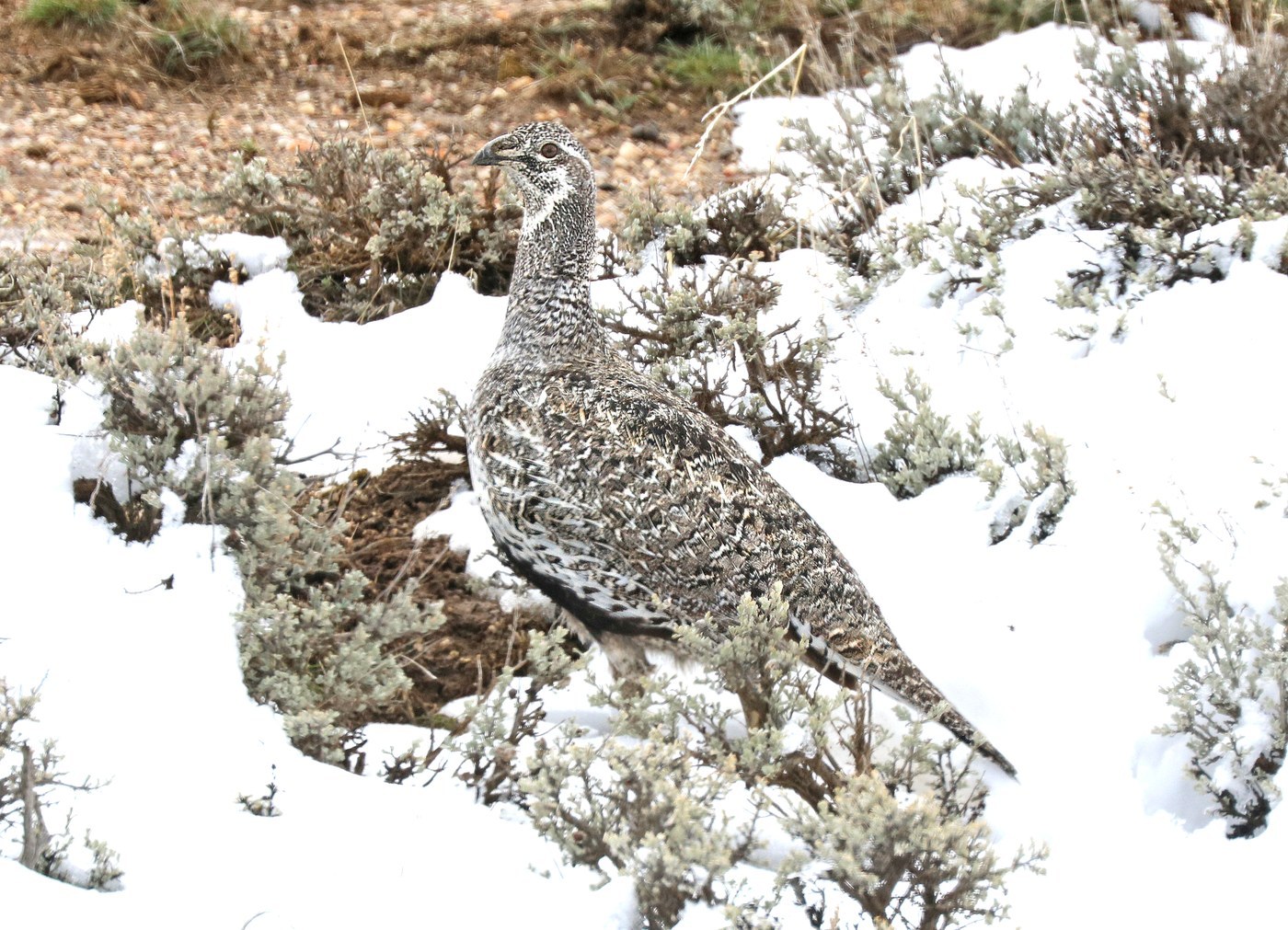
What Greater Sage-Grouse's Feathers Look Like
The Greater Sage-Grouse is the largest grouse in North America, a sagebrush-obligate species famous for its elaborate lekking displays, and its feathers are finely tuned for camouflage against sagebrush and dry grassland. Body feathers show a finely vermiculated grey-brown-and-black pattern, mottled at a fine scale rather than boldly barred, matching the mixed grey-green tones of sagebrush country. Males show a bold solid black belly patch, a sharp contrast against the otherwise mottled plumage, and a black throat bordered by fluffy white feathers on the breast and neck that puff out dramatically during courtship display.
The single most diagnostic feathers are the tail feathers: long, narrow, sharply pointed and spike-like, marked with fine dark barring, and fanned out dramatically by displaying males — a shape unlike the rounded tail feathers of most other North American grouse. The white breast feathers used in display have a somewhat stiff, filamentous quality distinct from ordinary body down. Overall feather size is large, reflecting a bird that can weigh several kilograms, among the heaviest of all grouse.
Step-by-Step: Is This Feather From a Greater Sage-Grouse?
- Look for spiked tail feathers. A long, narrow, sharply pointed tail feather with fine dark barring is close to diagnostic for this species among North American grouse.
- Check for a black belly/throat feather. A solid black feather from the underparts, especially paired with fluffy white breast feathers, strongly supports this species.
- Assess overall pattern. Fine grey-brown-and-black vermiculation, rather than bold barring or spotting, fits this species' sagebrush camouflage.
- Measure it. Body and tail feathers run notably large, reflecting this species' status as the largest North American grouse.
- Feel the breast feather texture. Stiff, filamentous white feathers, rather than soft down, may be from the display plumage of the breast/neck.
- Consider habitat. A large, finely mottled feather found in sagebrush steppe in the western United States strongly supports this species over prairie grouse of grassland habitats.
Similar Species & How to Tell Them Apart
The Gunnison Sage-Grouse, a smaller, more range-restricted relative found in Colorado and Utah, is similar but shows more filamentous, exaggerated breast plumes and a somewhat different tail feather pattern, plus a notably smaller overall size. Prairie grouse such as the Greater Prairie-Chicken and Sharp-tailed Grouse lack the solid black belly patch entirely and show rounded (not spiked) tail feathers, quickly ruling them out. Overall, the combination of a black belly patch and long, spike-shaped tail feathers is unique enough among North American grouse that a confident identification is usually possible.
Where & When You'll Find Them
Greater Sage-Grouse are restricted to sagebrush steppe habitat across the western United States and parts of southwestern Canada, depending entirely on sagebrush for food and cover throughout the year. Males gather each spring at traditional lek grounds to perform elaborate strutting displays using their spiked tail feathers and inflatable air sacs. Feathers, particularly the diagnostic tail feathers, are most likely to be found near these lek sites in spring, while body feather molt following breeding continues into late summer and fall, making spring through fall the most productive window near sagebrush habitat.
Frequently asked questions
What's the single most distinctive feather from this species?
The long, narrow, sharply pointed 'spiked' tail feathers, marked with fine dark barring, are close to diagnostic among North American grouse and are used dramatically in courtship display.
How do I tell this from a prairie-chicken feather?
Prairie-chickens lack the solid black belly patch and have rounded, not spiked, tail feathers, making the combination of black belly and pointed tail feathers a reliable way to separate the two.
How large should I expect the feathers to be?
Quite large — this is the biggest grouse in North America, and its feathers, especially the tail feathers, run notably bigger than those of prairie-chickens or sharp-tailed grouse.
Could this be a Gunnison Sage-Grouse feather instead?
Gunnison Sage-Grouse is smaller with more exaggerated, filamentous breast plumes and a somewhat different tail pattern; range (Colorado/Utah vs. broader western US) is also a helpful clue.
When are these feathers most likely to be found?
Spring near traditional lek display grounds, and spring through fall more broadly near sagebrush habitat as feathers turn up during and after the breeding molt.