
How to Identify Green-winged Macaw Feathers
How the green wing band, red-lined bare face, and huge blue-tipped tail distinguish this macaw from the similar Scarlet Macaw.
Read the full Green-winged Macaw encyclopedia entry →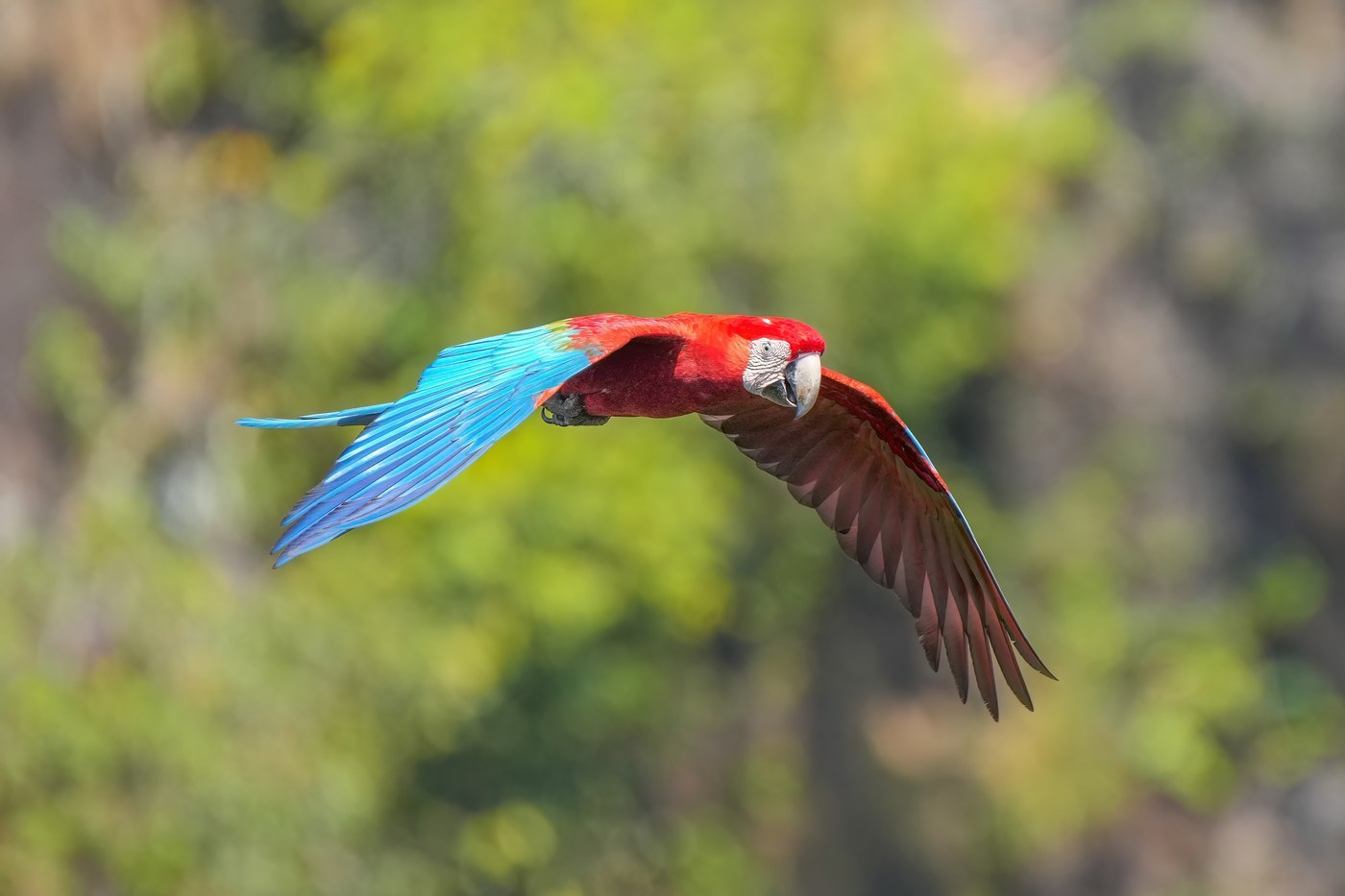
What Green-winged Macaw's Feathers Look Like
Also known as the Red-and-Green Macaw, this is one of the largest macaws, reaching 90-95 cm including its long, pointed tail - so its feathers are correspondingly large and robust. The body is overwhelmingly deep red, but the wing coverts show a green band crossing the wing - narrower than the yellow band found in the similar Scarlet Macaw - bordered by blue, then the surrounding red. Flight feathers (primaries) and the lower back/rump are blue. The tail is very long, predominantly red with a blue tip. One of the most useful diagnostic clues involves the face: unlike the essentially bare white face of the Scarlet Macaw, the Green-winged Macaw's white facial skin is crossed by fine rows of small red contour feathers, so if you find tiny red feathers that seem to have come from a bare-skin area, that fits this species specifically.
Step-by-Step: Is This Feather From a Green-winged Macaw?
- Check wing covert color. A green band on an otherwise red wing feather is the primary diagnostic separating this species from the yellow-banded Scarlet Macaw.
- Look at overall feather size. Given the bird's very large size, feathers - especially tail feathers - should be notably large and robust.
- Check tail feather color pattern. Long, red feathers with blue only at the tip match this species.
- Consider tiny facial feathers. Small red feathers, if you know they came from the face/cheek area, support Green-winged Macaw, since Scarlet Macaw's face is essentially featherless.
- Assess blue extent. Blue confined mainly to the rump, flight feathers, and tail tip (rather than forming a broad wing band) fits this species over relatives with more extensive blue.
Similar Species & How to Tell Them Apart
- Scarlet Macaw (Ara macao): Shows a yellow wing band instead of green, and its face is essentially bare white without rows of small feathers - both the wing band color and facial feathering are the most reliable ways to separate the two similarly sized, similarly red macaws.
- Other large red macaws: Generally show different band colors or proportions of red/blue/green; always check the wing band color first, since that's the fastest diagnostic.
Where & When You'll Find Them
Green-winged Macaws range across South America, favoring humid forest, forest edge, and palm groves from the Amazon basin into parts of Central America's southern reaches. They are also widely kept in aviculture, so feathers - especially the large, striking tail feathers - are sometimes found in a captive or pet-trade context rather than strictly in the wild; this is worth considering depending on where the feather was found. Wild birds are non-migratory residents, so feathers can appear year-round, with molt often loosely tied to the local breeding season.
Frequently asked questions
Why does the wing band color matter so much?
Green-winged Macaw shows a green band across the wing coverts, while the very similar Scarlet Macaw shows a yellow band in the same location - this single color difference is the fastest way to separate the two species.
What are the tiny red feathers on bare-looking facial skin?
Green-winged Macaws have fine rows of small red contour feathers crossing their white facial skin, unlike Scarlet Macaws, whose face is essentially featherless - finding these tiny feathers supports this species specifically.
Could this large feather be from a pet or aviary bird?
Quite possibly - Green-winged Macaws are widely kept in captivity, so a large red-and-blue tail feather found outside South America, or near a home/aviary, likely comes from a companion bird rather than a wild one.
How big should I expect these feathers to be?
Quite large - this is one of the biggest macaw species at 90-95 cm overall length, so tail feathers in particular should be long and substantial compared to smaller parrots.
Is there a season when wild birds lose more feathers?
Wild Green-winged Macaws are non-migratory and molt loosely tied to the local breeding season, so feathers can be found year-round with some increase around nesting periods.