
How to Identify Harpy Eagle Feathers
A field guide to the huge flight feathers, barred grey-black tail, and barred thigh feathers of the Harpy Eagle, the largest eagle in the Americas.
Read the full Harpy Eagle encyclopedia entry →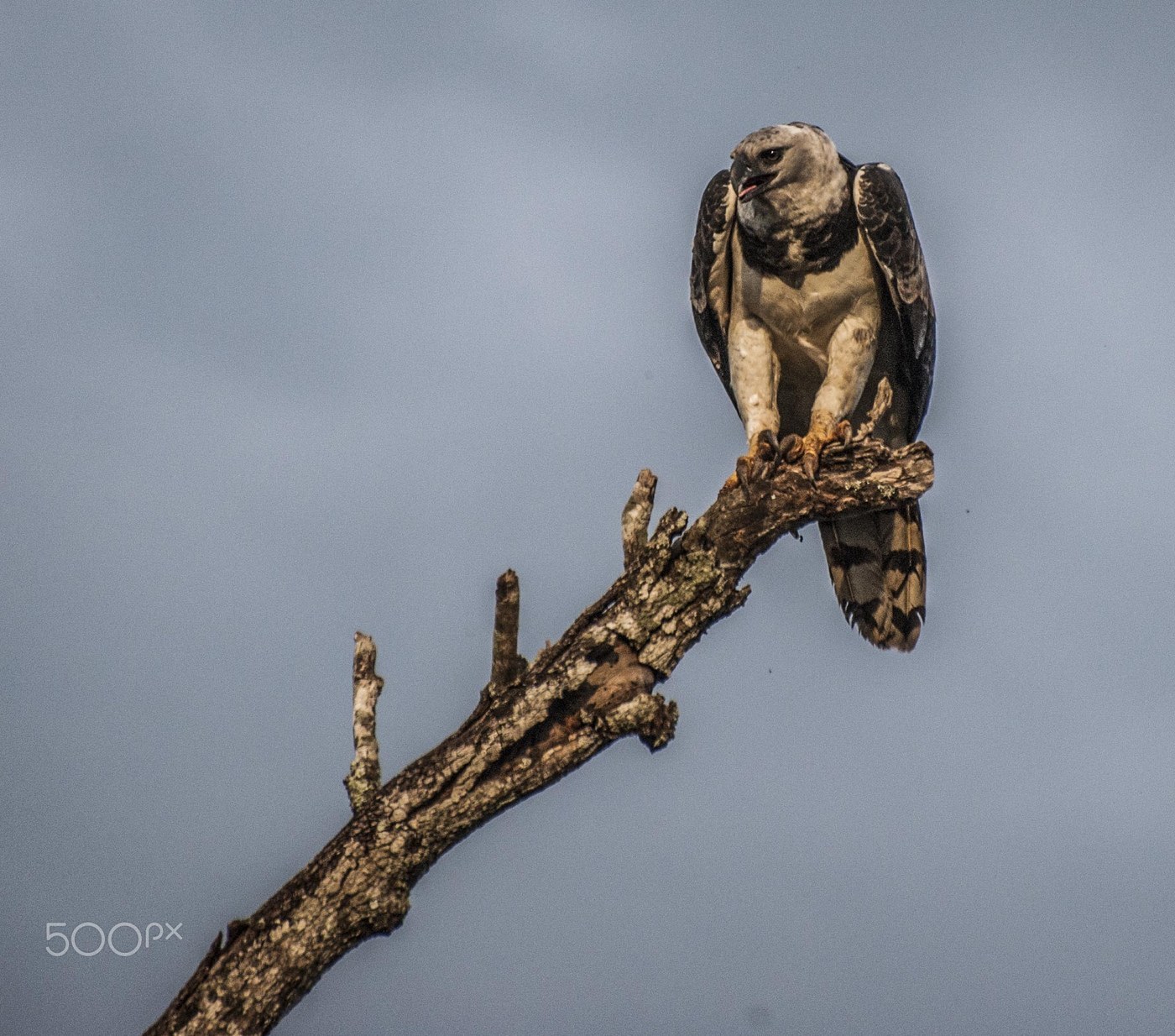
What Harpy Eagle Feathers Look Like
The Harpy Eagle is the most powerful raptor in the Americas, and its feathers are correspondingly massive — often the biggest clue you'll have.
- Flight feathers (primaries/secondaries): dark grey to blackish, and enormous — primaries can measure 30–40+ cm long, reflecting the eagle's huge wingspan and body size.
- Wing shape: broad and rounded, built for maneuvering below the rainforest canopy rather than soaring in open sky.
- Body feathers: dark slate-grey to blackish across the back and a dark chest band, contrasting with a white belly.
- Thigh ("legging") feathers: white with bold black barring — a distinctive and diagnostic pattern found on few other raptors this large.
- Tail feathers: long and broad, with 3–4 wide alternating grey and black bands — a thick, bold banding pattern rather than fine barring.
- Crest feathers: grey, double-pointed feathers on the head that the bird can raise into a shaggy double crest.
Step-by-Step: Is This Feather From a Harpy Eagle?
- Measure it first. Flight feathers over 25–30 cm long immediately point to one of the largest raptors in the Americas — Harpy Eagle is the prime candidate in Central/South American rainforest.
- Check the tail banding. Look for thick, well-defined grey-and-black bands (3–4 of them) rather than fine, numerous barring.
- Look for barred thigh feathers. White feathers with bold black bars, if found alongside large dark flight feathers, strongly support Harpy Eagle.
- Note the wing shape. Broad and rounded rather than long and pointed fits a forest-canopy hunter rather than an open-country soaring eagle.
- Consider the location. Only lowland tropical rainforest from southern Mexico through Central America to northern Argentina hosts this species — feathers found outside that range are not Harpy Eagle.
Similar Species & How to Tell Them Apart
- Crested Eagle: similar barred tail and forest habitat, but overall greyer with a different, less boldly barred tail pattern and a single narrow crest rather than the Harpy's shaggy double crest.
- Ornate Hawk-Eagle: much smaller, with a rufous breast band and finer barring — its feathers are noticeably shorter than the Harpy's.
- Black-and-chestnut Eagle: found in Andean forest rather than lowland rainforest, with an overall darker, less contrastingly barred tail.
Where & When You'll Find Them
Harpy Eagles inhabit lowland and foothill primary rainforest from southern Mexico through Central America and into South America as far as northern Argentina, nesting high in emergent canopy trees. Because they don't migrate and molt gradually and continuously rather than all at once, feathers can be found under regularly used nest or perch trees at any time of year, though the species' rarity and reliance on undisturbed forest makes any find noteworthy.
Frequently asked questions
How big are Harpy Eagle flight feathers compared to other raptors?
They're among the largest of any eagle in the Americas, with primaries often measuring 30–40 cm or more, reflecting the species' massive wingspan and body size.
What's the best single clue for identifying a Harpy Eagle tail feather?
Look for thick, well-defined alternating grey and black bands — typically 3 to 4 bold bands rather than many fine ones.
Do Harpy Eagles molt all their feathers at once?
No, they molt gradually and continuously throughout the year rather than in one concentrated period, so feathers can turn up under nest trees at any time.
Could a large dark feather from Central America be a vulture instead of a Harpy Eagle?
Possibly — vultures also have large dark flight feathers, but they lack the Harpy's bold black-barred white thigh feathers and thick-banded tail pattern.