
How to Identify Helmeted Hornbill Feathers
How to identify the extraordinarily elongated, black-banded white central tail feathers that make the Helmeted Hornbill unmistakable among rainforest birds.
Read the full Helmeted Hornbill encyclopedia entry →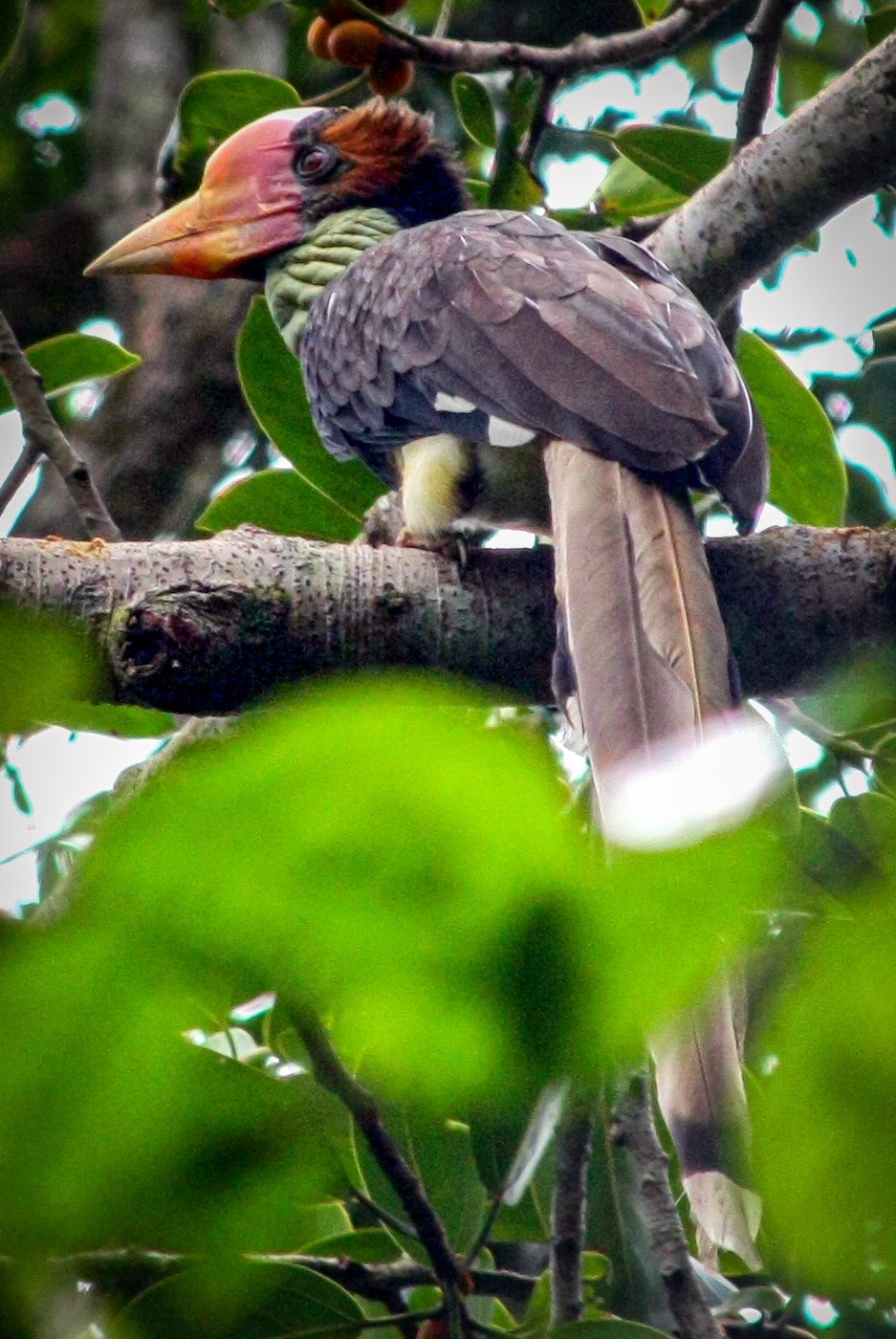
What Helmeted Hornbill Feathers Look Like
The Helmeted Hornbill is a Southeast Asian rainforest bird, and its tail feathers are among the most extreme in the bird world — the single clearest identifying feature you could find.
- Body/contour feathers: overall blackish, with a contrasting white belly and white leg feathers.
- Central tail feathers: dramatically elongated, often exceeding 50 cm in length on their own — far longer than the tail feathers of any other hornbill.
- Tail feather color pattern: pure white with a bold black subterminal band near the tip — a clean, simple, but very long pattern.
- Flight feathers: black, broad, and rounded, typical of hornbills built for powerful flapping flight through dense canopy.
Step-by-Step: Is This Feather From a Helmeted Hornbill?
- Check the length first. If a white tail feather with a black band exceeds roughly 40–50 cm, especially if it's one of a central pair, Helmeted Hornbill is the leading candidate among Southeast Asian birds.
- Look at the band pattern. A single bold black band near the tip of an otherwise white, elongated feather is the diagnostic combination.
- Compare overall proportions. The extreme elongation of the central tail feathers, well beyond the rest of the tail, is unique to this species among hornbills.
- Consider body feathers separately. Plain black body feathers with white belly patches found alongside the elongated tail feathers reinforce the identification.
- Treat any find as exceptional. Given the impact of poaching for its solid casque, encountering feathers in the wild is genuinely rare and noteworthy.
Similar Species & How to Tell Them Apart
- Great Hornbill: also shows a white tail with a black band, but its tail feathers are not elongated in the same extreme way and the species usually shows a yellowish wash on the neck/head.
- Rhinoceros Hornbill: has a white tail band too, but a differently shaped, more colorful casque and no dramatically elongated central tail feathers.
- Wreathed Hornbill: tail is mostly plain white without the bold black band, and lacks the elongated central feathers entirely.
Where & When You'll Find Them
Helmeted Hornbills inhabit lowland and hill primary rainforest in Sumatra, Borneo, the Malay Peninsula, and parts of southern Thailand and Myanmar, feeding mainly on figs in tall emergent canopy trees. The species has become increasingly rare due to poaching for its solid "red ivory" casque, so feather finds are unlikely in most areas; where they do occur, look beneath large fruiting fig trees in intact primary forest, which the species depends on for both feeding and roosting.
Frequently asked questions
What is the single clearest way to identify a Helmeted Hornbill feather?
Look for a dramatically elongated central tail feather — often over 50 cm — that is white with a single bold black band near the tip; no other hornbill has tail feathers this extreme.
Why are Helmeted Hornbill feathers so rare to find?
The species has become rare due to poaching for its solid casque, and it depends on intact primary rainforest, both of which make encounters and feather finds increasingly uncommon.
How does a Helmeted Hornbill's tail differ from a Great Hornbill's?
Great Hornbill also has a white, black-banded tail, but its feathers aren't elongated the way the Helmeted Hornbill's central tail feathers are.
Where should I look for Helmeted Hornbill feathers in the forest?
Beneath large fruiting fig trees in intact lowland or hill primary rainforest in Sumatra, Borneo, the Malay Peninsula, or southern Thailand/Myanmar, where the species feeds and roosts.