
How to Identify Hooded Crane Feathers
Learn to recognize the sharply two-toned white head and slate-gray body feathers, plus the drooping bustle plumes, of this East Asian crane.
Read the full Hooded Crane encyclopedia entry →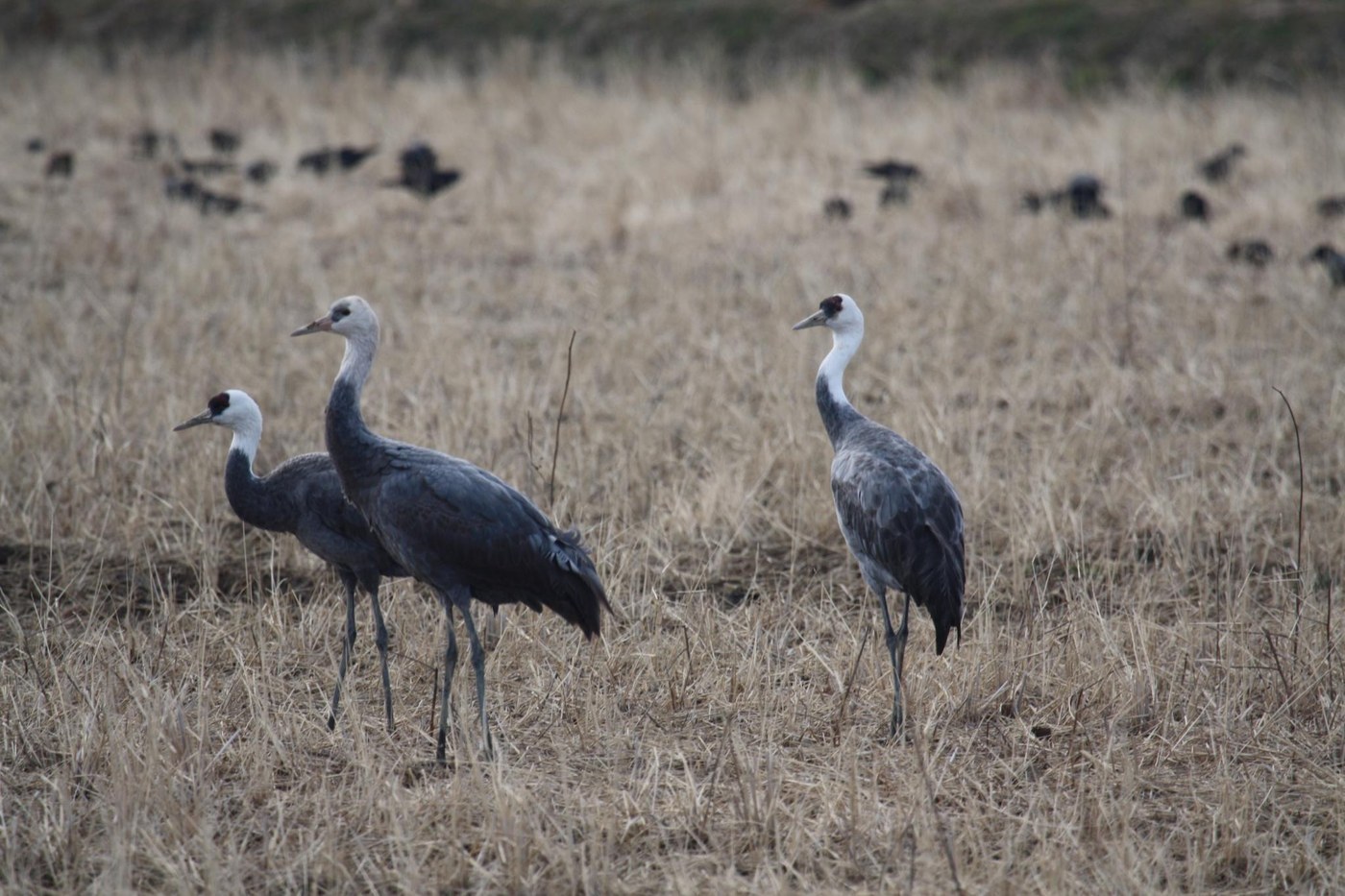
What Hooded Crane Feathers Look Like
The Hooded Crane is a mid-sized crane of East Asia named for its clean white head and upper neck, which contrast sharply against a uniformly dark slate-gray body. Head and upper-neck feathers are pure white, short, and smooth, sharply cut off from the gray at the base of the neck — there is no gradual blending, which is a useful clue if you find head feathers still attached to neck feathers. Body contour feathers (breast, back, flanks) are a soft, even dark blue-gray, unmarked and unstreaked.
The most distinctive plumes are the elongated inner secondary and tertial feathers, which grow long, loose, and drooping, curving downward over the tail and rump to form a soft "bustle" — a feature shared with other true cranes but especially prominent and dark gray in this species. Primaries are blackish, providing a dark wingtip contrast in flight. Tail feathers are short (largely hidden by the bustle plumes) and gray. Legs and feet are blackish, and the crown of the head bears a small patch of bare red skin rather than feathers — so a "feather" showing red is likely skin/caruncle debris, not a true feather, from this species.
Step-by-Step: Is This Feather From a Hooded Crane?
- Check size. Hooded Cranes are large but the smallest of the crane species found in East Asia; body feathers and plumes are large (10-25+ cm for tertials) but somewhat shorter than Red-crowned or Eurasian Crane plumes.
- Look at color transition. A feather that is crisp white on one end grading to nothing (i.e., separate white vs. gray feathers, not a blended single feather) matches the hard head/body boundary of this species.
- Check the gray tone. Hooded Crane body feathers are a fairly dark, cool slate-gray, darker than the paler gray of the Eurasian Crane.
- Look for long, droopy, loosely webbed tertial plumes — a hallmark of true cranes in general and a strong pointer toward crane rather than heron or stork if the origin is uncertain.
- Rule out red coloring on the feather itself — the red crown patch is bare skin, not plumage.
Similar Species & How to Tell Them Apart
The main look-alike is the Eurasian Crane (Common Crane), which also has a red crown patch but shows a blackish neck with a bold white stripe running down the side of the head/neck, rather than the Hooded Crane's fully white head and upper neck. Eurasian Crane body gray is also somewhat paler and more silvery. The Demoiselle Crane is smaller overall, lacks red skin entirely, and has black (not white) head plumes with white ear tufts. If the head feathers are wholly white with no black neck stripe, Hooded Crane is favored over Eurasian Crane.
Where & When You'll Find Them
Hooded Cranes breed in remote bogs and wetlands of southeastern Siberia and winter almost entirely at a handful of sites in Japan (notably Izumi), the Korean Peninsula, and parts of China, often in large concentrated flocks. Because most of the world population winters at just a few traditional sites, feathers are disproportionately likely to be found at these wintering wetlands from late autumn through early spring, with additional molt feathers dropped near remote Siberian breeding bogs in summer.
Frequently asked questions
What is the clearest single feather clue for Hooded Crane?
A sharp, unblended boundary between pure white head/neck feathers and dark slate-gray body feathers, without any black neck stripe.
How is this different from a Eurasian Crane feather?
Eurasian Crane has a blackish neck with a white side stripe, while Hooded Crane's entire head and upper neck are solid white.
Are the long drooping plumes actual tail feathers?
No, they are elongated tertial and inner secondary feathers that curve over the true tail, a classic crane feature called a bustle.
Is the red on the head part of the feather?
No, the red crown patch is bare skin (a caruncle), not feathered, so a true feather from this bird will never show red.
Where is the best place to look for shed feathers?
At major wintering wetlands in Japan and the Korean Peninsula in winter, since the global population concentrates at very few traditional sites.