
How to Identify Indian Roller Feathers
A guide to the vivid two-tone blue flight feathers of the Indian Roller and how to distinguish them from the European Roller and Dollarbird.
Read the full Indian Roller encyclopedia entry →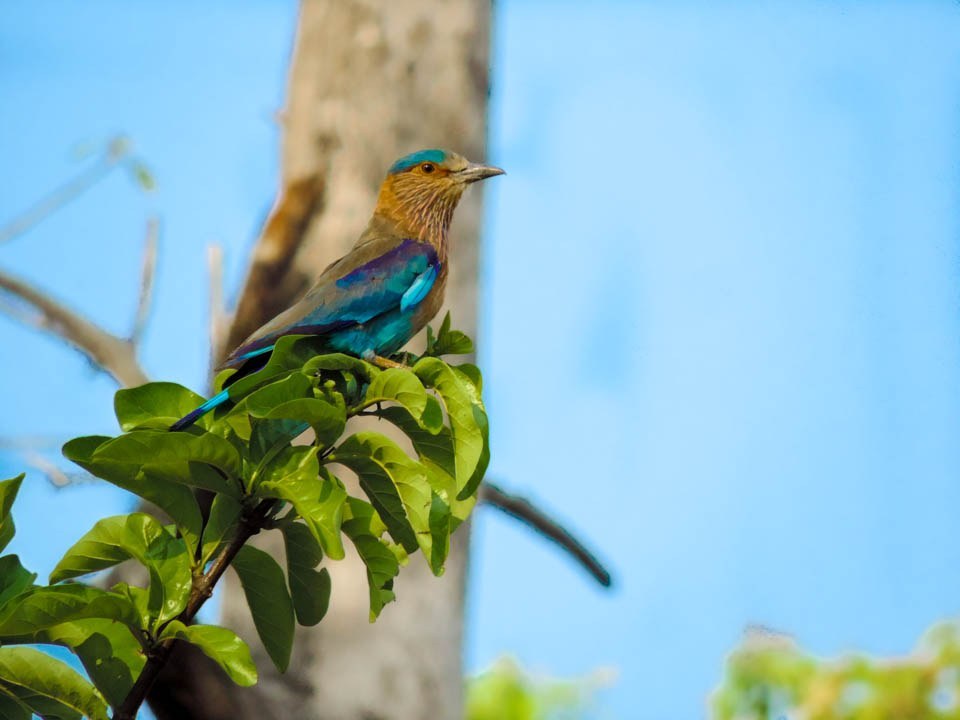
What Indian Roller's Feathers Look Like
The Indian Roller is famous for the brilliant flash of blue it reveals in flight, and that color is written into its feathers. The flight feathers (primaries) are a deep, purplish cobalt blue, while the wing covert feathers are a paler, more turquoise blue — the contrast between these two shades is what produces the roller's dazzling two-tone wing flash and is one of the best clues in a loose feather. Tail feathers are also blue, with the central pair duller and more subdued while the outer feathers stay bright blue. Body feathers away from the wing — the breast and throat — are a more muted light brown or lilac-brown, streaked with pale blue on the throat. All of this blue coloration is structural, so it can shift subtly in tone depending on the light. Feather size is moderate, fitting a stocky bird roughly the size of a pigeon.
Step-by-Step: Is This Feather From an Indian Roller?
- Separate primaries from coverts. If you have more than one feather, check whether one is darker purplish-blue (primary) and another paler turquoise (covert) — that two-tone pairing is highly characteristic.
- Check the breast/back feather color. A light brown or lilac-toned body feather alongside vivid blue wing feathers fits this species; an all-blue-green body does not.
- Look at tail feathers for a banded look. Central tail feathers duller than the bright blue outer feathers is a useful secondary clue.
- Judge the blue's saturation. Deep, almost indigo-purple tone on the flight feathers is more intense than the softer teal of some other roller species.
- Consider the region. Feathers found across the Indian subcontinent strongly favor this species over its Old World relatives.
Similar Species & How to Tell Them Apart
The European Roller, found from Europe into parts of the Middle East and rarely overlapping in range, has a more uniformly teal-blue body with a chestnut back, a color combination the Indian Roller never shows (its back and breast are brown/lilac, not blue, and it lacks the chestnut saddle). The Dollarbird, an Asian relative, is mostly dark brownish-black overall with only a small pale blue patch on the wing, rather than the Indian Roller's extensively blue wings and tail — a Dollarbird feather will look much darker and less colorful overall except for that limited wing patch. If a feather shows strong two-tone blue across most of the wing and tail with brown limited to the breast, Indian Roller is the best fit.
Where & When You'll Find Them
Indian Rollers are common in open country, farmland, and along roadsides across the Indian subcontinent, frequently perching on wires and poles to hunt from. They are non-migratory residents in most of their range, and molt typically follows the breeding season, which peaks around the monsoon; feathers are most often found in open agricultural and grassland habitat rather than dense forest, scattered near favored perching sites.
Frequently asked questions
What is the two-tone blue clue on Indian Roller feathers?
Primaries are a deep purplish-blue while wing covert feathers are a paler turquoise blue — that contrast is one of the best identification clues.
Why is the body feather I found brown instead of blue?
The Indian Roller's breast and back feathers are light brown to lilac, not blue; the intense blue is concentrated in the wings and tail.
How do I tell Indian Roller from European Roller by feather?
European Roller has a chestnut back and more uniform teal-blue body, while Indian Roller has a brown/lilac back and breast with more contrast between primary and covert blues.
Could this be a Dollarbird feather instead?
Dollarbird is mostly dark brownish-black with only a small pale blue wing patch, much less extensively blue than an Indian Roller feather.
Where should I look for Indian Roller feathers?
Open farmland, grassland, and roadside habitat across the Indian subcontinent, near perches like wires and poles.
Indian Roller identified by the community
Recent Indian Roller feathers identified with Feather Identifier.
