
How to Identify Jungle Myna Feathers
A practical guide to the grayish body feathers, white wing flash, and tufted crown feathers of the Jungle Myna, and how to distinguish it from Common Myna.
Read the full Jungle Myna encyclopedia entry →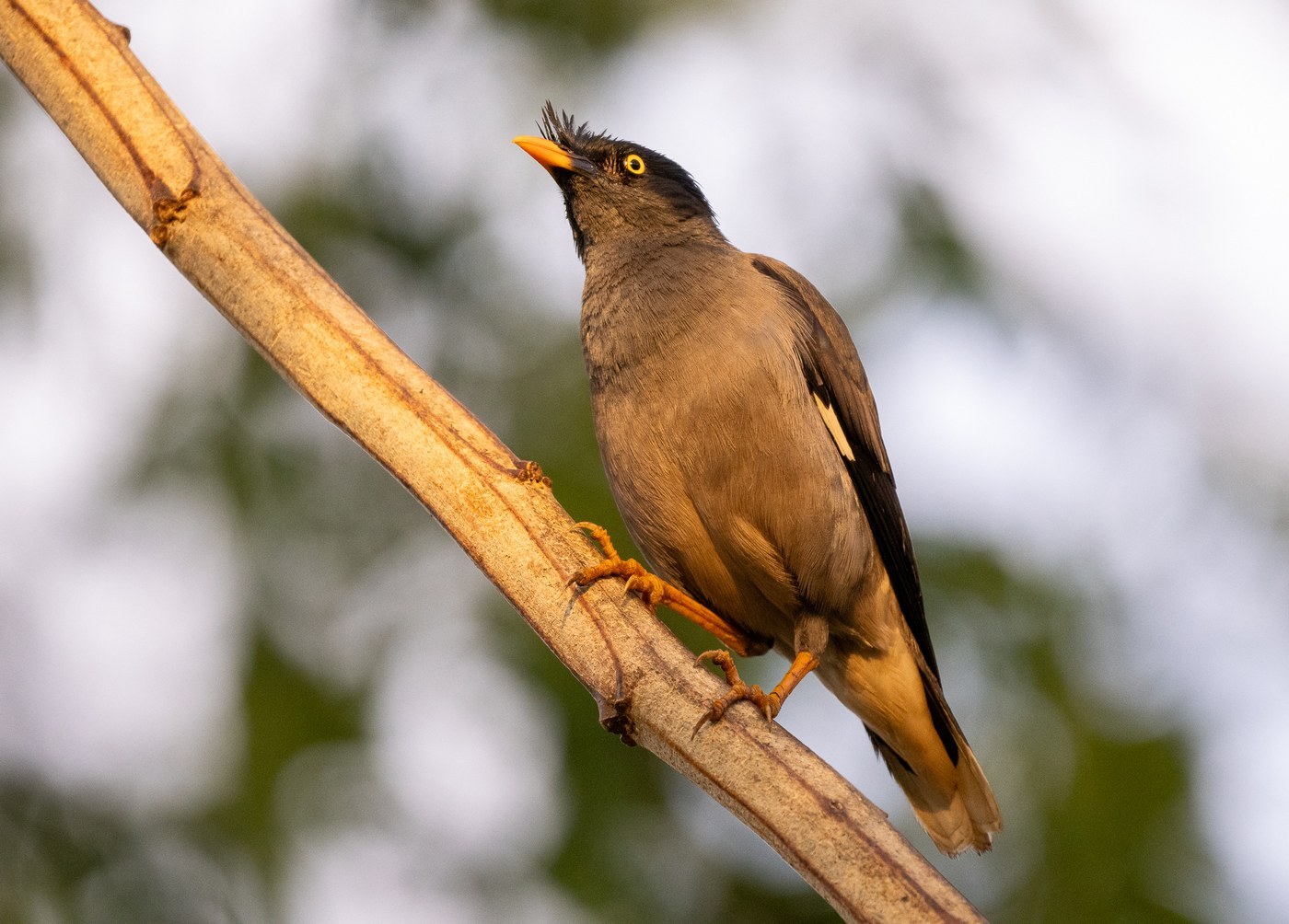
What Jungle Myna Feathers Look Like
Jungle Myna body feathers are a soft slate-gray to gray-brown, darkest on the head and lightest on the belly, without the warm brown tones seen in some related starlings. The most distinctive single feature is a small tuft of elongated feathers at the base of the forehead, just above the bill — short, stiff, and slightly upright, forming a modest crest that's unique among common mynas. Wing feathers are gray-brown overall but show a bold white patch at the base of the primaries, visible as a flash in flight and identifiable even on a single detached primary by the sharp white base transitioning to dark gray tip. The tail is squared off and dark gray-brown with a crisp white tip on each feather, another reliable diagnostic when you have a tail feather in hand. Underparts feathers are paler gray, and the vent area often shows a warmer buff tinge. Feather texture is typical sturdy starling-type: fairly stiff, glossy, with a strong shaft.
Step-by-Step: Is This Feather From a Jungle Myna?
- Look for a white tip. If it's a tail feather, a neat white tip on an otherwise gray-brown feather is a strong Jungle Myna indicator.
- Check wing feathers for a white base. A primary that's dark gray at the tip but sharply white near the base/shaft area fits this species' wing-flash pattern.
- Assess overall color tone. Slate-gray to gray-brown, not warm chocolate-brown or glossy black, matches Jungle Myna rather than several other Asian starlings.
- Look for a forehead tuft feather. Short, slightly stiff feathers that would have stood up as a small crest (found near where the bill met the forehead) are diagnostic if present.
- Rule out bright yellow. No feather on this species should show yellow — if you see yellow tones, you're likely looking at Common Myna instead.
Similar Species & How to Tell Them Apart
- Common Myna is warmer brown overall with a bare yellow eye-patch and yellow bill/legs reflected in a brighter yellow wash near the face in fresh feathers, and its wing patch is also white but its body tone is browner and warmer than Jungle Myna's cooler gray.
- Bank Myna shows a similar gray body but has orange-red bare skin around the eye rather than a forehead tuft, and lacks the crest-like feather tuft of the Jungle Myna.
- Common Starling (where ranges might overlap in captivity/escapees) shows glossy black feathers with pale spangles, a very different pattern from Jungle Myna's flat gray-brown.
- Pied Myna (Asian Pied Starling) shows bold black-and-white patterning rather than uniform gray, making confusion unlikely once the pattern is compared.
Where & When You'll Find Them
Jungle Mynas are common across South and Southeast Asia in open woodland, farmland, tea estates, and increasingly around towns and villages, often in noisy flocks with other mynas and starlings. As a non-migratory resident species, feathers can be found in any month, but look especially near roost trees at dusk, where large communal flocks gather and preen, and around farmland edges and fruiting trees where they forage. A modest uptick in loose body feathers follows the breeding season as adults molt into fresh plumage.
Frequently asked questions
What's the single best diagnostic feather feature for Jungle Myna?
A tail feather with a crisp white tip on an otherwise gray-brown feather, combined with a white-based primary, is the most reliable combination.
How do I tell Jungle Myna from Common Myna feathers?
Jungle Myna is cooler slate-gray overall while Common Myna runs warmer brown with yellow facial-skin tones bleeding into nearby feather bases; Common Myna also lacks the small forehead feather tuft.
Does the white wing patch appear on every feather?
No — it's concentrated at the base of the primaries, so only certain flight feathers will show the sharp white-to-gray transition; body feathers are plain gray-brown.
Is the forehead tuft always visible on a feather find?
Only if you happen to find one of those specific short forehead feathers; it's a small, easily overlooked feature but is diagnostic when present since few similar mynas have it.
Are Jungle Myna feathers likely outside Asia?
They're uncommon outside the native South/Southeast Asian range, so a matching feather elsewhere should be double-checked against local starling and myna species before concluding it's this species.