
How to Identify Kakapo Feathers
How to recognize the moss-green, owl-like mottled feathers of the flightless Kakapo and distinguish them from Kea and Kaka feathers.
Read the full Kakapo encyclopedia entry →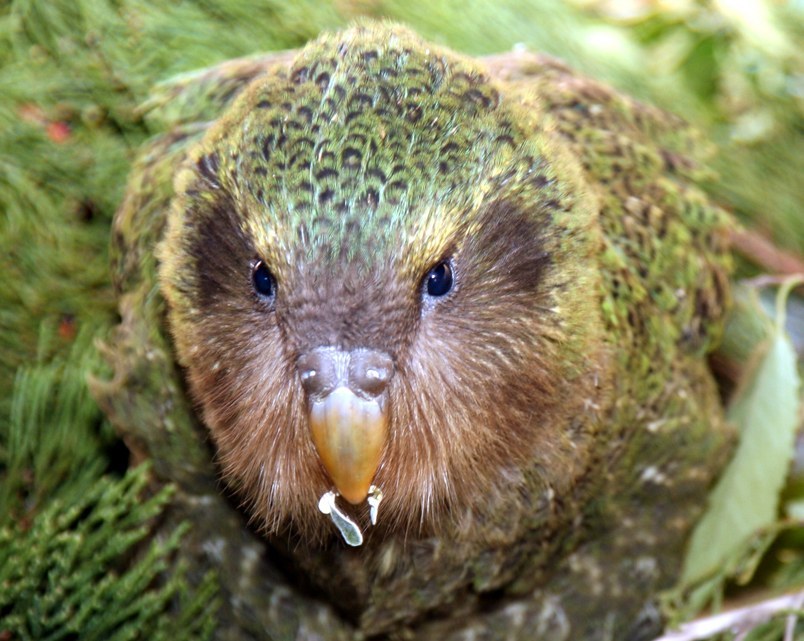
What Kakapo Feathers Look Like
Kakapo feathers are unmistakable once you know what to look for: a moss-green to yellowish-green base color, heavily mottled and barred with irregular blotches of black and yellow, creating a dappled camouflage pattern reminiscent of forest floor lichen and moss. This mottling covers the back, wings, and crown densely, while underparts feathers are paler yellow-green with lighter, less busy markings. Because Kakapo are flightless and nocturnal, their feathers have evolved a soft, owl-like texture — looser barbules and less rigid vane structure than typical flying parrots, giving the feather a fluffier, less "combed" appearance, especially noticeable on facial disc-area feathers, which form a subtle, rounded arrangement around the face similar in function (if not identical in look) to an owl's facial disc. Flight feathers are notably reduced in stiffness and symmetry since they're not used for powered flight, appearing softer and more rounded than the flight feathers of any flying parrot. Overall feather size is large, reflecting this species' status as the world's heaviest parrot.
Step-by-Step: Is This Feather From a Kakapo?
- Check the color and pattern first. Moss-green with black and yellow mottling in an irregular, camouflage-like arrangement is highly distinctive and unlike any other parrot.
- Feel the texture. A softer, less stiff feel than typical parrot flight feathers — more like an owl's soft-fringed feather — supports Kakapo given its flightless lifestyle.
- Assess size. Large body feathers and broad, rounded flight feathers fit this heavy-bodied, ground-dwelling parrot.
- Look for facial feathers. Feathers with a rounded, slightly forward-facing arrangement (from around the face) hint at Kakapo's subtle facial-disc-like feathering.
- Consider rarity and location. Kakapo has a tiny, intensively managed population confined to a handful of predator-free New Zealand islands — a genuine find would almost certainly come from one of these specific managed sites.
Similar Species & How to Tell Them Apart
- Kea and Kaka are both New Zealand parrots but have stiffer flight feathers (since they fly), and neither shows the same moss-green-with-black-and-yellow camouflage mottling; Kea is olive-green with crimson underwings, Kaka is brown-scalloped.
- Kakariki (New Zealand parakeets) are solid bright green without the dense mottled camouflage pattern, and their flight feathers are fully rigid for active flight.
- Owls in general can show a superficially similar soft-fringed texture, but owl feathers lack the specific green-yellow-black mottled parrot coloring and typically show a more uniform brown or gray base tone.
- Ground-dwelling parrots elsewhere (e.g., Ground Parrot, Australia) show a greener, more barred pattern too, but are geographically separate and generally smaller-feathered than the notably large Kakapo.
Where & When You'll Find Them
Kakapo now exist only on a small number of intensively managed, predator-free New Zealand islands (such as Codfish Island/Whenua Hou and a few others used in the recovery program), where every individual is closely monitored. They do not migrate, so feathers could in theory be found year-round on these islands, with more loose body feathers likely during the molt following the breeding season, which itself is tied to the irregular, multi-year masting cycle of rimu trees that triggers Kakapo breeding. Given the species' extremely restricted range and small population, any genuine Kakapo feather find would almost certainly occur within one of these managed sanctuary islands rather than anywhere else in the wild.
Frequently asked questions
What's the single most distinctive Kakapo feather feature?
The moss-green base heavily mottled with irregular black and yellow blotches, a camouflage pattern unlike any other parrot's plumage.
Why do Kakapo feathers feel softer than other parrot feathers?
Because Kakapo are flightless, their flight feathers never evolved the same rigid, tightly zipped structure needed for powered flight, leaving them looser and more owl-like in texture.
Could I realistically find a Kakapo feather in the wild?
Only on the small number of predator-free New Zealand islands where the remaining, intensively managed population lives — the species has a very restricted range.
Is Kakapo breeding and molt timing predictable?
Not entirely — breeding is tied to irregular, multi-year masting of rimu trees, so molt-related feather drop follows an irregular cycle rather than a fixed annual season.
How does size help rule out other parrots?
Kakapo is the world's heaviest parrot, so its body feathers and rounded flight feathers run larger than similarly colored but lighter-bodied parrots like Kakariki.