
How to Identify Kentucky Warbler Feathers
A guide to the olive-green back, bright yellow underparts, and black facial markings of the Kentucky Warbler, and how to separate its feathers from similar warblers.
Read the full Kentucky Warbler encyclopedia entry →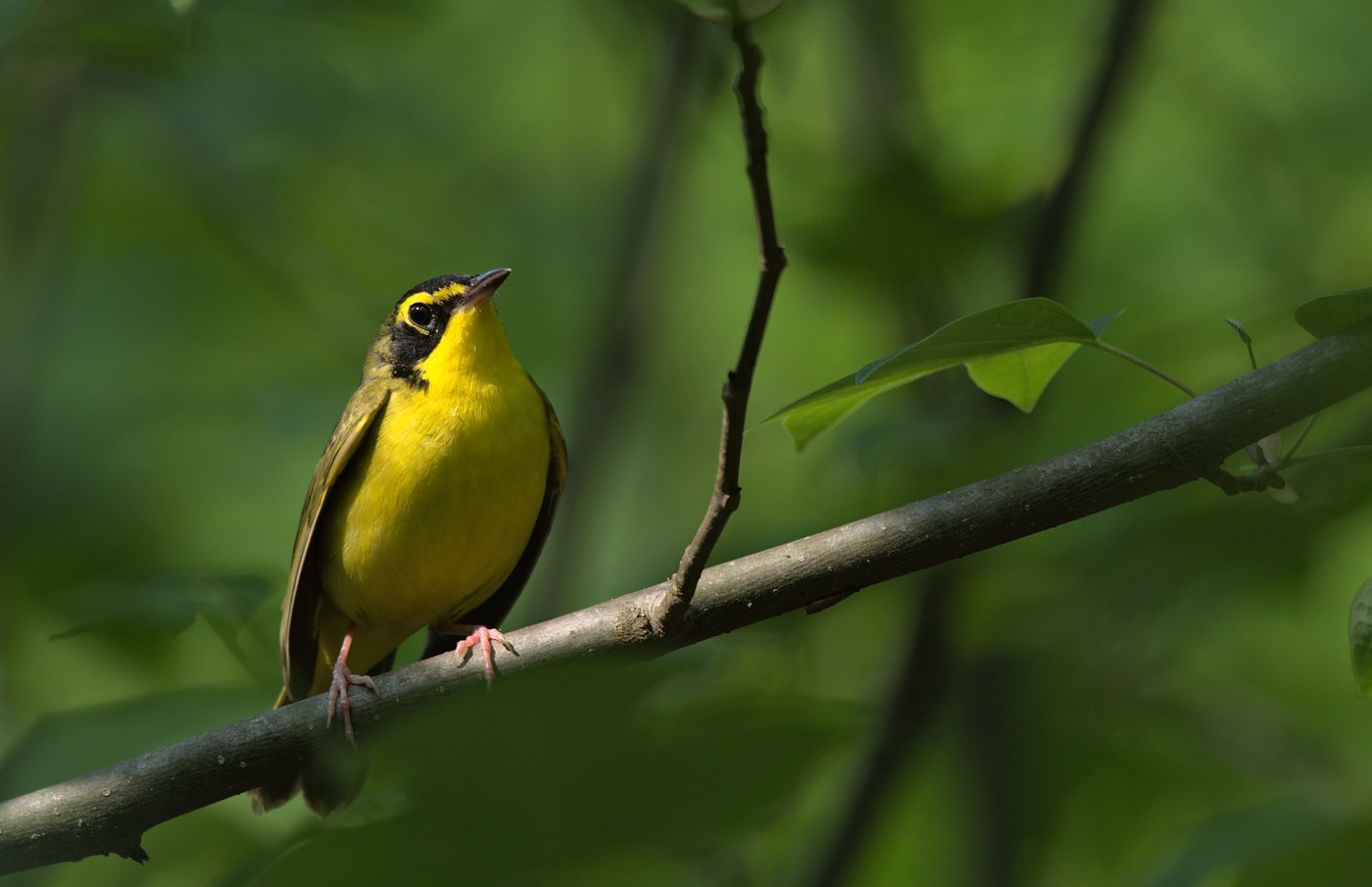
What Kentucky Warbler Feathers Look Like
Kentucky Warbler feathers combine a fairly plain back with a bold face pattern that makes head feathers especially diagnostic. Back, wing, and tail feathers are a clean, unmarked olive-green, with no wing bars and no white tail spots — a notably plain-winged, plain-tailed combination among warblers. Underparts feathers (throat, breast, belly) are a rich, saturated bright yellow, unstreaked and clean. The most identifiable feathers come from the face: bold black feathers form "sideburns" that extend down from the eye area along the side of the face and neck, contrasting sharply with a bright yellow "spectacles" pattern of feathering that rings the eye and extends toward the bill — so an isolated black facial feather paired with adjacent bright yellow feathering is a strong signature. Male facial black is typically more extensive and solid than in females, where the black areas can be duller, sootier, or more restricted. Overall feather texture is soft and fine, typical of a ground-foraging wood-warbler.
Step-by-Step: Is This Feather From a Kentucky Warbler?
- Rule in plain wings and tail first. No wing bars and no white in the tail supports Kentucky Warbler over many other yellow-and-olive warblers that show one or both.
- Check underparts for solid, unstreaked yellow. Clean bright yellow with no streaking on the breast/belly fits this species.
- Look for black facial feathers. Bold black feathering from the face extending down the neck side ("sideburns") is highly distinctive.
- Check for yellow "spectacle" feathers around the eye. Bright yellow feathering encircling the eye, contrasting with the black sideburn area, reinforces the ID.
- Consider size and softness. A small, soft-feathered bird consistent with a ground-foraging wood-warbler, not a larger songbird.
Similar Species & How to Tell Them Apart
- Common Yellowthroat males show a broader, more mask-like black band across the whole face bordered above by a pale/whitish line, rather than Kentucky Warbler's narrower black sideburn with yellow spectacles; female Yellowthroats lack black facial feathers altogether, unlike female Kentucky Warblers which retain some dusky facial markings.
- Hooded Warbler males show a solid black hood covering the entire crown and throat framing a yellow face, a much more extensive black area than Kentucky Warbler's sideburn-only pattern.
- Canada Warbler shows a necklace of black streaks across the breast against a gray back, a completely different pattern from Kentucky Warbler's plain yellow underparts and olive back.
- Yellow Warbler lacks black facial markings entirely and shows fine reddish breast streaking in males, easily separated once the face pattern is compared.
Where & When You'll Find Them
Kentucky Warblers breed in the understory of moist deciduous forest across the eastern and southeastern United States, favoring dense ground-level vegetation, ravines, and thickets where they forage and nest close to the forest floor. They are long-distance migrants, wintering from southern Mexico to northern South America, so feathers in the breeding range are most likely found from late spring through summer, with adults undergoing a complete molt on the breeding grounds in mid-to-late summer before fall migration. Check dense understory thickets, ravine bottoms, and moist forest floor leaf litter where this notoriously secretive, ground-loving warbler spends most of its time.
Frequently asked questions
What's the most distinctive Kentucky Warbler feather?
A black facial 'sideburn' feather paired with adjacent bright yellow spectacle feathering around the eye — a combination not matched by most similarly yellow warblers.
How do I tell Kentucky Warbler from Common Yellowthroat?
Yellowthroat shows a broader black mask across the whole face with a pale border above, while Kentucky Warbler shows a narrower black sideburn plus yellow spectacles, and female Yellowthroats lack black facial feathers entirely unlike female Kentucky Warblers.
Does this species have wing bars or tail spots?
No — both wings and tail are plain olive-green with no bars or white spots, a useful negative check against several other warblers.
When is this species present in its breeding range?
Roughly late spring through summer; it winters in Central America and northern South America, so feathers found in the eastern/southeastern US breeding range in winter would not be from this species.
What habitat should I search?
Dense understory of moist deciduous forest, especially ravines and thickets close to the ground, where this warbler forages and nests.