
How to Identify Lilac-crowned Amazon Feathers
A guide to identifying Lilac-crowned Amazon feathers by their scalloped green body plumage, maroon-lilac forehead, and reddish eye patch, distinct from other Amazon parrots.
Read the full Lilac-crowned Amazon encyclopedia entry →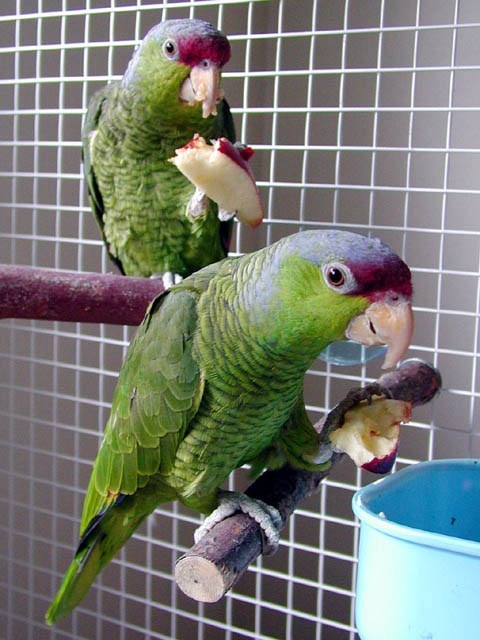
What Lilac-crowned Amazon Feathers Look Like
Lilac-crowned Amazons show the classic scalloped green plumage of Amazon parrots, but with a distinctive head pattern that sets them apart. Body, back, and wing covert feathers are bright grass-green, each feather edged with a thin darker green to blackish margin, producing a subtle scalloped or scaly texture across the whole body rather than a flat solid green. The forehead and crown feathers are a rich maroon to lilac-purple, fading into pale lilac-blue on the rest of the crown and nape — this maroon-to-lilac gradient on the head is the species' defining trait. A patch of red feathers is often present just above and behind the eye, though it can be limited in extent and is sometimes subtle. Flight feathers show patches of blue and red in the secondaries (the "speculum"), typical of many Amazon parrots, visible mainly in flight or on spread wings. Tail feathers are green with pale yellowish tips, and the outer tail feathers may show small red bases, though these are often hidden by covert feathers.
Step-by-Step: Is This Feather From a Lilac-crowned Amazon?
- Check body feather texture. Bright green with fine dark scalloped edging, rather than plain solid green, fits the Amazon parrot group generally.
- Look for a maroon-to-lilac gradient on crown/forehead feathers — deep maroon at the very front, transitioning to soft lilac-blue further back on the crown.
- Check for a small red patch above/behind the eye, a supporting (though not always present) clue.
- Examine tail feathers for pale yellowish tips on an otherwise green feather.
- Look for blue and red patches on secondary flight feathers, consistent with the Amazon parrot wing speculum pattern.
- Note find location — western Mexico (Pacific slope) supports this species over other Amazons.
Similar Species & How to Tell Them Apart
The Red-crowned Amazon (also called Green-cheeked Amazon) is the closest look-alike but shows a solid red crown patch rather than the maroon-to-lilac gradient, with no lilac tones on the head at all — a clear difference once crown feathers are compared. The Red-lored Amazon shows a red forehead band with a blue crown, a different color sequence than the maroon-fading-to-lilac pattern of Lilac-crowned Amazon. Yellow-headed Amazon and Yellow-crowned Amazon both show yellow rather than any maroon or lilac tones on the head, making those separations straightforward. Because head/crown feather color sequence varies distinctly across Amazon parrot species, this is usually the most reliable part of the bird to examine for a confident ID.
Where & When You'll Find Them
Lilac-crowned Amazons are native to tropical deciduous and semi-deciduous forest along the Pacific slope of western Mexico, from Sinaloa south to Oaxaca and Guerrero, and have also established feral populations in parts of southern California and Florida through the pet trade. As a non-migratory resident, feathers can be found throughout the year near roosting and feeding trees, with a likely increase during the post-breeding molt in the months following the regional breeding season (typically spring), and near nest cavities in large trees during the breeding period itself.
Frequently asked questions
What is the defining head feature of a Lilac-crowned Amazon feather?
A crown feather showing deep maroon at the front fading into soft lilac-blue further back — a gradient not shared by most other Amazon parrots.
How is this different from a Red-crowned Amazon feather?
Red-crowned Amazon shows a solid red crown patch with no lilac tones at all, unlike the maroon-to-lilac gradient of Lilac-crowned Amazon.
Does this species always show red near the eye?
Often, but the red patch above/behind the eye can be limited in extent or subtle, so it should be used as supporting evidence rather than a standalone test.
What does the scalloped texture on body feathers mean?
Each green body feather has a thin darker edge, creating a scaly or scalloped look typical of Amazon parrots generally, not unique to this species alone.
Where is this species native to, and where might feral feathers turn up?
Native to the Pacific slope of western Mexico; feral populations also exist in parts of southern California and Florida due to the pet trade.