
How to Identify Little Auk Feathers
A guide to identifying Little Auk (Dovekie) feathers by their small chunky black-and-white pattern, stubby shape, and dense, water-resistant structure suited to Arctic seas.
Read the full Little Auk encyclopedia entry →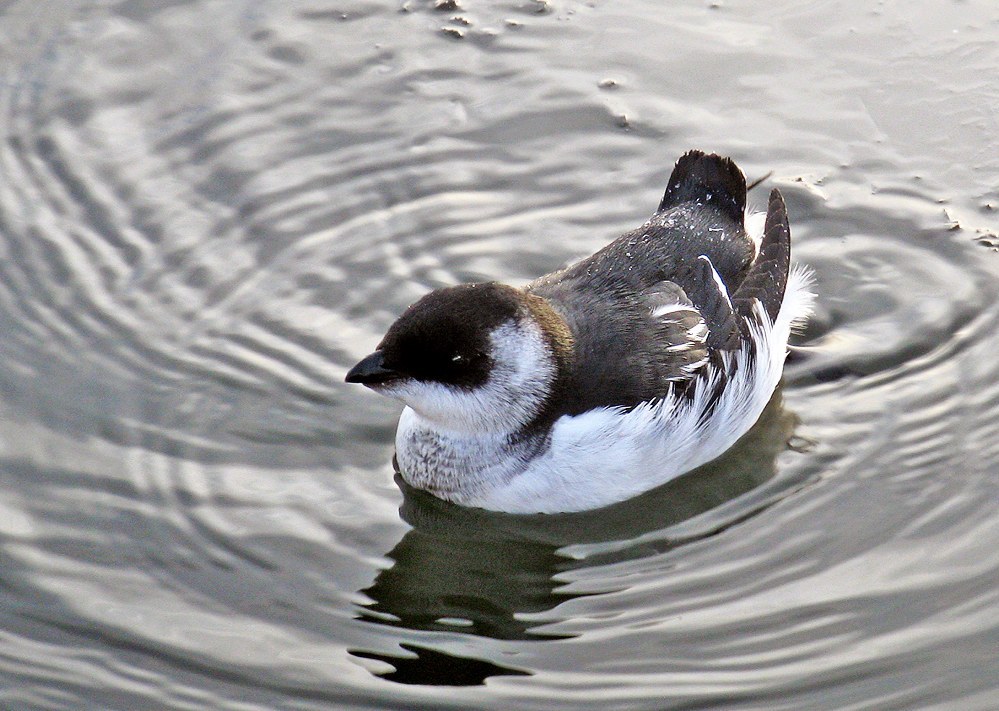
What Little Auk Feathers Look Like
The Little Auk, also called the Dovekie, is the smallest auk in the North Atlantic, and its feathers are built for cold-water diving rather than aerial flight. Upperpart feathers (crown, back, and wings) are solid glossy black, dense and tightly structured to resist water penetration, while underpart (breast and belly) feathers are crisp white. In breeding (summer) plumage, the black extends down over the throat and upper breast; in non-breeding (winter) plumage, the throat and foreneck feathers turn white, leaving black confined to the crown, nape, and back — so the exact boundary between black and white on throat/neck feathers can indicate the season. Wing feathers are notably short and stubby compared to the bird's body size, an adaptation for underwater "flying" (wing-propelled diving) rather than efficient aerial flight, and this short, stiff wing feather shape is a strong diagnostic when compared to similar-sized birds. A thin white streak or spotting may be visible on the scapular (shoulder) feathers, providing a subtle break in the otherwise solid black upperparts. The bill is short and stubby (not visible in a feather alone, but a bill fragment found nearby supports the ID).
Step-by-Step: Is This Feather From a Little Auk?
- Check overall size first. Little Auk feathers are small, consistent with a bird only about the size of a starling — much smaller than a Razorbill or guillemot.
- Assess wing feather shape. Short, stiff, and stubby rather than long and streamlined supports this species' wing-propelled diving adaptation.
- Look at the black/white boundary on the throat/neck, if present — a black throat suggests breeding plumage, a white throat suggests winter plumage.
- Check for a thin white streak on scapular (shoulder) feathers, a subtle but useful supporting clue.
- Confirm density and structure. Feathers should feel dense and tightly packed, typical of a cold-water diving seabird.
- Note location — a find on Arctic or high-latitude North Atlantic coastlines, or after storms further south, fits this species' range.
Similar Species & How to Tell Them Apart
Juvenile Razorbills and juvenile Common Murres (Guillemots) share the same basic black-and-white pattern but are considerably larger overall, with proportionally longer, more streamlined flight feathers built for longer-distance flight and deeper diving. Black Guillemot in winter plumage shows more white mottling across the wings and a different overall pattern rather than clean black upperparts and white underparts. Because Little Auk is so much smaller than every other North Atlantic alcid, size alone is often sufficient to confirm identification once other auks have been ruled out by comparison.
Where & When You'll Find Them
Little Auks breed in vast colonies on Arctic cliffs and scree slopes across Greenland, Svalbard, and other high Arctic islands, spending the rest of the year at sea across the North Atlantic, sometimes moving as far south as the British Isles or the northeastern United States during winter storms ("wrecks"). Feathers are most likely to be found near breeding colonies during the summer nesting season (June through August) or washed ashore on North Atlantic and Arctic coastlines during autumn and winter storm events, when birds are blown closer to land than usual.
Frequently asked questions
How can I tell a Little Auk feather from a Razorbill feather?
Size is the main clue — Little Auk feathers are noticeably smaller and the wing feathers are shorter and stubbier, reflecting its status as the smallest North Atlantic auk.
Does the black-and-white pattern change seasonally?
Yes, breeding birds show a black throat and upper breast, while winter birds show a white throat and foreneck with black confined to the crown, nape, and back.
Why are the wing feathers so short and stubby?
Little Auks use their wings to 'fly' underwater while diving for food, an adaptation that favors short, stiff feathers over long, streamlined ones.
Where are these feathers most likely found?
Near Arctic breeding colonies in summer, or washed up on North Atlantic coastlines during autumn and winter storms.
Is there a subtle marking on the upperparts besides solid black?
Yes, a thin white streak or spotting can appear on the scapular (shoulder) feathers, providing a small break in the otherwise solid black back.