
How to Identify Magnificent Frigatebird Feathers
A guide to recognizing the long, narrow black flight feathers and deeply forked tail feathers of the Magnificent Frigatebird, a large tropical seabird.
Read the full Magnificent Frigatebird encyclopedia entry →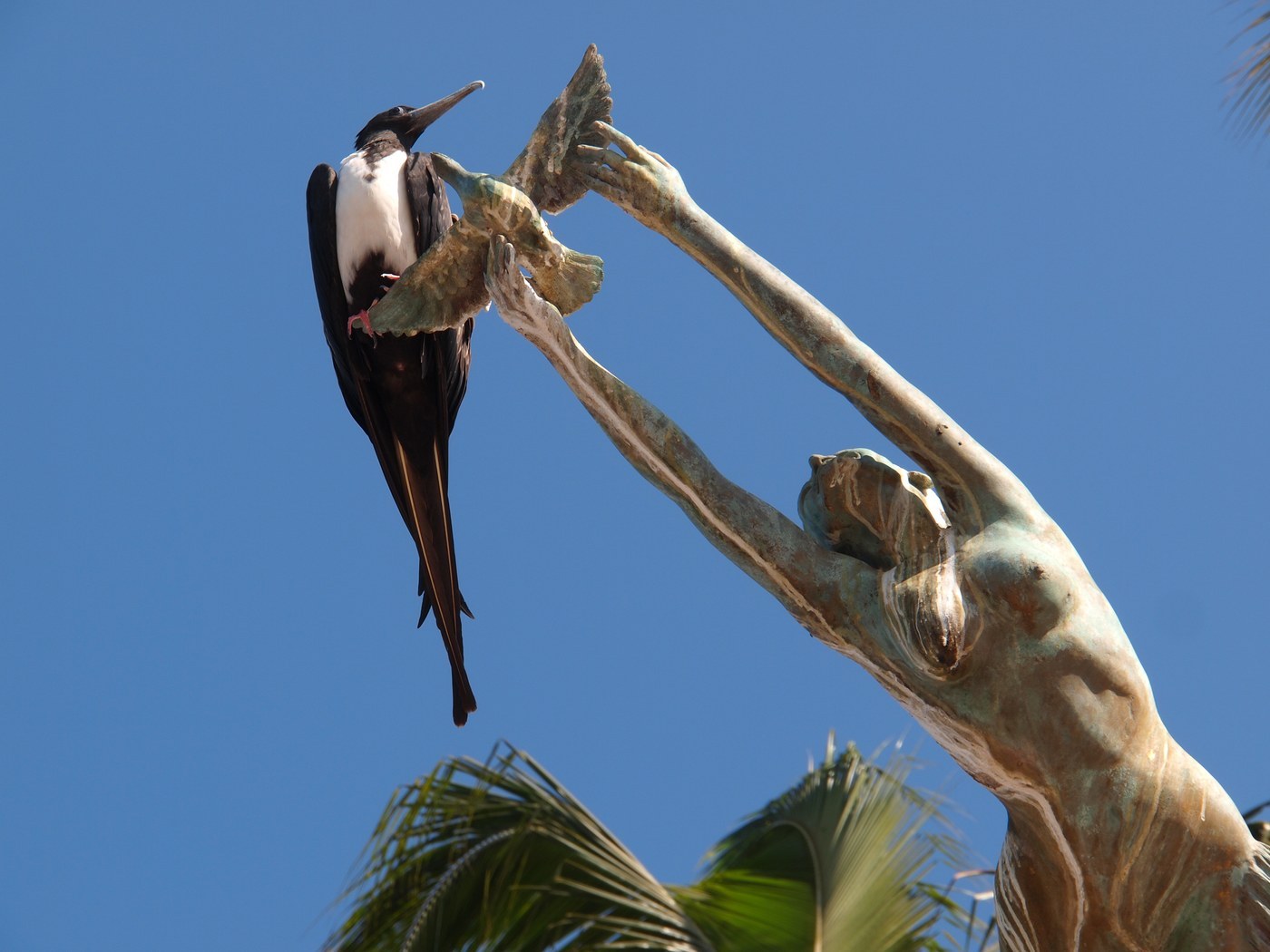
What Magnificent Frigatebird's Feathers Look Like
The Magnificent Frigatebird is a large tropical seabird built for soaring, and its feathers reflect that lifestyle: long, narrow, and lightweight. Flight feathers (primaries and secondaries) are all black, very long and slender, some of the longest relative to body size of any seabird, an adaptation for the species' extremely long, narrow wings and near-effortless soaring flight. Body feathers on males are glossy black with an iridescent green or purplish sheen on the back and scapulars, visible mainly in strong direct light. Females differ clearly: they show a white breast and lower foreneck patch, so any white feather from a frigatebird-sized seabird found alongside black feathers likely came from a female's underside. Tail feathers are exceptionally long, narrow, and pointed, forming the bird's signature deeply forked tail — a single tail feather can be recognized by its unusual length paired with a narrow, tapering shape. Down feathers are sparse and the plumage overall is notably light for the bird's large wingspan, an adaptation that keeps the frigatebird's body weight low for sustained soaring.
Step-by-Step: Is This Feather From a Magnificent Frigatebird?
- Check for extreme length paired with narrowness. Very long, slender flight or tail feathers relative to their width suggest a soaring seabird built for minimal weight.
- Look for iridescent black. A glossy black feather with a green or purple sheen in strong light matches a male's back or scapular feathers.
- Note any white feathers found with black ones. A clean white feather from the chest area alongside black feathers points to a female frigatebird.
- Assess overall lightness. Frigatebird feathers, and the skeleton behind them, are unusually light for the bird's size — a large but surprisingly light feather fits.
- Consider tail feather shape. A long, narrow, deeply tapering feather is consistent with the frigatebird's forked tail, one of the most distinctive tail shapes among all seabirds.
Similar Species & How to Tell Them Apart
The main confusion risk is with other frigatebird species (Great Frigatebird, Lesser Frigatebird), which look extremely similar and are best separated by range rather than feather details alone — Magnificent Frigatebird is the only frigatebird regularly found in the Atlantic and eastern Pacific coasts of the Americas, while Great and Lesser Frigatebirds are mainly Indo-Pacific. Cormorants and anhingas share glossy black plumage but have shorter, broader, less tapering feathers suited to swimming rather than soaring, and lack the frigatebird's extreme wing and tail feather length. Black skimmers and terns are far smaller, with correspondingly smaller feathers, easily ruled out by size alone.
Where & When You'll Find Them
Magnificent Frigatebirds are found along tropical and subtropical coastlines of the Americas, from the southeastern United States through the Caribbean and Gulf of Mexico down to South America's Pacific and Atlantic coasts, almost always over or near open water and rarely landing on the ground or water itself. Feathers are most often found on beaches, offshore islands, and around nesting colonies on mangrove cays, since these birds rarely swim and instead rest and roost on trees, cliffs, or floating structures. Molt in frigatebirds is unusually slow and prolonged, often taking more than a year to complete due to the enormous size of their flight feathers, so feathers can be found scattered across most of the year near breeding and roosting colonies.
Frequently asked questions
How can I tell a male frigatebird feather from a female's?
Males show glossy black feathers with a green or purple iridescent sheen throughout, while females have a patch of clean white feathers on the breast alongside black body feathers.
Why are the feathers so long and narrow compared to other seabirds?
Frigatebirds have the largest wingspan-to-body-weight ratio of any bird, built for near-constant soaring, which favors long, narrow, lightweight flight and tail feathers.
Can I distinguish this from a Great or Lesser Frigatebird by feather alone?
Not reliably by feather details — range is the best clue, since Magnificent Frigatebird is the frigatebird found in the Americas while its relatives are mainly Indo-Pacific species.
Why don't frigatebird feathers show waterproofing like a cormorant's?
Frigatebirds rarely land on water and instead snatch food from the surface or steal it from other birds in flight, so their feathers are not built for the diving, swimming lifestyle that shapes cormorant plumage.
Is there a specific molt season to watch for?
Not really — frigatebird molt is unusually slow and can stretch over more than a year, so feathers can be found scattered throughout the year near colonies and roosts.